







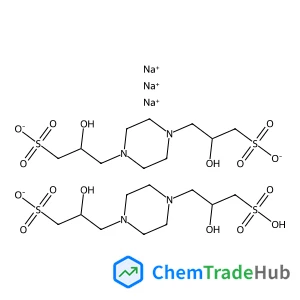
3,3'-(Piperazine-1,4-diyl)bis(2-hydroxypropane-1-sulfonic acid) Sodium Salt
CAS号:
108321-08-0
分子式:
C20H41N4Na3O16S4
Guannan Wang, Raju Raju, Kiho Cho, Sandy Wong, B. Gangadhara Prusty, Martina H. Stenzel
In order to generate 3D printed nanocomposites, good compatibility between the polymer resin and the nanoparticle is necessary. This is often achieved by modifying the surface of the nanoparticle such as the here employed graphene oxide (GO). In this work, we have explored the use of the multicomponent Passerini reaction to graft poly(N-isopropyl acrylamide) (PNIPAM) to and from the surface of GO in order to increase the dispersibility of GO in the triethylene glycol dimethacrylate (TEGDMA) and bisphenol A-glycidyl methacrylate (Bis-GMA) resin. For the grafting to process, aldehyde-terminated PNIPAM was prepared by RAFT polymerization. The polymers of various lengths – PNIPAM80, PNIPAM120, and PNIPAM228 – were grafted onto commercial GO, which was used as received, simply by stirring the aqueous solution at ambient temperature in the presence of cyclohexyl isocyanide. The grafting density was found to decrease with increasing molecular weight from 0.61 to 0.12 polymers per nm2. The grafting from procedure entailed the immobilization of RAFT agents by Passerini reaction on the surface of GO, followed by RAFT polymerization of NIPAM. Analysis of the resulting polymer grafted GO by thermogravimetric analysis (TGA) suggests that the growth of the polymer on the surface slowed down. The various PNIPAM grafted GO was mixed with the resin and 3D printed using a three-component visible light initiator. The 3D printed strips were analyzed by three-point bending test revealing an improvement in flexural modulus of 60–70% at 0.10 wt% modified GO. In contrast, the flexural modulus of the resin containing unmodified GO decreased noticeable.
Nhu Pailes Nguyen, Tyler P. Farr, H. Evan Bush, Andrea Ambrosini, Peter G. Loutzenhiser
DOI: 10.1039/D1CP03303D
Alexander J. Armstrong, Jackson E. Moore, Stephen A. Holt, Rico F. Tabor, Alexander F. Routh
DOI: 10.1039/D1CP04317J
Nicusor Tîmneanu, Oscar Grånäs
DOI: 10.1039/D1CP03419G
Giacomo Fanciullo, Irene Conti, Pascal Didier, Andrey Klymchenko, Jérémie Léonard, Marco Garavelli
DOI: 10.1039/D1CP04260B
Xinwen Ou, Ming Yi, Jingyuan Li
DOI: 10.1039/D1CP04000F
Kento Minamikawa, Shun Sarugaku, Masashi Arakawa, Akira Terasaki
DOI: 10.1039/D2CP90012B
Hengyu Yang
DOI: 10.1039/D1CP01383A
Pablo G. Jambrina, Naduvalath Balakrishnan, F. Javier Aoiz
DOI: 10.1039/D1CP02755G
DOI: 10.1039/D1CP03259C
Peter R. Birkin, Jack J. Youngs, Tadd T. Truscott, Silvana Martini
DOI: 10.1039/D1CP03655F
该化合物适用的法规指南包括GHS(全球化学品统一分类和标签制度)分类为特定目标器官毒性-单次接触类别3;根据欧盟REACH法规,该化合物需要进行注册和评估;在美...
在合成中,可以考虑使用一些类似的化合物作为4-(4-氯苯基)-1H-咪唑的替代品,如4-(4-溴苯基)-1H-咪唑或4-(4-甲氧基苯基)-1H-咪唑。这些化合...
N~2~-甲基丙氨酸酰胺是一种有机化合物,其化学名为2-(Methylamino)propanamide。它是一种酰胺类化合物,分子式为C4H10N2O,相对分...
处理含有N-苄基-3-氨基氧杂环丁烷草酸盐(CAS号:1956341-96-0)的废料时,应首先确保遵循相关法规要求,如GHS和REACH等。通常,废液应先进行...
4-溴-2-氯-6-甲基苯甲酸是一种固体化合物,具有较高的熔点和较低的沸点。它的分子量为261.03 g/mol。该化合物在水中几乎不溶,在有机溶剂中溶解度适中...
该化合物通常通过缩合反应合成,典型的方法是将2,5-二氯嘧啶与N-甲基苯甲酰胺在碱性条件下进行偶联反应。常用的碱包括NaH、LDA等强碱。该合成路线具有较高的选...
3,5-二溴-4-甲基苯胺在某些合成路线中可能没有直接替代品。然而,在某些应用场景下,可以考虑使用其他类似结构的化合物如3,5-二溴-4-硝基苯胺或3,5-二碘...
2-氯喹啉-4-羧酸甲酯主要用于有机合成和药物合成领域,作为中间体或原料。它在合成某些药物和染料时具有重要作用。此外,该化合物还可能用于某些特定的化学研究中。
6-溴-8-氯咪唑[1,2-a]吡啶在操作过程中需要谨慎以确保安全。该化合物具有一定的毒性,吸入其蒸气或粉尘可能导致呼吸道刺激。处理时应佩戴适当的防护装备,如手...

Polymer Chemistry welcomes submissions in all areas of polymer science that have a strong focus on macromolecular chemistry. Manuscripts may cover a broad range of fields, yet no direct application focus is required.
![1,1'-[(E)-1,2-Ethenediyl]bis(4-bromobenzene) structure](https://cnstatic.chemtradehub.com/structs/188/18869-30-2-c907.webp "1,1'-[(E)-1,2-Ethenediyl]bis(4-bromobenzene) structure")