



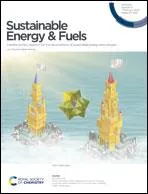
Well-ordered Cs–Ru/@SBA-15 nanocomposite materials for low pressure ammonia synthesis
文献信息
发布日期
2020-10-01
DOI
10.1039/D0SE01077D
影响因子
6.367
作者
Shih-Yuan Chen, Masayasu Nishi, Albert Chang, Wei-Chih Hsiao, Takehisa Mochizuki
查看原文
摘要
A facile route for preparing large-pore SBA-15-supported and Cs-promoted Ru nanocomposite materials (denoted as Cs–Ru/@SBA-15) was developed for catalysing the synthesis of ammonia under low pressure conditions. Aqueous solutions of ruthenium(III) nitrosyl nitrate and caesium carbonate were impregnated on the as-prepared SBA-15 mesoporous silica in a step-wise manner. The P123 template not only chelated with the Ru and Cs species but also stabilised the mesoporous silica framework, prior to carbonisation at 400 °C in N2. As a result, the Cs–Ru/@SBA-15 catalysts prepared with Ru loadings of 2–6 wt% and a fixed Cs/Ru molar ratio of 2.5 possessed high surface area, porosities, and ordered pore structures. The XRD patterns, CO chemisorption data, and STEM images revealed that the nanostructured Ru particles (<5 nm) and amorphous Cs species were stably embedded within the channelling pores of the prepared Cs–Ru/@SBA-15 catalysts when the Ru loadings were below 8 wt%. The studies of temperature-programmed reduction and surface reaction demonstrated that there was a strong interaction between the Ru and Cs species, which contributed to high ammonia synthesis activity (>1.5 mmol NH3 gcat−1 h−1) of the Cs–Ru/@SBA-15 catalysts at atmospheric pressure. Conversely, the catalysts impregnated with only Ru or Cs species had no effect on the ammonia synthesis. The solid 13Cs–4Ru/@SBA-15 catalyst with a Ru loading of 3.2 wt% and Cs/Ru molar ratio of 3.1 exhibited the highest activity (5.3 mmol NH3 gcat−1 h−1) at 460 °C and a H2/N2 molar ratio of 1 at atmospheric pressure. The high activity was maintained by varying the space velocity, H2/N2 molar ratio, and reaction temperature under low-pressure conditions, which facilitated green ammonia synthesis using low-carbon hydrogen derived from renewable energy-based water hydrolysis.
相关文献
Addressable droplet microarrays for single cell protein analysis
Ali Salehi-Reyhani, Edward Burgin
2014-08-06
Paper
DOI: 10.1039/C4AN01208A
Light-up fluorescent probes utilizing binding behavior of perylenediimide derivatives to a hydrophobic pocket within DNA
Tadao Takada, Kosato Yamaguchi, Suguru Tsukamoto, Mitsunobu Nakamura, Kazushige Yamana
2014-06-16
Paper
DOI: 10.1039/C4AN00493K
Selective ion-sensing with membrane-functionalized electrolyte-gated carbon nanotube field-effect transistors
K. Melzer, A. M. Münzer, E. Jaworska, K. Maksymiuk, A. Michalska, G. Scarpa
2014-06-30
Paper
DOI: 10.1039/C4AN00714J
Determination of psychostimulants and their metabolites by electrochemistry linked on-line to flowing atmospheric pressure afterglow mass spectrometry
Marek Smoluch, Przemyslaw Mielczarek, Edward Reszke, Gary M. Hieftje
2014-07-10
Paper
DOI: 10.1039/C3AN02067C
Quantitative determination of protein molecular weight with an acoustic sensor; significance of specific versus non-specific binding
Achilleas Tsortos
2014-05-16
Paper
DOI: 10.1039/C4AN00616J
Detection of multiple steroidal compounds in synthetic urine using comprehensive gas chromatography-mass spectrometry (GC×GC-MS) combined with a molecularly imprinted polymer clean-up protocol
Adnan Zulfiqar, Geraint Morgan, Nicholas W. Turner
2014-07-17
Paper
DOI: 10.1039/C4AN00721B
A novel aptasensor based on MUC-1 conjugated CNSs for ultrasensitive detection of tumor cells
Hongmei Cao, Daixin Ye, Qianqian Zhao, Juan Luo, Song Zhang, Jilie Kong
2014-07-08
Paper
DOI: 10.1039/C4AN00844H
High efficiency tandem mass spectrometry analysis using dual linear ion traps
Linfan Li, Xiaoyu Zhou, James W. Hager
2014-07-18
Communication
DOI: 10.1039/C4AN01070A
Modification of microfluidic paper-based devices with silica nanoparticles
Elizabeth Evans, Tomás E. Benavidez, Wendell Karlos Tomazelli Coltro, Carlos D. Garcia
2014-08-20
Paper
DOI: 10.1039/C4AN01147C
An Ru(ii)–Fe(iii) bimetallic complex as a multifunctional device for detecting, signal amplifying, and degrading oxalate
Cheng-Bin Gong
2014-07-03
Paper
DOI: 10.1039/C4AN00350K
您可能还喜欢
化合物问答
什么是5-Fluoro-4-iodo-2-methylaniline(CAS号:307306-08-7)?
5-氟-4-碘-2-甲氨基苯属于芳香族化合物,其分子式为C8H7FN2I。该化合物具有一定的反应活性,在有机合成和药物化学领域有一定的应用。
307306-08-75-Fluoro-4-iodo-2-me...
化合物问答
4-氟-3-硝基三氟甲苯(CAS号:367-86-2)通常如何合成?
4-氟-3-硝基三氟甲苯通常通过将三氟甲基苯在酸性条件下催化氧化为三氟甲基硝基苯,然后进行氟化反应得到目标化合物。该过程需要使用催化剂,如三氟乙酸,反应产率较高...
367-86-21-Fluoro-2-nitro-4-(...
化合物问答
6-氯-9-(2,3,5-三苯甲酰氧基-2-C-甲基-beta-D-呋喃核糖基)-9H-嘌呤(CAS号:205171-05-7)的物理化学性质是什么?
该化合物为白色至类白色晶体,分子量约为1046.95。它在水中几乎不溶,在有机溶剂如乙腈和甲醇中具有一定的溶解性。该化合物具有良好的化学稳定性和生物活性。
205171-05-76-Chloro-9-(2-C-meth...
化合物问答
如何储存6-氟喹啉-4-羧酸(CAS号:220844-73-5)?
6-氟喹啉-4-羧酸应储存在阴凉、干燥、通风良好的地方,避免阳光直射。储存在密闭容器中,避免与空气中的水分接触。储存温度应控制在室温以下,避免高温。
220844-73-56-Fluoroquinoline-4-...
化合物问答
(2S,2'S,3S,3'S)-3,3'-di-tert-butyl-4,4'-bis(2,6-dimethoxyphenyl)-2,2',3,3'-tetrahydro-2,2'-bibenzo[d][1,3]oxaphosphole(CAS号:1435940-21-8)通常如何合成?
该化合物通常通过芳香族化合物的亲核取代反应合成,首先将2,6-二甲氧基苯基引入到双环结构中,然后通过特定条件下的还原或氧化反应引入二叔丁基。反应过程中使用了钯作...
1435940-21-8(2S,2'S,3S,3'S)-4,4'...
化合物问答
如何储存KY02111(CAS号:1118807-13-8)?
KY02111应储存于阴凉、干燥、通风良好的地方,避免阳光直射和高温环境。应使用合适的密闭容器储存,并确保容器密封良好,防止水分和潮气进入。在储存期间,应注意检...
1118807-13-8N-(6-chlorobenzo[d]t...
化合物问答
如何储存4-(4-氯苯氧基)丁酸乙酯(CAS号:59227-79-1)?
4-(4-氯苯氧基)丁酸乙酯应储存在阴凉、干燥、通风良好的地方,远离火源和热源。避免阳光直射,防止容器破裂导致泄漏。储存时应保持容器密封,避免与空气中的水蒸气接...
59227-79-1Ethyl 4-(4-chlorophe...
化合物问答
4-庚基苯乙酮(CAS号:37593-03-6)安全吗?
4-庚基苯乙酮相对安全,但在使用和储存时仍需注意。应避免吸入其蒸气,避免皮肤接触,使用时需佩戴防护眼镜和手套。储存时应远离火源和热源,保持容器密封,放置于阴凉、...
37593-03-61-(4-Heptylphenyl)et...
化合物问答
什么是乙基2-氨基-4-(3-溴苯基)噻吩-3-羧酸乙酯(CAS号:438218-48-5)?
乙基2-氨基-4-(3-溴苯基)噻吩-3-羧酸乙酯是一种有机化合物,分子式为C16H12BrN2O2S。它是一种含有噻吩环、氨基、溴苯基和羧酸酯结构的化合物。这...
438218-48-5ethyl 2-amino-4-(3-b...
化合物问答
什么是(9ci)-2-氨基-6-甲基-苯甲酰胺(CAS号:1885-31-0)?
(9ci)-2-氨基-6-甲基-苯甲酰胺是一种化学化合物,其英文名称为2-Amino-6-methylbenzamide,CAS号为1885-31-0。该化合物...
1885-31-02-Amino-6-methylbenz...
来源期刊
推荐化合物
![2-{[4-(2-Methoxyethyl)phenoxy]methyl}oxirane structure](https://cnstatic.chemtradehub.com/structs/567/56718-70-8-f037.webp "2-{[4-(2-Methoxyethyl)phenoxy]methyl}oxirane structure")


推荐供应商




免责声明
本页面提供的学术期刊信息仅供参考和研究使用。我们与任何期刊出版商均无关联,也不处理投稿事宜。如有投稿相关咨询,请直接联系相关期刊出版商。
如发现页面信息有误,请发送邮件至 support@chemtradehub.com 联系我们。我们将及时核实并处理您的问题。