


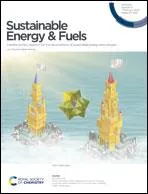
Insights into the phenomenon of ‘bubble-free’ electrocatalytic oxygen evolution from water
文献信息
发布日期
2020-12-21
DOI
10.1039/D0SE01633K
影响因子
6.367
作者
Richard Terrett, Zheyin Yu, Zhenxiang Cheng, Gerhard F. Swiegers, Takuya Tsuzuki, Robert Stranger, Ronald J. Pace
查看原文
摘要
Water electrolysis powered by renewable electricity will likely be critical to a future hydrogen economy. However, bubbles produced during water electrolysis add to capital and operational costs, due to blocking of the electrode surface and the necessary use of pumps and gas–liquid separators in electrolyser systems. Here ‘bubble-free’ electrocatalytic oxygen evolution from water was studied using a gas diffusion electrode that extracted oxygen as it was evolved, before bubbles were formed. The electrode comprised a gas-generating catalyst-binder layer, a poly(tetrafluoroethylene) (PTFE) interlayer, and a gas-extracting expanded PTFE (ePTFE) membrane (Gore-Tex®). Electrode properties between 20–60 °C, and with excess pressure on the alkaline electrolyte (≤80 kPa), were examined using detailed electrochemical measurements and video recordings. Electrochemical signal drift (dV/dt) was developed as a sensitive probe of bubble formation. ‘Breathability’, or the capacity for evolved oxygen to be directly extracted without forming bubbles, correlated with performance, and improved with temperature. A significant decline in oxygen evolution reaction (OER) activation energy with temperature was also observed. Bubble-free operation proceeded through the transportation of gas along a continuous network of hydrophobic, ‘aerophilic’ PTFE surfaces. The further development of bubble-free electrodes ought to permit revolutionary, low-cost electrolyser designs, adding impetus to the creation of a future hydrogen economy.
期刊推荐
Organic Process Research & Development
Saudi Pharmaceutical Journal
Crystallography Reports

Chemistry Education Research and Practice
New Journal of Chemistry

Journal of Peptide Science
Current Opinion in Colloid & Interface Science
Russian Journal of Applied Chemistry
Russian Journal of Coordination Chemistry
Journal of Saudi Chemical Society
相关文献
Template controlled self-assembly of bidentate phosphine complexes with hemilabile coordination behaviour
Samir Chikkali, Dietrich Gudat, Mark Niemeyer
2006-12-12
Communication
DOI: 10.1039/B616102B
Efficient proton conduction in dry nanofilms of amorphous aluminosilicate
Yoshitaka Aoki, Emi Muto, Shinya Onoue, Toyoki Kunitake
2007-03-09
Communication
DOI: 10.1039/B618920B
Recent advances in polymer protected gold nanoparticles: synthesis, properties and applications
Jun Shan, Heikki Tenhu
2007-07-09
Feature Article
DOI: 10.1039/B707740H
Catalytic enantioselective diboration, disilation and silaboration: new opportunities for asymmetric synthesis
Heather E. Burks, James P. Morken
2007-08-22
Feature Article
DOI: 10.1039/B707779C
Decarboxylative reduction of free aliphatic carboxylic acids by photogenerated cation radical
Yasuharu Yoshimi, Tatsuya Itou, Minoru Hatanaka
2007-10-17
Communication
DOI: 10.1039/B714526H
The first direct C–H arylation of purinenucleosides
Igor Čerňa, Radek Pohl, Michal Hocek
2007-10-25
Communication
DOI: 10.1039/B714253F
A facile solution-chemistry method for Cu(OH)2nanoribbon arrays with noticeable electrochemical hydrogen storage ability at room temperature
Peng Gao, Milin Zhang, Zhongyi Niu, Quanping Xiao
2007-10-12
Communication
DOI: 10.1039/B713154B
Retracted article: Biogenetic hypothesis and first steps towards a biomimetic synthesis of haouamines
Edmond Gravel, Erwan Poupon, Reynald Hocquemiller
2006-12-19
Communication
DOI: 10.1039/B613737G
New strong organic acceptors by cycloaddition of TCNE and TCNQ to donor-substituted cyanoalkynes
Philippe Reutenauer, Milan Kivala, Peter D. Jarowski, Corinne Boudon, Jean-Paul Gisselbrecht, Maurice Gross, François Diederich
2007-10-31
Communication
DOI: 10.1039/B714731G
A new zinc–zinc-bonded compound with a dianionic α-diimine ligand: synthesis and structure of [Na(THF)2]2·[LZn–ZnL] (L = [(2,6-iPr2C6H3)N(Me)C]22−)
Yaoming Xie, Henry F. Schaefer, Yongmin Liang
2007-04-20
Communication
DOI: 10.1039/B703200E
您可能还喜欢
化合物问答
奥美沙坦酯杂质4(CAS号:95579-71-8)的主要用途是什么?
奥美沙坦酯杂质4在药物工业中并无特定用途,主要作为生产和质量控制中的监控指标,以确保产品质量和符合相关规范。它具有一定的化学活性,因此在生产过程中需要严格控制其...
95579-71-84-Chloro-4-methyl-5-...
化合物问答
如何储存C3bot (154-182)(CAS号:1246280-79-4)?
C3bot (154-182)应储存在干燥、阴凉、通风良好的环境中,避免阳光直射。具体储存条件需要参考其相关安全数据表(SDS)中的储存信息。建议使用密闭容器存...
1246280-79-4C3bot (154-182)
化合物问答
在合成中是否有4-吡唑甲酸乙酯(CAS号:37622-90-5)的替代品?
在合成过程中,可以考虑使用类似结构的化合物作为替代品,例如4-吡唑甲酸甲酯或其他吡唑类化合物。这些替代品在性质上相似,可以用于相似的合成反应中,但需根据具体应用...
37622-90-5Ethyl 1H-pyrazole-4-...
化合物问答
(2-溴乙基)三甲基硅烷(CAS号:18156-67-7)的主要用途是什么?
(2-溴乙基)三甲基硅烷主要用作有机合成中的溴代试剂,特别是在硅化学领域中,用于制备硅烷衍生物和硅基功能材料。它也用于表面改性、催化剂合成、医药中间体合成以及分...
18156-67-7(2-Bromoethyl)(trime...
化合物问答
如何处理含有2-(4-broMophenyl)-1,1,1-trifluoropropan-2-ol(CAS号:122243-28-1)的废料?
含该化合物的废料需按照危险废物管理规定进行分类和处理。首先,应尽量减少废料的产生,通过改进生产工艺实现废物最小化。对于不可避免的废料,建议采用安全的收集方法,避...
122243-28-12-(4-bromophenyl)-1,...
化合物问答
什么是1,1,1-三氟-6-苯基-5-(e)-己烯-2,4-二酮(CAS号:18931-64-1)?
1,1,1-三氟-6-苯基-5-(e)-己烯-2,4-二酮是一种有机化合物,化学式为C14H8F3O2。它是一种具有特定立体结构的芳香族化合物,属于酮类。
18931-64-1(5E)-1,1,1-Trifluoro...
化合物问答
2-(2-甲基哌啶-1-基)-2-氧代-乙酸(CAS号:77654-61-6)的主要用途是什么?
2-(2-甲基哌啶-1-基)-2-氧代-乙酸主要用于药物合成、有机合成及作为化学试剂。它在医药领域有一定的应用,可用于合成某些药物中间体。此外,它还用于实验室研...
77654-61-6(2-Methyl-1-piperidi...
化合物问答
如何储存(R)-1-(3-Chlorophenyl)-2,2,2-trifluoroethanamine(CAS号:1213627-66-7)?
应将(R)-1-(3-氯苯基)-2,2,2-三氟乙胺储存在阴凉、干燥、通风良好的地方,远离火源和热源。应使用密封的容器储存,并避免光照。储存温度应控制在室温范围...
1213627-66-7(1R)-1-(3-Chlorophen...
化合物问答
N-亚硝基-N,N-二壬基胺(CAS号:84424-96-4)的市场或研究趋势如何?
N-亚硝基-N,N-二壬基胺目前主要应用于有机合成和药物化学领域。市场趋势显示,随着有机合成技术的进步,该化合物在新药研发中的应用将更加广泛。新兴研究领域包括其...
84424-96-4N-Nitroso-N-nonyl-1-...
化合物问答
5-Chloro-2-methoxy-3-(2,2,2-trifluoroethoxy)pyridine(CAS号:1280786-68-6)的市场或研究趋势如何?
该化合物在医药、农药等领域有潜在应用价值,但市场需求较小。目前研究趋势主要集中在探索其在特定领域的应用潜力,如作为药物合成中的中间体。随着研究的深入,预计未来市...
1280786-68-65-Chloro-2-methoxy-3...
来源期刊
推荐化合物
![2-Methyl-2-propanyl 4-[3-(aminomethyl)phenyl]-1-piperazinecarboxylate structure](https://cnstatic.chemtradehub.com/structs/889/889948-55-4-5c12.webp "2-Methyl-2-propanyl 4-[3-(aminomethyl)phenyl]-1-piperazinecarboxylate structure")
2-Methyl-2-propanyl 4-[3-(aminomethyl)phenyl]-1-piperazinecarboxylate
CAS号:
889948-55-4
分子式:
C16H25N3O2
推荐供应商






免责声明
本页面提供的学术期刊信息仅供参考和研究使用。我们与任何期刊出版商均无关联,也不处理投稿事宜。如有投稿相关咨询,请直接联系相关期刊出版商。
如发现页面信息有误,请发送邮件至 support@chemtradehub.com 联系我们。我们将及时核实并处理您的问题。