




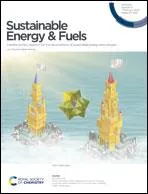
The rational design of hierarchical CoS2/CuCo2S4 for three-dimensional all-solid-state hybrid supercapacitors with high energy density, rate efficiency, and operational stability
文献信息
发布日期
2020-12-22
DOI
10.1039/D0SE01698E
影响因子
6.367
作者
Yogesh Kumar Sonia, Mahesh Kumar Paliwal, Sumanta Kumar Meher
查看原文
摘要
In the context of developing all-solid-state hybrid supercapacitor devices with superior performance, and excellent charge storage, energy and power densities, working stability, and rate efficiency, herein, we have adopted an anion-exchange method to design hierarchically structured CoS2/CuCo2S4 with multiple reactive equivalents, enhanced conductivity, and a distinctive ion-permeable bulk microstructure. The electrochemical investigation of CoS2/CuCo2S4 in a three-electrode setup revealed the excellent high-rate specific capacitance (1492 F g−1 at 6 A g−1), strong redox reversibility, trivial voltage drop, extremely low charge transfer (approximately 0.23 Ω), and low Warburg and equivalent series (0.78 Ω) resistance of the material. Furthermore, a thorough electrochemical study of the CoS2/CuCo2S4‖N-rGO all-solid-state hybrid supercapacitor (ASSHSC) device (with CoS2/CuCo2S4 and N-rGO as the positive and negative electrode materials, respectively) showed a substantial faradaic contribution to the overall charge storage, a small high-rate overpotential, an insignificant voltage drop, exceptional rate capacitance/capacity, excellent coulombic efficiency under high-rate conditions, and very low charge transfer and equivalent series resistance. The CoS2/CuCo2S4‖N-rGO ASSHSC device offers remarkable high-rate energy density (20.7 W h kg−1 at an extreme power density of approximately 23 000 W kg−1) and operational stability (approximately 92.8% after 10 000 GCD cycles). The excellent energy storage performance of the CoS2/CuCo2S4-based ASSHSC device is ascribed to the abundant boundary pores and inter-crystallite pores, multiple redox possibilities (due to Co3+, Co2+, and Cu2+), electroactive ion-reservoir-like behaviour, active CoS2|CuCo2S4 interface, enhanced electromechanical stability of the electrode materials, and CoS2- and N-induced improved conductivity of CoS2/CuCo2S4 and N-rGO, respectively.
相关文献
Lewis base stabilized lithium TMP-aluminates: an unexpected fragmentation and capture reaction involving cyclic ether 1,4-dioxane
Joaquín García-Álvarez, Eva Hevia, Alan R. Kennedy, Jan Klett, Robert E. Mulvey
2007-03-09
Communication
DOI: 10.1039/B700785J
Enhancement of large magnetoresistances in ruthenocuprates by Ta substitution
A. C. Mclaughlin, L. Begg, A. J. McCue, J. P. Attfield
2007-03-06
Communication
DOI: 10.1039/B617872C
Maximizing the relaxivity of HSA-bound gadolinium complexes by simultaneous optimization of rotation and water exchange
Stefano Avedano, Lorenzo Tei, Alberto Lombardi, Giovanni B. Giovenzana, Silvio Aime, Dario Longo, Mauro Botta
2007-10-26
Communication
DOI: 10.1039/B714438E
Template controlled self-assembly of bidentate phosphine complexes with hemilabile coordination behaviour
Samir Chikkali, Dietrich Gudat, Mark Niemeyer
2006-12-12
Communication
DOI: 10.1039/B616102B
Boron–oxygen luminescence centres in boron–nitrogen systems
Chengchun Tang, Yoshio Bando, Chunyi Zhi, Dmitri Golberg
2007-09-04
Communication
DOI: 10.1039/B711807D
Facile transformation of hydrophilic cellulose into superhydrophobic cellulose
Shenghai Li, Haibo Xie, Suobo Zhang, Xianhong Wang
2007-09-21
Communication
DOI: 10.1039/B712056G
Transition metal dinitrogen complexes supported by a versatile monoanionic [N2P2] ligand
Wayne A. Chomitz, John Arnold
2007-09-05
Communication
DOI: 10.1039/B709763H
A tetradecanuclear copper dimeric macrocyclic complex with a body-centred heptanuclear core-structure and magnetism
Santokh S. Tandon, Scott D. Bunge, Laurence K. Thompson
2006-11-23
Communication
DOI: 10.1039/B612795A
Retracted article: Biogenetic hypothesis and first steps towards a biomimetic synthesis of haouamines
Edmond Gravel, Erwan Poupon, Reynald Hocquemiller
2006-12-19
Communication
DOI: 10.1039/B613737G
Direct 23Na NMR observation of mixed cations residing inside a G-quadruplex channel
Ramsey Ida, Irene C. M. Kwan, Gang Wu
2006-11-15
Communication
DOI: 10.1039/B613105K
您可能还喜欢
化合物问答
奥美沙坦酯杂质4(CAS号:95579-71-8)的主要用途是什么?
奥美沙坦酯杂质4在药物工业中并无特定用途,主要作为生产和质量控制中的监控指标,以确保产品质量和符合相关规范。它具有一定的化学活性,因此在生产过程中需要严格控制其...
95579-71-84-Chloro-4-methyl-5-...
化合物问答
如何储存C3bot (154-182)(CAS号:1246280-79-4)?
C3bot (154-182)应储存在干燥、阴凉、通风良好的环境中,避免阳光直射。具体储存条件需要参考其相关安全数据表(SDS)中的储存信息。建议使用密闭容器存...
1246280-79-4C3bot (154-182)
化合物问答
在合成中是否有4-吡唑甲酸乙酯(CAS号:37622-90-5)的替代品?
在合成过程中,可以考虑使用类似结构的化合物作为替代品,例如4-吡唑甲酸甲酯或其他吡唑类化合物。这些替代品在性质上相似,可以用于相似的合成反应中,但需根据具体应用...
37622-90-5Ethyl 1H-pyrazole-4-...
化合物问答
(2-溴乙基)三甲基硅烷(CAS号:18156-67-7)的主要用途是什么?
(2-溴乙基)三甲基硅烷主要用作有机合成中的溴代试剂,特别是在硅化学领域中,用于制备硅烷衍生物和硅基功能材料。它也用于表面改性、催化剂合成、医药中间体合成以及分...
18156-67-7(2-Bromoethyl)(trime...
化合物问答
如何处理含有2-(4-broMophenyl)-1,1,1-trifluoropropan-2-ol(CAS号:122243-28-1)的废料?
含该化合物的废料需按照危险废物管理规定进行分类和处理。首先,应尽量减少废料的产生,通过改进生产工艺实现废物最小化。对于不可避免的废料,建议采用安全的收集方法,避...
122243-28-12-(4-bromophenyl)-1,...
化合物问答
什么是1,1,1-三氟-6-苯基-5-(e)-己烯-2,4-二酮(CAS号:18931-64-1)?
1,1,1-三氟-6-苯基-5-(e)-己烯-2,4-二酮是一种有机化合物,化学式为C14H8F3O2。它是一种具有特定立体结构的芳香族化合物,属于酮类。
18931-64-1(5E)-1,1,1-Trifluoro...
化合物问答
2-(2-甲基哌啶-1-基)-2-氧代-乙酸(CAS号:77654-61-6)的主要用途是什么?
2-(2-甲基哌啶-1-基)-2-氧代-乙酸主要用于药物合成、有机合成及作为化学试剂。它在医药领域有一定的应用,可用于合成某些药物中间体。此外,它还用于实验室研...
77654-61-6(2-Methyl-1-piperidi...
化合物问答
如何储存(R)-1-(3-Chlorophenyl)-2,2,2-trifluoroethanamine(CAS号:1213627-66-7)?
应将(R)-1-(3-氯苯基)-2,2,2-三氟乙胺储存在阴凉、干燥、通风良好的地方,远离火源和热源。应使用密封的容器储存,并避免光照。储存温度应控制在室温范围...
1213627-66-7(1R)-1-(3-Chlorophen...
化合物问答
N-亚硝基-N,N-二壬基胺(CAS号:84424-96-4)的市场或研究趋势如何?
N-亚硝基-N,N-二壬基胺目前主要应用于有机合成和药物化学领域。市场趋势显示,随着有机合成技术的进步,该化合物在新药研发中的应用将更加广泛。新兴研究领域包括其...
84424-96-4N-Nitroso-N-nonyl-1-...
化合物问答
5-Chloro-2-methoxy-3-(2,2,2-trifluoroethoxy)pyridine(CAS号:1280786-68-6)的市场或研究趋势如何?
该化合物在医药、农药等领域有潜在应用价值,但市场需求较小。目前研究趋势主要集中在探索其在特定领域的应用潜力,如作为药物合成中的中间体。随着研究的深入,预计未来市...
1280786-68-65-Chloro-2-methoxy-3...
来源期刊
推荐化合物
![Ethyl 5-[({[(2-methyl-2-propanyl)oxy]carbonyl}amino)methyl]-1,2-oxazole-3-carboxylate structure](https://cnstatic.chemtradehub.com/structs/253/253196-37-1-8450.webp "Ethyl 5-[({[(2-methyl-2-propanyl)oxy]carbonyl}amino)methyl]-1,2-oxazole-3-carboxylate structure")
推荐供应商




免责声明
本页面提供的学术期刊信息仅供参考和研究使用。我们与任何期刊出版商均无关联,也不处理投稿事宜。如有投稿相关咨询,请直接联系相关期刊出版商。
如发现页面信息有误,请发送邮件至 support@chemtradehub.com 联系我们。我们将及时核实并处理您的问题。