


Ultrafast energy transfer between lipid-linked chromophores and plant light-harvesting complex II
文献信息
发布日期
2021-08-26
DOI
10.1039/D1CP01628H
影响因子
3.676
作者
Minjung Son, Muath Nairat, Tiejun Wei, Christopher D. P. Duffy, Gabriela S. Schlau-Cohen
查看原文
摘要
Light-Harvesting Complex II (LHCII) is a membrane protein found in plant chloroplasts that has the crucial role of absorbing solar energy and subsequently performing excitation energy transfer to the reaction centre subunits of Photosystem II. LHCII provides strong absorption of blue and red light, however, it has minimal absorption in the green spectral region where solar irradiance is maximal. In a recent proof-of-principle study, we enhanced the absorption in this spectral range by developing a biohybrid system where LHCII proteins together with lipid-linked Texas Red (TR) chromophores were assembled into lipid membrane vesicles. The utility of these systems was limited by significant LHCII quenching due to protein–protein interactions and heterogeneous lipid structures. Here, we organise TR and LHCII into a lipid nanodisc, which provides a homogeneous, well-controlled platform to study the interactions between TR molecules and single LHCII complexes. Fluorescence spectroscopy determined that TR-to-LHCII energy transfer has an efficiency of at least 60%, resulting in a 262% enhancement of LHCII fluorescence in the 525–625 nm range, two-fold greater than in the previous system. Ultrafast transient absorption spectroscopy revealed two time constants of 3.7 and 128 ps for TR-to-LHCII energy transfer. Structural modelling and theoretical calculations indicate that these timescales correspond to TR–lipids that are loosely- or tightly-associated with the protein, respectively, with estimated TR-to-LHCII separations of ∼3.5 nm and ∼1 nm. Overall, we demonstrate that a nanodisc-based biohybrid system provides an idealised platform to explore the photophysical interactions between extrinsic chromophores and membrane proteins with potential applications in understanding more complex natural or artificial photosynthetic systems.
期刊推荐
Mini-Reviews in Medicinal Chemistry
CrystEngComm
Environmental Toxicology and Pharmacology
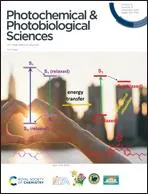
Photochemical & Photobiological Sciences

Physical Chemistry Chemical Physics
Advanced Engineering Materials
Molecular Diversity
European Journal of Organic Chemistry
Lab on a Chip
Journal of Enzyme inhibition and Medicinal Chemistry
相关文献
First principles prediction of interfacial magnetoelectric coupling in tetragonal La2/3Sr1/3MnO3/BiFeO3 multiferroic superlattices
Nan Feng, Wenbo Mi, Xiaocha Wang
2015-04-24
Paper
DOI: 10.1039/C5CP01857A
Single-molecule spectroscopy and femtosecond transient absorption studies on the excitation energy transfer process in ApcE(1–240) dimers
Saran Long, Meng Zhou, Kun Tang, Xiao-Li Zeng, Yingli Niu, Qianjin Guo, Kai-Hong Zhao, Andong Xia
2015-04-23
Paper
DOI: 10.1039/C5CP01687H
Irreversible structural change of a dry ionic liquid under nanoconfinement
L. Andres Jurado, Hojun Kim, Andrea Arcifa, Cecilia Leal, Nicholas D. Spencer
2015-04-27
Paper
DOI: 10.1039/C4CP05592F
A low-cost and advanced SiOx–C composite with hierarchical structure as an anode material for lithium-ion batteries
Wenjun Wu, Jing Shi, Yunhui Liang, Fang Liu, Yi Peng, Huabin Yang
2015-04-24
Paper
DOI: 10.1039/C5CP01212K
Visible-light photocatalysis in Cu2Se nanowires with exposed {111} facets and charge separation between (111) and () polar surfaces
Bin Liu, Lichao Ning, Hua Zhao, Congjie Zhang, Heqing Yang, Shengzhong (Frank) Liu
2015-04-16
Paper
DOI: 10.1039/C5CP00450K
Structural change of NaO1/2–WO3–NbO5/2–LaO3/2–PO5/2 glass induced by electrochemical substitution of sodium ions with protons
Tomohiro Ishiyama, Takuya Yamaguchi, Junji Nishii, Toshiharu Yamashita, Hiroshi Kawazoe, Naoaki Kuwata, Junichi Kawamura, Takahisa Omata
2015-04-27
Paper
DOI: 10.1039/C4CP05999A
Electronic structure and photoelectron spectra of Bn with n = 26–29: an overview of structural characteristics and growth mechanism of boron clusters
Truong Ba Tai, Minh Tho Nguyen
2015-04-22
Paper
DOI: 10.1039/C5CP01851J
Viscosity minima in binary mixtures of ionic liquids + molecular solvents
M. Tariq, K. Shimizu, J. M. S. S. Esperança, L. P. N. Rebelo
2015-04-20
Paper
DOI: 10.1039/C5CP01563D
您可能还喜欢
化合物问答
如何储存1,2-环己二酮环乙缩醛(CAS号:4746-96-7)?
1,2-环己二酮环乙缩醛应储存在阴凉、干燥、通风良好的地方,避免阳光直射。建议使用密封容器保存,并保持环境温度在室温范围内,远离火源和热源。
4746-96-71,4-Dioxaspiro[4.5]d...
化合物问答
Ecopladib(CAS号:381683-92-7)的市场或研究趋势如何?
Ecopladib作为一种新型的药物,主要应用于治疗高胆固醇等疾病。目前,市场和研究趋势显示,Ecopladib因其独特的药理作用而受到关注。随着对心血管疾病治...
381683-92-7Ecopladib
化合物问答
2,3-Dimethyl-3H-imidazo[4,5-c]pyridine(CAS号:52538-09-7)通常如何合成?
2,3-二甲基-3H-咪唑[4,5-c]吡啶通常通过咪唑和2,3-二甲基吡啶的缩合反应合成。具体来说,将咪唑和2,3-二甲基吡啶在适当的溶剂中进行加热或加压反应...
52538-09-72,3-Dimethyl-3H-imid...
化合物问答
2,3,4,5-tetrahydro-1H-3-苯并氮杂环;盐酸盐(CAS号:17379-01-0)的市场或研究趋势如何?
该化合物在药物化学和有机合成中有一定的应用。近年来,随着对新型药物化合物的需求增加,该化合物的研究趋势主要集中在探索其生物活性,尤其是其在神经系统疾病治疗中的潜...
17379-01-02,3,4,5-Tetrahydro-1...
68-90-6(2-Ethyl-1-benzofura...
化合物问答
如何储存盐酸甘氨酸丁酯(CAS号:13048-99-2)?
盐酸甘氨酸丁酯应储存在阴凉、干燥、通风良好的地方,避免阳光直射和高温环境,温度应控制在25℃以下。储存容器应密封,避免与空气中的水分和酸性物质接触,以防发生水解...
13048-99-2Butyl glycinate hydr...
化合物问答
什么是2-Iodo-N,N-dimethylbenzamide(CAS号:54616-46-5)?
2-碘-N,N-二甲基苯胺是一种有机化合物,化学名为2-Iodo-N,N-dimethylbenzamide。其分子式为C<sub>9</sub>H<sub>1...
54616-46-52-Iodo-N,N-dimethylb...
16817-90-6N-Cyclohexylglycinam...
化合物问答
5-溴-2-(4H-1,2,4-三唑-4-基)吡啶(CAS号:959240-99-4)的市场或研究趋势如何?
随着医药、农药和新材料领域的发展,该化合物作为关键中间体的应用日益增多。特别是在药物合成中,由于其独特的化学性质,可以用于合成多种药物分子。未来的研究趋势可能集...
959240-99-45-Bromo-2-(4H-1,2,4-...
化合物问答
2,4-二溴-6-三氟甲基嘧啶(CAS号:785778-00-9)通常如何合成?
2,4-二溴-6-三氟甲基嘧啶通常通过溴化反应合成。首先,将6-三氟甲基嘧啶与溴化剂(如液溴)在适当的溶剂(如二氯甲烷、四氢呋喃)中反应,加入适当的催化剂(如四...
785778-00-92,4-Dibromo-6-(trifl...
来源期刊
Physical Chemistry Chemical Physics
CiteScore:
5.5
自引率:
10.3%
年发文量:
3036
Physical Chemistry Chemical Physics (PCCP) is an international journal co-owned by 19 physical chemistry and physics societies from around the world. This journal publishes original, cutting-edge research in physical chemistry, chemical physics and biophysical chemistry. To be suitable for publication in PCCP, articles must include significant innovation and/or insight into physical chemistry; this is the most important criterion that reviewers and Editors will judge against when evaluating submissions. The journal has a broad scope and welcomes contributions spanning experiment, theory, computation and data science. Topical coverage includes spectroscopy, dynamics, kinetics, statistical mechanics, thermodynamics, electrochemistry, catalysis, surface science, quantum mechanics, quantum computing and machine learning. Interdisciplinary research areas such as polymers and soft matter, materials, nanoscience, energy, surfaces/interfaces, and biophysical chemistry are welcomed if they demonstrate significant innovation and/or insight into physical chemistry. Joined experimental/theoretical studies are particularly appreciated when complementary and based on up-to-date approaches.
推荐化合物
![[(1S,2S,3R,4S,7R,9S,10S,12R,15S)-4,12-Diacetyloxy-15-[(2R,3S)-3-benzamido-3-phenyl-2-(2,2,2-trichloroethoxycarbonyloxy)propanoyl]oxy-1,9-dihydroxy-10,14,17,17-tetramethyl-11-oxo-6-oxatetracyclo[11.3.1.03,10.04,7]heptadec-13-en-2-yl] benzoate structure](https://cnstatic.chemtradehub.com/structs/100/100431-55-8-7104.webp "[(1S,2S,3R,4S,7R,9S,10S,12R,15S)-4,12-Diacetyloxy-15-[(2R,3S)-3-benzamido-3-phenyl-2-(2,2,2-trichloroethoxycarbonyloxy)propanoyl]oxy-1,9-dihydroxy-10,14,17,17-tetramethyl-11-oxo-6-oxatetracyclo[11.3.1.03,10.04,7]heptadec-13-en-2-yl] benzoate structure")
推荐供应商




免责声明
本页面提供的学术期刊信息仅供参考和研究使用。我们与任何期刊出版商均无关联,也不处理投稿事宜。如有投稿相关咨询,请直接联系相关期刊出版商。
如发现页面信息有误,请发送邮件至 support@chemtradehub.com 联系我们。我们将及时核实并处理您的问题。