


Adsorption and reaction mechanisms of single and double H2O molecules on graphene surfaces with defects: a density functional theory study
文献信息
发布日期
2021-08-11
DOI
10.1039/D1CP02595C
影响因子
3.676
作者
Zeng Liang, Kejiang Li, Ziming Wang, Yushan Bu, Jianliang Zhang
查看原文
摘要
More attention needs to be drawn to the high application value of the gasification reaction between carbonaceous materials and water in industry. In this study, density functional theory is used to investigate the adsorption and reaction mechanism of water molecules on graphene surfaces with various kinds of defects. The desorption mechanism of the reaction product is also analyzed. The optimal and stable physical adsorption configuration of water molecules on the pristine graphene and various defects graphene surface has been determined. Chemisorption configurations of a single water molecule and double water molecules on the graphene surface with single vacancy defects are discussed and used as reaction precursors to explore the reaction path of water molecules in the process of desorbing hydrogen at active sites. The whole process of the reaction is largely exothermic and the thermodynamic advantages of double water molecules participating in the reaction are determined. The two reaction mechanisms of two-steps or co-adsorption and desorption of double water molecules are compared, and the lowest energy barrier advantage of the latter is determined.
期刊推荐
Foundations of Chemistry
Advanced Engineering Materials
Nature Reviews Drug Discovery
Green Chemistry
Journal of Enzyme inhibition and Medicinal Chemistry
Angewandte Chemie International Edition
Photochemical & Photobiological Sciences
Contact Lens & Anterior Eye
Environmental Toxicology and Pharmacology
Current Pharmaceutical Biotechnology
相关文献
Expression of concern: Preparation and characterization of nano-sized Pt–Ru/C catalysts and their superior catalytic activities for methanol and ethanol oxidation
2021-08-18
Expression of Concern
DOI: 10.1039/D1CP90169A
Subtle structure matters: boosting surface-directed photoelectron transfer via the introduction of specific monovalent oxygen vacancies in TiO2
Fei Li, Dong Wang, Xue-Qing Gong
2021-08-18
Paper
DOI: 10.1039/D1CP02787E
Transient absorption spectroscopy of the electron transfer step in the photochemically activated polymerizations of N-ethylcarbazole and 9-phenylcarbazole
Georgia L. Thornton, Ryan Phelps, Andrew J. Orr-Ewing
2021-08-05
Paper
DOI: 10.1039/D1CP03137F
First-principles prediction of strain-induced gas-sensing tuning in tin sulfide
Xin Shen, Yinan Bai
2021-08-06
Paper
DOI: 10.1039/D1CP02770K
Ultrafast energy transfer between lipid-linked chromophores and plant light-harvesting complex II
Minjung Son, Muath Nairat, Tiejun Wei, Christopher D. P. Duffy, Gabriela S. Schlau-Cohen
2021-08-26
Paper
DOI: 10.1039/D1CP01628H
Massive dipoles across the metal–semiconductor cluster interface: towards chemically controlled rectification
Dinesh Bista, Turbasu Sengupta, Shiv N. Khanna
2021-08-11
Paper
DOI: 10.1039/D1CP02420E
A molecular beam and computational study on the barrierless gas phase formation of (iso)quinoline in low temperature extraterrestrial environments
Long Zhao, Matthew Prendergast, Ralf I. Kaiser, Bo Xu, Wenchao Lu, Musahid Ahmed, A. Hasan Howlader, Stanislaw F. Wnuk, Alexander S. Korotchenko, Mikhail M. Evseev, Eugene K. Bashkirov, Alexander M. Mebel
2021-08-06
Paper
DOI: 10.1039/D1CP02169A
UVPD spectroscopy of differential mobility-selected prototropic isomers of protonated adenine
Mircea Guna, Bradley B. Schneider, J. C. Yves Le Blanc, Marcel Nooijen
2021-08-30
Paper
DOI: 10.1039/D1CP02688G
Exploring the thermodynamic, kinetic and inhibitory mechanisms of 5-iTU targeting mitotic kinase haspin by integrated molecular dynamics
Qianqian Wang, Qinggao Zhang, Elaine Lai Han Leung, Yingqing Chen, Xiaojun Yao
2021-08-03
Paper
DOI: 10.1039/D1CP02783B
您可能还喜欢
化合物问答
如何储存1,2-环己二酮环乙缩醛(CAS号:4746-96-7)?
1,2-环己二酮环乙缩醛应储存在阴凉、干燥、通风良好的地方,避免阳光直射。建议使用密封容器保存,并保持环境温度在室温范围内,远离火源和热源。
4746-96-71,4-Dioxaspiro[4.5]d...
化合物问答
Ecopladib(CAS号:381683-92-7)的市场或研究趋势如何?
Ecopladib作为一种新型的药物,主要应用于治疗高胆固醇等疾病。目前,市场和研究趋势显示,Ecopladib因其独特的药理作用而受到关注。随着对心血管疾病治...
381683-92-7Ecopladib
化合物问答
2,3-Dimethyl-3H-imidazo[4,5-c]pyridine(CAS号:52538-09-7)通常如何合成?
2,3-二甲基-3H-咪唑[4,5-c]吡啶通常通过咪唑和2,3-二甲基吡啶的缩合反应合成。具体来说,将咪唑和2,3-二甲基吡啶在适当的溶剂中进行加热或加压反应...
52538-09-72,3-Dimethyl-3H-imid...
化合物问答
2,3,4,5-tetrahydro-1H-3-苯并氮杂环;盐酸盐(CAS号:17379-01-0)的市场或研究趋势如何?
该化合物在药物化学和有机合成中有一定的应用。近年来,随着对新型药物化合物的需求增加,该化合物的研究趋势主要集中在探索其生物活性,尤其是其在神经系统疾病治疗中的潜...
17379-01-02,3,4,5-Tetrahydro-1...
68-90-6(2-Ethyl-1-benzofura...
化合物问答
如何储存盐酸甘氨酸丁酯(CAS号:13048-99-2)?
盐酸甘氨酸丁酯应储存在阴凉、干燥、通风良好的地方,避免阳光直射和高温环境,温度应控制在25℃以下。储存容器应密封,避免与空气中的水分和酸性物质接触,以防发生水解...
13048-99-2Butyl glycinate hydr...
化合物问答
什么是2-Iodo-N,N-dimethylbenzamide(CAS号:54616-46-5)?
2-碘-N,N-二甲基苯胺是一种有机化合物,化学名为2-Iodo-N,N-dimethylbenzamide。其分子式为C<sub>9</sub>H<sub>1...
54616-46-52-Iodo-N,N-dimethylb...
16817-90-6N-Cyclohexylglycinam...
化合物问答
5-溴-2-(4H-1,2,4-三唑-4-基)吡啶(CAS号:959240-99-4)的市场或研究趋势如何?
随着医药、农药和新材料领域的发展,该化合物作为关键中间体的应用日益增多。特别是在药物合成中,由于其独特的化学性质,可以用于合成多种药物分子。未来的研究趋势可能集...
959240-99-45-Bromo-2-(4H-1,2,4-...
化合物问答
2,4-二溴-6-三氟甲基嘧啶(CAS号:785778-00-9)通常如何合成?
2,4-二溴-6-三氟甲基嘧啶通常通过溴化反应合成。首先,将6-三氟甲基嘧啶与溴化剂(如液溴)在适当的溶剂(如二氯甲烷、四氢呋喃)中反应,加入适当的催化剂(如四...
785778-00-92,4-Dibromo-6-(trifl...
来源期刊
Physical Chemistry Chemical Physics

CiteScore:
5.5
自引率:
10.3%
年发文量:
3036
Physical Chemistry Chemical Physics (PCCP) is an international journal co-owned by 19 physical chemistry and physics societies from around the world. This journal publishes original, cutting-edge research in physical chemistry, chemical physics and biophysical chemistry. To be suitable for publication in PCCP, articles must include significant innovation and/or insight into physical chemistry; this is the most important criterion that reviewers and Editors will judge against when evaluating submissions. The journal has a broad scope and welcomes contributions spanning experiment, theory, computation and data science. Topical coverage includes spectroscopy, dynamics, kinetics, statistical mechanics, thermodynamics, electrochemistry, catalysis, surface science, quantum mechanics, quantum computing and machine learning. Interdisciplinary research areas such as polymers and soft matter, materials, nanoscience, energy, surfaces/interfaces, and biophysical chemistry are welcomed if they demonstrate significant innovation and/or insight into physical chemistry. Joined experimental/theoretical studies are particularly appreciated when complementary and based on up-to-date approaches.
推荐化合物
![1-[(4-Methylphenyl)sulfonyl]-3-(4,4,5,5-tetramethyl-1,3,2-dioxaborolan-2-yl)-1H-pyrrolo[2,3-b]pyridine-5-carbonitrile structure](https://cnstatic.chemtradehub.com/structs/143/1434747-57-5-fc0d.webp "1-[(4-Methylphenyl)sulfonyl]-3-(4,4,5,5-tetramethyl-1,3,2-dioxaborolan-2-yl)-1H-pyrrolo[2,3-b]pyridine-5-carbonitrile structure")
![(2E)-3-(3-Chlorophenyl)-N-{2-[4-(methylsulfonyl)-1-piperazinyl]-2-oxoethyl}acrylamide structure](https://cnstatic.chemtradehub.com/structs/250/2505001-54-5-c1e9.webp "(2E)-3-(3-Chlorophenyl)-N-{2-[4-(methylsulfonyl)-1-piperazinyl]-2-oxoethyl}acrylamide structure")
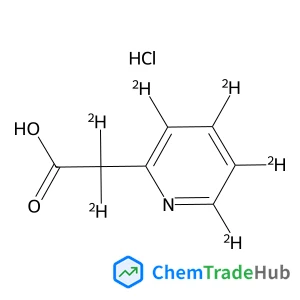
2,2-dideuterio-2-(3,4,5,6-tetradeuterio-2-pyridyl)acetic acid;hydrochloride
CAS号:
1329799-67-8
分子式:
C7H2ClD6NO2
推荐供应商





免责声明
本页面提供的学术期刊信息仅供参考和研究使用。我们与任何期刊出版商均无关联,也不处理投稿事宜。如有投稿相关咨询,请直接联系相关期刊出版商。
如发现页面信息有误,请发送邮件至 support@chemtradehub.com 联系我们。我们将及时核实并处理您的问题。