


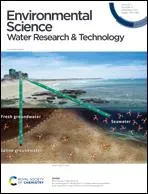
Carbonaceous DBP (THMs and HAAs) formation during Cl2 and ClO2 treatment of aqueous soluble fractions of soil derived natural organic matter
文献信息
发布日期
2021-12-30
DOI
10.1039/D1EW00716E
影响因子
4.251
作者
R. K. Padhi
查看原文
摘要
A substantial portion of surface water dissolved organic matter is of terrestrial origin and serves as an important precursor for toxic disinfection byproduct formation. In the present study, organic matter extracted from a composite soil sample from our local area was investigated for its potential for disinfection byproduct (DBP) formation during Cl2 and ClO2 treatment. The soil organic content (SOC) was separated into base leachable organic content (OCB) and acid leachable organic content (OCA). The OCA and OCB constituents were further fractionated into hydrophobic (HPO), transphilic (TPI) and hydrophilic (HPI) constituents, based on their selective adsorption onto XAD-4 and XAD-8 resin. The isolated organic fractions were treated with 3–25 mg L−1 of Cl2 and ClO2 to evaluate their specific trihalomethane (THM) and haloacetic acid (HAA) potential. The THM formation potentials of the OCA and OCB were 251.2 and 191.3 μg per mg-C for Cl2 treatment at a 3 : 1 Cl2 : OC (organic carbon) ratio. The order of THM formation potentials of different fractions of SOC was HPO > HPI > TPI for the OCA; and HPO > TPI > HPI for the OCB during chlorine treatment. The SOC showed insignificant reactivity toward ClO2: the HPO (4.23 μg per mg-C) and TPI (1.03 μg per g-C) fractions of the OCA only resulted in the formation of a small amount of THMs. Similarly, for HAAs: Cl2 (ClO2) treatment of the OCA and OCB generated 67.2 (11.1) and 114.9 (11.86) μg per mg-C. The distribution pattern of four THMs and nine HAAs was clearly different for the Cl2 and ClO2 treatment of the SOC. Tribromomethane was the dominant THM for Cl2 treatment, whereas bromodichloromethane was the most frequently detected THM for ClO2. The di-HAAs dominated the HAA species in the case of Cl2; in contrast tri-HAAs were the only HAA species formed during ClO2 treatment of the SOC. Overall, these results provide important insights pertaining to the significance of soil derived organic fractions on the formation of DBPs during Cl2 and ClO2 treatment of surface water.
期刊推荐

Current Opinion in Solid State & Materials Science
Journal of Natural Medicines
Russian Journal of General Chemistry
Journal of Peptide Science

Russian Chemical Bulletin
Russian Journal of Coordination Chemistry

Chemistry Education Research and Practice
Saudi Pharmaceutical Journal

Acta Materialia
Russian Journal of Bioorganic Chemistry
相关文献
Antiferromagnetic ordering based on intermolecular London dispersion interactions in amphiphilic TEMPO ammonium salts
Jessica Exner, Steffen Eusterwiemann, Oliver Janka, Oliver Niehaus, Constantin G. Daniliuc, Rainer Pöttgen, Armido Studer
2018-11-09
Communication
DOI: 10.1039/C8CP05837G
Conformational preference and cationic structure of 2-methylpyrazine by VUV-MATI spectroscopy and natural bond orbital analysis
Do Won Kang, Hong Lae Kim, Chan Ho Kwon
2019-04-16
Paper
DOI: 10.1039/C9CP00766K
Polarized absorbance and Davydov splitting in bulk and thin-film pentacene polymorphs
Caterina Cocchi, Tobias Breuer, Gregor Witte, Claudia Draxl
2018-11-14
Paper
DOI: 10.1039/C8CP06384B
Ab initio paramagnetic NMR shifts via point-dipole approximation in a large magnetic-anisotropy Co(ii) complex
Jiří Mareš, Juha Vaara
2018-08-20
Paper
DOI: 10.1039/C8CP04123G
Counteraction of denaturant-induced protein unfolding is a general property of stabilizing agents
Serena Cozzolino, Rosario Oliva, Giuseppe Graziano, Pompea Del Vecchio
2018-11-07
Paper
DOI: 10.1039/C8CP04421J
Theoretical prediction of LiScO2 nanosheets as a cathode material for Li–O2 batteries
Zhixiao Liu, Shiguo Zhang, Wangyu Hu
2018-08-11
Paper
DOI: 10.1039/C8CP01756E
Computer simulations of the adsorption of an N-terminal peptide of statherin, SN15, and its mutants on hydroxyapatite surfaces
Muzhong Luo, Shengjiang Yang, Xuebo Quan, Delin Sun, Jian Zhou
2019-04-09
Paper
DOI: 10.1039/C9CP01638D
A comparative study of the structure, stability and energetic performance of 5,5′-bitetrazole-1,1′-diolate based energetic ionic salts: future high energy density materials
B. Moses Abraham, Vikas D. Ghule
2018-11-09
Paper
DOI: 10.1039/C8CP06635C
Impact of pore size, interconnections, and dynamic conductivity on the electrochemistry of vanadium pentoxide in well defined porous structures
Nam Kim, Emily Sahadeo, Chanyuan Liu, Olivia Rose
2018-11-21
Paper
DOI: 10.1039/C8CP04706E
Distribution of water in the pores of periodic mesoporous organosilicates – a proton solid state MAS NMR study
V. S. Veena, Kavya Illath, Anish Lazar, C. P. Vinod, T. G. Ajithkumar, S. Jayanthi
2018-11-01
Paper
DOI: 10.1039/C8CP04902E
您可能还喜欢
化合物问答
如何储存1,2-环己二酮环乙缩醛(CAS号:4746-96-7)?
1,2-环己二酮环乙缩醛应储存在阴凉、干燥、通风良好的地方,避免阳光直射。建议使用密封容器保存,并保持环境温度在室温范围内,远离火源和热源。
4746-96-71,4-Dioxaspiro[4.5]d...
化合物问答
Ecopladib(CAS号:381683-92-7)的市场或研究趋势如何?
Ecopladib作为一种新型的药物,主要应用于治疗高胆固醇等疾病。目前,市场和研究趋势显示,Ecopladib因其独特的药理作用而受到关注。随着对心血管疾病治...
381683-92-7Ecopladib
化合物问答
2,3-Dimethyl-3H-imidazo[4,5-c]pyridine(CAS号:52538-09-7)通常如何合成?
2,3-二甲基-3H-咪唑[4,5-c]吡啶通常通过咪唑和2,3-二甲基吡啶的缩合反应合成。具体来说,将咪唑和2,3-二甲基吡啶在适当的溶剂中进行加热或加压反应...
52538-09-72,3-Dimethyl-3H-imid...
化合物问答
2,3,4,5-tetrahydro-1H-3-苯并氮杂环;盐酸盐(CAS号:17379-01-0)的市场或研究趋势如何?
该化合物在药物化学和有机合成中有一定的应用。近年来,随着对新型药物化合物的需求增加,该化合物的研究趋势主要集中在探索其生物活性,尤其是其在神经系统疾病治疗中的潜...
17379-01-02,3,4,5-Tetrahydro-1...
68-90-6(2-Ethyl-1-benzofura...
化合物问答
如何储存盐酸甘氨酸丁酯(CAS号:13048-99-2)?
盐酸甘氨酸丁酯应储存在阴凉、干燥、通风良好的地方,避免阳光直射和高温环境,温度应控制在25℃以下。储存容器应密封,避免与空气中的水分和酸性物质接触,以防发生水解...
13048-99-2Butyl glycinate hydr...
化合物问答
什么是2-Iodo-N,N-dimethylbenzamide(CAS号:54616-46-5)?
2-碘-N,N-二甲基苯胺是一种有机化合物,化学名为2-Iodo-N,N-dimethylbenzamide。其分子式为C<sub>9</sub>H<sub>1...
54616-46-52-Iodo-N,N-dimethylb...
16817-90-6N-Cyclohexylglycinam...
化合物问答
5-溴-2-(4H-1,2,4-三唑-4-基)吡啶(CAS号:959240-99-4)的市场或研究趋势如何?
随着医药、农药和新材料领域的发展,该化合物作为关键中间体的应用日益增多。特别是在药物合成中,由于其独特的化学性质,可以用于合成多种药物分子。未来的研究趋势可能集...
959240-99-45-Bromo-2-(4H-1,2,4-...
化合物问答
2,4-二溴-6-三氟甲基嘧啶(CAS号:785778-00-9)通常如何合成?
2,4-二溴-6-三氟甲基嘧啶通常通过溴化反应合成。首先,将6-三氟甲基嘧啶与溴化剂(如液溴)在适当的溶剂(如二氯甲烷、四氢呋喃)中反应,加入适当的催化剂(如四...
785778-00-92,4-Dibromo-6-(trifl...
来源期刊
推荐化合物
推荐供应商




免责声明
本页面提供的学术期刊信息仅供参考和研究使用。我们与任何期刊出版商均无关联,也不处理投稿事宜。如有投稿相关咨询,请直接联系相关期刊出版商。
如发现页面信息有误,请发送邮件至 support@chemtradehub.com 联系我们。我们将及时核实并处理您的问题。