




![N-[2-(2-Pyridinyl)ethyl]-1-propanamine structure](https://cnstatic.chemtradehub.com/structs/554/55496-57-6-22b4.webp "N-[2-(2-Pyridinyl)ethyl]-1-propanamine structure")
Construction of biodegradable core cross-linked nanoparticles from near infrared dyes encoded in polyprodrug amphiphiles and investigation of their synergistic anticancer activity
文献信息
发布日期
2021-03-05
DOI
10.1039/D1PY00128K
影响因子
5.582
作者
Xiaoxu Mao, Shoukui Hu, Ke Shang, Guangwei Yang, Jinhao Yan, Chao Ma, Jun Yin
查看原文
摘要
It has been widely accepted that covalently cross-linked nanoparticles show extended circulation time in the blood due to their large stable structures compared to free linear polyprodrugs. Herein, an efficient method, combining living radical polymerization, a ring-opening reaction, and a copper(I) catalyzed azide–alkyne cycloaddition click reaction, was employed to prepare amphiphilic polyprodrugs with a reduction-responsive camptothecin (CPT) prodrug and photothermal converted near-infrared dyes (IR780). The drug content could be regulated as needed through the monomer feed ratio. The obtained amphiphilic P[CPTM-co-GMA(-IR780/-OH)]-b-POEGMA polyprodrugs could molecularly dissolve in a good solvent and self-assembled into nanoparticles consisting of thiol-responsive P[CPTM-co-GMA(-IR780/-OH)] cores and well solvated POEGMA coronas in the selected solvent. Cross-linking of the P[CPTM-co-GMA(-IR780/-OH)] cores could be facilely achieved via the reaction between the residual hydroxyls and hexachlorocyclic triphosphonitrile (HCCP; acid sensitive and biodegradable) to form structurally stable core cross-linked (CCL) nanoparticles. DLS, TEM, UV-vis and fluorescent techniques, as well as subsequent in vitro cell experiments, confirmed that these CCL nanoparticles possessed excellent aqueous stability, high tumor micromilieu sensitivity, controlled drug release and severe cytotoxicity to HeLa cells with the aid of near-infrared light irradiation. Not only that, these CCL nanoparticles could serve as nanocarriers for loading other anti-cancer drugs (curcumin) to realize synergistic and highly effective treatment. Overall, this work provides a convenient way to produce promising intelligent, responsive and enhanced anticancer therapies.
相关文献
Predicted structures and superconductivity of LiYHn (n = 5–10) under high pressure
Tao Gao, Shiyin Ma, Xiaoqiu Ye
2022-03-28
Paper
DOI: 10.1039/D2CP00059H
Sp2- and sp3–C⋯O tetrel bonds in the 3-oxetanone homodimer
Hao Wang, Yang Zheng, Xinyue Zhang, Xuefang Xu
2022-03-22
Paper
DOI: 10.1039/D2CP00703G
Structure, hydrogen bond dynamics and phase transition in a model ionic liquid electrolyte
Peter Stange, Alexander G. Stepanov
2022-02-11
Paper
DOI: 10.1039/D2CP00452F
Tuning the magnetic anisotropy energy by external electric fields of CoPt dimers deposited on graphene
P. Ruiz-Díaz, C. Núñez-Valencia, M. Muñoz-Navia, E. Urrutia-Bañuelos, J. Dorantes-Dávila
2022-04-11
Paper
DOI: 10.1039/D2CP00482H
Charge transport in the spatially correlated exponential random energy landscape: effect of the nonpositive correlation function
2022-03-30
Paper
DOI: 10.1039/D1CP04991G
Vibrational Stark fields in carboxylic acid dimers
Manjusha Boda, G. Naresh Patwari
2022-02-04
Paper
DOI: 10.1039/D1CP02211C
Infrared spectroscopy of 2-oxo-octanoic acid in multiple phases
2022-02-25
Paper
DOI: 10.1039/D1CP05345K
Multicomponent chiral hydrogel fibers with block configurations based on the chiral liquid crystals of cellulose nanocrystals and M13 bacteriophages
Yuhan Wang, Xiaonan Zheng, Weiting Zhong, Zihan Ye, Xinzhi Wang, Ziyue Dong, Zhenkun Zhang
2022-08-17
Paper
DOI: 10.1039/D2PY00965J
Functionalized few-layer silicene nanosheets: stability, elastic, structural, and electronic properties
Bruno Ipaves, João F. Justo, Lucy V. C. Assali
2022-03-22
Paper
DOI: 10.1039/D1CP05867C
Diffusion measurements of hydrocarbons in H-MCM-41 extrudates with pulsed-field gradient nuclear magnetic resonance spectroscopy
Vladimir V. Zhivonitko, Zuzana Vajglová, Päivi Mäki-Arvela, Narendra Kumar, Markus Peurla, Ville-Veikko Telkki, Dmitry Yu. Murzin
2022-03-16
Paper
DOI: 10.1039/D2CP00138A
您可能还喜欢
化合物问答
什么是2,6-二溴-4,8-双[(2-乙基己基)氧基]苯并[1,2-b:4,5-b']二噻吩(CAS号:1226782-13-3)?
2,6-二溴-4,8-双[(2-乙基己基)氧基]苯并[1,2-b:4,5-b']二噻吩是一种有机化合物,分子式为C23H32Br2O2S2。该化合物具有芳香性和...
1226782-13-32,6-Dibromo-4,8-bis[...
化合物问答
木聚硫钠(CAS号:37319-17-8)的物理化学性质是什么?
木聚硫钠通常为无色或白色结晶性粉末,具有吸湿性。其分子量约为121.11 g/mol。木聚硫钠易溶于水,不溶于醇类和其他非极性溶剂。在酸性或碱性溶液中,木聚硫钠...
37319-17-8Pentosan
化合物问答
2-甲氧基-4-(三氟甲基)苄溴, JRD(CAS号:886500-59-0)适用哪些法规指南?
该化合物在合成、储存和运输过程中需遵循《全球化学品统一分类和标签制度》(GHS)的健康、环境和物理危险分类。在欧洲还需符合《化学品注册、评估、授权和限制》(RE...
886500-59-02-Methoxy-4-(trifluo...
化合物问答
1,4-Diazoniabicyclo[2.2.2]octane-1,4-disulfinate(CAS号:119752-83-9)的主要用途是什么?
1,4-二氮杂双环[2.2.2]辛烷-1,4-二硫酸二酯主要用于有机合成中的保护基团,特别是在保护胺基和硫醇基方面具有广泛应用。此外,它还用于一些特殊化学反应的...
119752-83-91,4-Diazabicyclo[2.2...
化合物问答
如何处理含有4-(Bromomethyl)-2-fluorobenzenesulphonamide(CAS号:1645275-47-3)的废料?
含有4-(Bromomethyl)-2-fluorobenzenesulphonamide的废液应首先进行中和处理,以降低pH值,避免对环境造成腐蚀性影响。随后...
1645275-47-34-(Bromomethyl)-2-fl...
化合物问答
Loureiriol(CAS号:479195-44-3)的物理化学性质是什么?
Loureiriol是一种天然化合物,其分子式为C15H22O4。Loureiriol为无色结晶性粉末,具有较高的熔点和良好的热稳定性。其相对分子质量为262....
479195-44-3Loureiriol
化合物问答
在合成中是否有3-氨基苯甲酰苯胺(CAS号:14315-16-3)的替代品?
在合成过程中,可以考虑使用类似结构的化合物作为3-氨基苯甲酰苯胺的替代品,例如N-苯基-3-氰基苯胺或N-苯基-3-硝基苯胺等,这些化合物具有相似的化学性质,可...
14315-16-33-Amino-N-phenylbenz...
化合物问答
4-异氰酰苯基硼酸频哪醇酯(CAS号:380430-64-8)的市场或研究趋势如何?
4-异氰酰苯基硼酸频哪醇酯主要应用于有机合成、药物化学和材料科学领域。随着绿色化学的发展,该化合物因其高效的官能团转化能力和环境友好性而受到越来越多的关注。近年...
380430-64-82-(4-Isocyanatopheny...
化合物问答
如何储存3β-乙酰氧基-7,25-甘遂二烯-24(R)-醇(CAS号:1352001-09-2)?
3β-乙酰氧基-7,25-甘遂二烯-24(R)-醇应储存在阴凉、干燥、通风良好的地方,避免直接光照。储存容器应密封,防止空气中的水分和氧气影响化合物的稳定性。建...
1352001-09-23β-acetoxy-eupha- 7,...
化合物问答
如何储存4-氟-2-甲基-1H-吲哚(CAS号:1260383-51-4)?
应将4-氟-2-甲基-1H-吲哚存放在阴凉、干燥、通风良好的地方,避免直接暴露在光照下。容器应密封,避免与空气中的水蒸气接触。建议在避光、温度不超过25℃的环境...
1260383-51-44-Fluoro-2-methyl-1H...
来源期刊
Polymer Chemistry

CiteScore:
8.6
自引率:
7.3%
年发文量:
457
Polymer Chemistry welcomes submissions in all areas of polymer science that have a strong focus on macromolecular chemistry. Manuscripts may cover a broad range of fields, yet no direct application focus is required.
推荐化合物
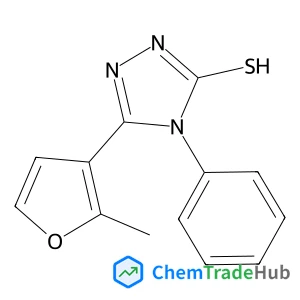
5-(2-Methyl-3-furyl)-4-phenyl-2,4-dihydro-3H-1,2,4-triazole-3-thione
CAS号:
346464-59-3
分子式:
C13H11N3OS
![6,6-Dimethylbicyclo[3.1.1]hept-2-ene-2-carbaldehyde structure](https://cnstatic.chemtradehub.com/structs/564/564-94-3-e746.webp "6,6-Dimethylbicyclo[3.1.1]hept-2-ene-2-carbaldehyde structure")
推荐供应商




免责声明
本页面提供的学术期刊信息仅供参考和研究使用。我们与任何期刊出版商均无关联,也不处理投稿事宜。如有投稿相关咨询,请直接联系相关期刊出版商。
如发现页面信息有误,请发送邮件至 support@chemtradehub.com 联系我们。我们将及时核实并处理您的问题。