


Synthesis of a bead-like multicyclic polymer by UV-induced coupling of an anthracene-telechelic monocyclic precursor and its reversible topological conversion
文献信息
发布日期
2021-08-30
DOI
10.1039/D1PY00341K
影响因子
5.582
作者
Hua-long Zhang, Wen Xu, Chao Liu
查看原文
摘要
In this study, a bead-like multicyclic polymer was synthesized by the UV-induced coupling reaction of an anthracene-telechelic monocyclic precursor and the reversible topological transformation between the monocyclic polymer and the multicyclic polymer was realized. Poly(ethylene oxide) (PEO) containing bromine and anthryl groups at both ends was used as a macroinitiator for the atom transfer radical polymerization (ATRP) of styrene to afford a linear block polymer (PS-PEO-Br). After azidation, the azide-terminated linear polymer (PEO-PS-N3) underwent bimolecular ring-closure using sym-dibenzo-1,5-cyclooctadiene-3,7-diyne (DIBOD) as a bifunctional linker via a self-accelerating click reaction, and the corresponding monocyclic polymer with two pendant anthryl groups (C(PEO-PS)-ant) was synthesized. Considering the photo-responsive nature of anthracene, the monocyclic polymer was taken as a macromonomer for synthesizing a bead-like multicyclic polymer through the dimerization reaction of anthryl groups under 365 nm UV irradiation. The obtained polymers were characterized by NMR, FT-IR and GPC. According to the result of GPC, there were about 14 “monocyclic units” in the bead-like multicyclic polymer on average. Moreover, the bead-like multicyclic polymer could be cleaved at the nodal points and converted back to the monocyclic structure when exposed to 254 nm UV light.
期刊推荐

Chemical Communications
Crystallography Reports
Organic Process Research & Development

Current Opinion in Solid State & Materials Science
Russian Journal of Bioorganic Chemistry
Russian Journal of Coordination Chemistry

Acta Materialia
Drug Discovery Today

Chemistry Education Research and Practice
Journal of Saudi Chemical Society
相关文献
A novel clean catalytic method for waste-free modification of polysaccharides by oxidation
Svetlana L. Kachkarova-Sorokina, Pierre Gallezot, Alexander B. Sorokin
2004-11-04
Communication
DOI: 10.1039/B411694A
Poly(9,9′-spirobifluorene-manganese porphyrin): a new catalytic material for oxidation of alkenes by iodobenzene diacetate and iodosylbenzene
Cyril Poriel, Yann Ferrand, Paul le Maux, Joëlle Raul-Berthelot, Gerard Simonneaux
2003-04-02
Communication
DOI: 10.1039/B301717F
Mo2P4O15 – the most complex oxide structure solved by single crystal methods?
Sarah E. Lister, Ivana Radosavljevic Evans, Judith A. K. Howard, Alan Coelho, John S. O. Evans
2004-10-04
Communication
DOI: 10.1039/B408413F
Synthesis of novel starburst and dendritic polyhedral oligosilsesquioxanes
Kenji Wada, Naoki Watanabe, Koichi Yamada, Teruyuki Kondo, Take-aki Mitsudo
2004-11-29
Communication
DOI: 10.1039/B413921F
Coordination polymers based on square planar Co(ii) node and linear spacer: solvent-dependent pseudo-polymorphism and an unprecedented interpenetrating structure containing both 2D and 3D topological isomers
Dong Mok Shin, In Su Lee, Young Keun Chung, Myoung Soo Lah
2003-04-02
Communication
DOI: 10.1039/B210320F
Efficient immobilisation of Rh-MonoPhos on the aluminosilicate AlTUD-1
Ulf Hanefeld, Isabel W. C. E. Arends, Adriaan J. Minnaard, Thomas Maschmeyer, Roger A. Sheldon
2004-10-26
Communication
DOI: 10.1039/B411506F
Excimer formation by interstrand stacked pyrenes
Simon M. Langenegger, Robert Häner
2004-11-09
Communication
DOI: 10.1039/B412831A
Influence of substrate on self-assembled photonic crystal
Sachiko I. Matsushita
2004-02-09
Communication
DOI: 10.1039/B313410E
Modified micro-space using self-organized nanoparticles for reduction of methylene blue
Xianying Li, Hongzhi Wang, Kouzou Inoue, Masato Uehara, Hiroyuki Nakamura, Masaya Miyazaki, Eiichi Abe, Hideaki Maeda
2003-03-18
Communication
DOI: 10.1039/B300765K
Monitoring the formation of biosilica catalysed by histidine-tagged silicatein
Muhammad Nawaz Tahir, Patrick Théato, Werner E. G. Müller, Heinz C. Schröder, Andreas Janshoff, Jian Zhang, Joachim Huth, Wolfgang Tremel
2004-10-27
Communication
DOI: 10.1039/B410283E
您可能还喜欢
化合物问答
如何处理含有8-氯咪唑并[1,2-A]吡嗪(CAS号:69214-33-1)的废料?
处理含有8-氯咪唑并[1,2-A]吡嗪的废料时,应首先将其收集并进行化学回收或降解。如果无法回收,需采用安全的化学处理方法,如中和、氧化还原或沉淀。处理过程中需...
69214-33-18-chloroimidazo[1,2-...
化合物问答
Calhex 231 hydrochloride(CAS号:2387505-78-2)适用哪些法规指南?
Calhex 231 hydrochloride 需要遵循《全球化学品统一分类和标签制度》(GHS)的分类和标签要求,以及欧盟的《化学品注册、评估、授权和限制条...
2387505-78-24-Chloro-N-[(1S,2S)-...
化合物问答
11-Beta,17-alpha,21-三羟基-5-beta-孕烯-3,20-二酮(CAS号:1482-50-4)的物理化学性质是什么?
11-Beta,17-alpha,21-三羟基-5-beta-孕烯-3,20-二酮是一种无色结晶性粉末,分子量为372.45 g/mol。该化合物在水中的溶解度...
1482-50-45β-Dihydrocortisol
化合物问答
处理5-异丙基-1,3,4-恶二唑-2-羧酸(CAS号:944907-13-5)时应注意哪些实验室安全事项?
处理5-异丙基-1,3,4-恶二唑-2-羧酸时应注意以下安全事项:穿戴适当的个人防护装备,包括实验室外套、手套和护目镜;操作应在通风橱中进行,以减少吸入或接触有...
944907-13-55-Isopropyl-1,3,4-ox...
化合物问答
benzyl 3-bromopropanoate(CAS号:90841-55-7)安全吗?
Benzyl 3-bromopropanoate属于有毒物质,吸入、摄入或皮肤接触均可能对人体造成伤害。操作时应佩戴防护眼镜、口罩和手套,避免吸入蒸汽和直接接触...
90841-55-7Benzyl 3-bromopropan...
化合物问答
什么是(R)-N-苄氧羰基-3,4-二氢-1H-异喹啉羧酸(CAS号:151004-88-5)?
(R)-N-苄氧羰基-3,4-二氢-1H-异喹啉羧酸是一种含有苄氧羰基和异喹啉环结构的化合物,分子式为C17H15NO3。它是一种有机化合物,具有一定的生物活性...
151004-88-5(1R)-2-[(Benzyloxy)c...
化合物问答
在合成中是否有1-苄基吡啶嗡-3-羧酸盐(CAS号:15990-43-9)的替代品?
可以考虑使用1-苄基吡啶-3-羧酸盐作为1-苄基吡啶嗡-3-羧酸盐的替代品。此外,还可以探索其他类似物,如1-苄基吡啶-3-氨基甲酸酯等。具体的替代品选择需根据...
15990-43-91-Benzyl-3-pyridiniu...
化合物问答
(2,6-二甲基吡啶-3-基)甲醇(CAS号:582303-10-4)安全吗?
(2,6-二甲基吡啶-3-基)甲醇在使用时需注意安全,应避免吸入其蒸汽,接触皮肤和眼睛。操作应在通风良好的环境中进行,佩戴适当的个人防护装备。
582303-10-4(2,6-Dimethyl-3-pyri...
化合物问答
5-溴-2-乙烯基吡啶(CAS号:226883-52-9)的物理化学性质是什么?
5-溴-2-乙烯基吡啶是一种有机化合物,外观为白色固体,具有良好的结晶性。分子量约为190.03 g/mol。它的溶解性在水中较差,但在有机溶剂如二氯甲烷、甲醇...
226883-52-95-Bromo-2-vinylpyrid...
化合物问答
2-羟基-3-硝基-5-甲基吡啶(CAS号:7464-14-4)应用于哪些行业?
2-羟基-3-硝基-5-甲基吡啶主要应用于医药、聚合物和半导体行业。在医药领域,它可以用作合成其他药物的中间体。在聚合物领域,它可以作为功能性单体参与聚合反应,...
7464-14-45-Methyl-3-nitro-2(1...
来源期刊
Polymer Chemistry

CiteScore:
8.6
自引率:
7.3%
年发文量:
457
Polymer Chemistry welcomes submissions in all areas of polymer science that have a strong focus on macromolecular chemistry. Manuscripts may cover a broad range of fields, yet no direct application focus is required.
推荐化合物
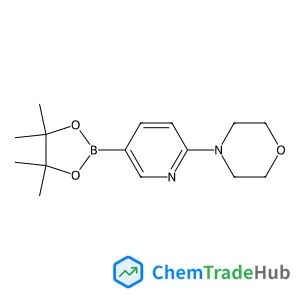
4-(5-(4,4,5,5-tetramethyl-1,3,2-dioxaborolan-2-yl)pyridin-2-yl)morpholine
CAS号:
485799-04-0
分子式:
C15H23BN2O3
![N,N'-1,2-Ethanediylbis[2-(vinylsulfonyl)acetamide] structure](https://cnstatic.chemtradehub.com/structs/667/66710-66-5-b556.webp "N,N'-1,2-Ethanediylbis[2-(vinylsulfonyl)acetamide] structure")
推荐供应商





免责声明
本页面提供的学术期刊信息仅供参考和研究使用。我们与任何期刊出版商均无关联,也不处理投稿事宜。如有投稿相关咨询,请直接联系相关期刊出版商。
如发现页面信息有误,请发送邮件至 support@chemtradehub.com 联系我们。我们将及时核实并处理您的问题。