






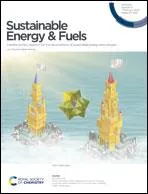
Biomass-derived carbon electrodes for supercapacitors and hybrid solar cells: towards sustainable photo-supercapacitors
文献信息
发布日期
2021-07-29
DOI
10.1039/D1SE00954K
影响因子
6.367
作者
Nilanka M. Keppetipola, Céline Olivier, Thierry Toupance, Ludmila Cojocaru
查看原文
摘要
Due to their outstanding electrochemical properties, electrical conductivity, flexibility, and low-cost, carbon materials open up new opportunities for the design of compact devices with a wide variety of potential applications. Biomass renewable resources for carbon material preparation have attracted huge attention in the last few years due to their widespread availability, low-cost processability and high-performance of the resulting porous carbons for sustainable technological applications. For example, the porosity and morphology of carbon materials, which can be tuned by different activation methods, govern the ion diffusion rate during supercapacitor charge/discharge processes. On the other hand, carbon electrodes have been applied as electrodes for dye-sensitized and perovskite solar cells, thanks to their low fabrication cost, compact structure, and optimized interfaces, which play a key role in the charge collection and stability of the devices. Moreover, due to the possibility of using carbon electrodes for storage and conversion devices, efficient methods to harvest and store energy in one single device are crucial for technological advancement and the energy transition process. This contribution aims to review the advances made in the use of carbon materials obtained from biomass sources as electrodes for storage and energy conversion devices, and the future application of shared and/or distinct carbon electrodes for the development of integrated power packs including supercapacitors and dye-sensitized or perovskite solar cells. The storage properties of supercapacitors are discussed in terms of the textural characteristics of biomass-derived activated carbons while the photovoltaic parameters of solar cells based on bio-sourced carbons are compared with those of devices using conventional metal-based electrodes. Finally, special emphasis is placed on the energy conversion–storage efficiencies of solar cell-supercapacitor integrated devices.
相关文献
Directional control of π-stacked building blocks for crystal engineering: the 1,8-naphthalimide synthon
Daniel L. Reger, J. Derek Elgin, Radu F. Semeniuc, Perry J. Pellechia, Mark D. Smith
2005-07-14
Communication
DOI: 10.1039/B504998A
The vicinal F–C–C–F moiety as a tool for influencing peptide conformation
Martin Schüler, David O'Hagan, Alexandra M. Z. Slawin
2005-07-14
Communication
DOI: 10.1039/B506010A
Chemistry of aluminium(i)
Herbert W. Roesky, S. Shravan Kumar
2005-07-13
Feature Article
DOI: 10.1039/B505307B
Highly luminescent water-soluble CdTe nanowires as fluorescent probe to detect copper(ii)
Bo Tang, Jinye Niu, Chengguang Yu, Linhai Zhuo, Jiechao Ge
2005-07-19
Communication
DOI: 10.1039/B502978C
Silylstannations of α,β-unsaturated carbonyl compoundsvia the generation of Bu3Sn− in ionic liquids
Steven Dickson, Darrell Dean, Robert. D. Singer
2005-08-04
Communication
DOI: 10.1039/B508400H
Solvolytic routes to new nonabismuth hydroxy- and alkoxy-oxo complexes: synthesis, characterization and solid-state structures of novel nonabismuth polyoxo cations Bi9(μ3-O)8(μ3-OR)65+ (R = H, Et)
John H. Thurston, Dale C. Swenson, Louis Messerle
2005-07-27
Communication
DOI: 10.1039/B504864H
Click-chemistry as an efficient synthetic tool for the preparation of novel conjugated polymers
Dirk Jan V. C. van Steenis, Olivier R. P. David, Gino P. F. van Strijdonck, Jan H. van Maarseveen, Joost N. H. Reek
2005-07-19
Communication
DOI: 10.1039/B507776A
A two-dimensional clathrate hydrate sandwiched by planar arrays of a copper complex
Riichi Miyamoto, Rika Tanaka Hamazawa, Masakazu Hirotsu, Takanori Nishioka, Isamu Kinoshita, L. James Wright
2005-06-15
Communication
DOI: 10.1039/B505681K
Facile synthetic approach to novel core-extended perylene carboximide dyes
Sibylle Müller, Klaus Müllen
2005-07-19
Communication
DOI: 10.1039/B509220E
您可能还喜欢
化合物问答
4-[[6-(3-苯基苯基)-7H-嘌呤-2-基]氨基]苯磺酰胺(CAS号:2079895-42-2)适用哪些法规指南?
该化合物需遵循REACH法规以确保其安全使用和管理。同时,根据其潜在的生物降解性和毒性,也需要符合GHS分类中的相应要求。此外,若用于医药或食品相关领域,则还需...
2079895-42-24-{[6-(3-Biphenylyl)...
化合物问答
反式-度骨化醇(CAS号:74007-20-8)的物理化学性质是什么?
反式-度骨化醇是一种脂溶性维生素D3的衍生物,呈无色或白色结晶性粉末,不溶于水,溶于乙醇、丙酮、氯仿等有机溶剂。其分子式为C28H44O,分子量为404.65。...
74007-20-8trans-Doxercalcifero...
化合物问答
莲花掌苷(CAS号:59282-56-3)的市场或研究趋势如何?
莲花掌苷作为一种天然产物,近年来在抗炎、抗癌等生物活性研究方面显示出一定的潜力,因此市场需求逐渐增长。市场动态方面,随着天然产物开发的深入,预计该化合物的研究会...
59282-56-3Lindleyin
化合物问答
2-溴-6-(吡咯烷-1-基)吡啶-4-硼酸频那醇酯(CAS号:1150271-64-9)应用于哪些行业?
2-溴-6-(吡咯烷-1-基)吡啶-4-硼酸频那醇酯在医药领域有着广泛的应用,它可以用作药物合成中的中间体。此外,它还可以用于有机合成,特别是在构建复杂杂环化合...
1150271-64-92-Bromo-6-(1-pyrroli...
化合物问答
什么是methyl 2-(4-bromophenyl)-3-methylbutanoate(CAS号:1061284-70-5)?
methyl 2-(4-溴苯基)-3-甲基丁酸甲酯是一种化学物质,分子式为C12H13BrO2。它是一种有机化合物,具有一定的挥发性和易燃性。
1061284-70-52-(4-Bromo-phenyl)-3...
化合物问答
CJC1-295(CAS号:863288-34-0)的物理化学性质是什么?
CJC1-295是一种具有复杂肽链结构的化合物,其分子量约为1875 Da。该化合物在水中具有一定的溶解性,但在有机溶剂中的溶解性不佳。它是一种反应活性化合物,...
863288-34-0L-tyrosyl-D-alanyl-L...
化合物问答
三正丁基锍碘(CAS号:18146-62-8)的市场或研究趋势如何?
三正丁基锍碘作为一种重要的有机硫化合物,主要用于有机合成中作为亲电试剂。近年来,由于其在合成中的广泛应用,市场对其需求持续增长。此外,随着绿色化学的发展,对其替...
18146-62-8Tributylsulfonium io...
化合物问答
雌二醇-[13C3]同位素内标(CAS号:1261254-48-1)通常如何合成?
雌二醇-[13C3]同位素内标通常通过在雌二醇分子中引入[13C3]同位素来合成。常见的方法是通过化学标记反应,如与[13C3]标记的甲基溴化物进行亲核取代反应...
1261254-48-117beta-Estradiol-2,3...
化合物问答
N1-(2-吡啶甲基)-N2-(2-甲基-1-萘基)草酰胺(CAS号:2611225-93-3)的物理化学性质是什么?
N1-(2-吡啶甲基)-N2-(2-甲基-1-萘基)草酰胺为固体化合物,具有良好的结晶形态,分子量为340.34 g/mol。该化合物在水中的溶解度较低,但在有...
2611225-93-3N-(2-Methyl-1-naphth...
化合物问答
如何处理含有十五碳烯酸甲酯(顺-10)(C15:1)标准品(CAS号:90176-52-6)的废料?
含有十五碳烯酸甲酯(顺-10)(C15:1)标准品的废料应首先进行适当收集和储存,避免与其他化学品混合。然后,可采用焚烧或交由专业废物处理公司进行处理。处理过程...
90176-52-6(Z)-10-Pentadecenoic...
来源期刊
推荐化合物
![4-[(2-{2-[2-(2-Aminoethoxy)ethoxy]ethoxy}ethyl)amino]-2-(2,6-dioxo-3-piperidinyl)-1H-isoindole-1,3(2H)-dione structure](https://cnstatic.chemtradehub.com/structs/209/2093416-31-8-3162.webp "4-[(2-{2-[2-(2-Aminoethoxy)ethoxy]ethoxy}ethyl)amino]-2-(2,6-dioxo-3-piperidinyl)-1H-isoindole-1,3(2H)-dione structure")
推荐供应商




免责声明
本页面提供的学术期刊信息仅供参考和研究使用。我们与任何期刊出版商均无关联,也不处理投稿事宜。如有投稿相关咨询,请直接联系相关期刊出版商。
如发现页面信息有误,请发送邮件至 support@chemtradehub.com 联系我们。我们将及时核实并处理您的问题。