









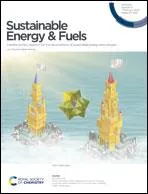
Vacancy-induced high activity of MoS2 monolayers for CO electroreduction: a computational study
文献信息
发布日期
2021-08-18
DOI
10.1039/D1SE00988E
影响因子
6.367
作者
Dongxu Jiao, Yu Tian, Yuejie Liu, Jingxiang Zhao
查看原文
摘要
The electroreduction of CO (COER) to valuable carbon-based chemicals is an attractive alternative to the traditional Fischer–Tropsch process, in which the development of electrocatalysts with high activity and high selectivity still remains a huge challenge. Herein, by means of density functional theory (DFT) computations, we systematically explored the potential of defective MoS2 monolayers with sulfur vacancies, including mono-sulfur (VS), di-sulfur (VS2 and V2S), and tri-sulfur (V3S), as COER electrocatalysts. Our results revealed that these defective MoS2-based candidates exhibit low formation energies and high stability, holding great promise for experimental synthesis and practical applications. In particular, according to the computed free energy changes, we found that the catalytic activity of these considered defective MoS2 monolayers for COER is highly dependent on the size of sulfur vacancies in MoS2 monolayers, among which V3S exhibits the best COER catalytic performance, and CH4 is identified as the main product. Interestingly, the difference between the adsorption strength of *CH2 and *CH3 species can be used as a rational descriptor to evaluate the COER catalytic activity of these defective MoS2 monolayers. Thus, controlling the size of S-vacancies can make MoS2 monolayers a promising electrocatalyst for COER, which not only further widens the potential of MoS2 monolayers in electrocatalysis, but also opens a new door for CO reduction for renewable energy supply.
相关文献
15N and 2H NMR relaxation and kinetics of stepwise double proton and deuteron transfer in polycrystalline tetraaza[14]annulene
Uwe Langer, Christof Hoelger, Gerd Buntkowsky, Hans-Martin Vieth, Hans-Heinrich Limbach
2001-03-22
Paper
DOI: 10.1039/B007564G
Design, synthesis and use of phthalocyanines as a new class of visible-light photoinitiators for free-radical and cationic polymerizations
Louise Breloy, Ozgur Yavuz, Ismail Yilmaz, Yusuf Yagci, Davy-Louis Versace
2021-06-19
Review Article
DOI: 10.1039/D1PY00462J
An analytical solution for the diffusion of electrolytes through a charge-mosaic membrane
Andriy E. Yaroshchuk
2001-04-11
Paper
DOI: 10.1039/B009186N
Synthesis and characterisation of chromium-substituted ETS-10
Andreas Philippou, Anabela Valente, João Rocha, Michael Anderson
2001-04-03
Paper
DOI: 10.1039/B006828O
The concepts of non-Gibbsian and non-Lewisian properties in chemical thermodynamics
João Carlos R. Reis, Michael J. Blandamer, Michael I. Davis, Gérard Douhéret
2001-03-16
Paper
DOI: 10.1039/B009512P
Intermolecular electron transfer in merocyanine aggregates studied by optical and transient EPR methods
Lorenzo Franco, Luigi Pasimeni, Glauco Ponterini, Marco Ruzzi, Ulderico Segre
2001-04-03
Paper
DOI: 10.1039/B009427G
Dielectric studies of freezing behavior in porous materials: Water and methanol in activated carbon fibres
K. E. Gubbins, R. Radhakrishnan
2001-03-13
Paper
DOI: 10.1039/B009792F
Synthesis of core-crosslinked star polymers via organocatalyzed living radical polymerization
Yichao Zheng, Jit Sarkar, Hiroshi Niino, Shunsuke Chatani, Shu Yao Hsu, Atsushi Goto
2021-07-05
Paper
DOI: 10.1039/D1PY00663K
您可能还喜欢
化合物问答
2-Bromo-4-chloro-1-(difluoromethyl)benzene(CAS号:1261476-50-9)的市场或研究趋势如何?
随着环保要求的提高和安全意识的增强,该化合物的研究和应用趋势正逐渐转向更安全、更环境友好的替代品。市场关注点主要集中在开发新型合成方法和绿色化学路径,以减少有害...
1261476-50-92-Bromo-4-chloro-1-(...
化合物问答
如何处理含有2,9 - 二苯基-1,10 - 菲罗啉(CAS号:25677-69-4)的废料?
处理含有2,9 - 二苯基 - 1,10 - 菲罗啉的废料时,应先将其收集在适当的容器中,避免与其他化学品混合。随后,可以通过水解或氧化等方法进行处理,直至达到...
25677-69-42,9-Diphenyl-1,10-ph...
化合物问答
处理(6-氯-吡嗪-3-基)-(4-乙基-哌嗪-1-基)-甲酮(CAS号:1178836-15-1)时应注意哪些实验室安全事项?
处理(6-氯-吡嗪-3-基)-(4-乙基-哌嗪-1-基)-甲酮时,应穿戴适当的个人防护装备(PPE),包括手套、护目镜和实验室外套。在通风橱中操作以确保良好的通...
1178836-15-1(6-Chloro-3-pyridazi...
化合物问答
处理(R)-2-氯-1-(2,4-二氯苯基)乙醇(CAS号:114446-57-0)时应注意哪些实验室安全事项?
在处理(R)-2-氯-1-(2,4-二氯苯基)乙醇时,应佩戴防护眼镜、实验室外套和手套,确保通风橱开启以减少接触和吸入的风险。避免直接接触皮肤和眼睛。处理过程中...
114446-57-0(1R)-2-Chloro-1-(2,4...
化合物问答
在合成中是否有3-氯-6-(3-氯哌啶-1-基)吡嗪(CAS号:1185310-37-5)的替代品?
可考虑使用类似结构的化合物作为替代品,如3-氯-6-(哌啶-1-基)吡嗪或3-氯-6-(2-氯哌啶-1-基)吡嗪,这些化合物在结构上与目标化合物相似,可能具有相...
1185310-37-53-Chloro-6-(3-chloro...
化合物问答
苯并三氮唑-5-甲酸乙酯(CAS号:73605-91-1)通常如何合成?
该化合物可以通过乙酸乙酯与5-溴-1H-苯并三氮唑的反应合成,通常在无水条件下进行。合成过程中,需要使用适当的溶剂如乙酸乙酯,并在适当的温度下反应。该反应具有较...
73605-91-1Ethyl 1H-benzotriazo...
化合物问答
什么是一水硫酸镁(CAS号:14168-73-1)?
一水硫酸镁是一种无机化合物,化学式为MgSO₄·H₂O,CAS号为14168-73-1。它由镁离子、硫酸根离子和一个结晶水分子组成,通常呈现为白色粉末或颗粒状固...
14168-73-1Magnesium sulfate hy...
化合物问答
氘代-1,3-二氯-2-丙醇(CAS号:1173020-20-6)应用于哪些行业?
氘代-1,3-二氯-2-丙醇主要应用于医药和有机合成领域,作为研究化合物的氘代替代品,用于标记和追踪反应过程。此外,在聚合物和半导体生产中也有一定的应用潜力。
1173020-20-61,3-Dichloro-2-(~2~H...
化合物问答
如何储存氰乙酸环己酯(CAS号:52688-11-6)?
氰乙酸环己酯应储存在阴凉、干燥、通风良好的环境中,远离火源和热源,防止阳光直射。储存容器应密封良好,避免与空气接触,防止发生不必要的反应。
52688-11-6Cyclohexyl cyanoacet...
化合物问答
2-碘-4-硝基苯胺(CAS号:6293-83-0)的市场或研究趋势如何?
目前,2-碘-4-硝基苯胺在医药和农药领域有一定的研究和应用,尤其是在开发新型药物和农药产品方面。然而,由于其潜在的环境和健康风险,行业正趋向于寻找更为安全和环...
6293-83-02-iodo-4-nitroanilin...
来源期刊
推荐化合物
![5,7-Dihydroxy-3-(4-hydroxyphenyl)-6-[(1R,6R)-3-methyl-6-prop-1-en-2-ylcyclohex-2-en-1-yl]chromen-4-one structure](https://cnstatic.chemtradehub.com/structs/191/1914963-20-4-2b05.webp "5,7-Dihydroxy-3-(4-hydroxyphenyl)-6-[(1R,6R)-3-methyl-6-prop-1-en-2-ylcyclohex-2-en-1-yl]chromen-4-one structure")
推荐供应商




免责声明
本页面提供的学术期刊信息仅供参考和研究使用。我们与任何期刊出版商均无关联,也不处理投稿事宜。如有投稿相关咨询,请直接联系相关期刊出版商。
如发现页面信息有误,请发送邮件至 support@chemtradehub.com 联系我们。我们将及时核实并处理您的问题。