







A synergistic photothermal and photocatalytic membrane for efficient solar-driven contaminated water treatment
文献信息
发布日期
2021-09-25
DOI
10.1039/D1SE01360B
影响因子
6.367
作者
Yang Ding, Kai Feng, Panpan He, Ning Liu, Liang Hao, Jiang Gong, Ran Niu
查看原文
摘要
Solar evaporation is considered as a promising approach for harvesting freshwater from non-potable water utilizing sustainable solar energy. Integrating the photocatalytic effect into solar vapor generation is beneficial for the substantial augmentation of solar energy utilization for freshwater production and dealing with polluted water when it is used as source water. In this work, a synergistic photothermal–photochemical hybrid membrane is prepared by facilely dip-coating three-dimensional porous carbon nitride (CN) and a two-dimensional MXene on non-woven cotton cloth. The obtained hybrid membrane possesses high light absorption in the whole solar spectrum, a decreased band gap, excellent photothermal conversion accompanied by a reduced non-radiative reflection loss, and enlarged photocurrent by forming a Schottky junction between the MXene and CN under simulated solar light. With the combined merits above, the hybrid membrane shows excellent photocatalytic performance and solar steam generation. Typically, the hybrid membrane degrades 95% Rhodamine B, 92% crystal violet and 72% methyl orange at 3 mg L−1 under 1 kW m−2 irradiation within 60 min. The water evaporation rate is up to 2.30 kg m−2 h−1 with a solar-to-vapor conversion efficiency of 98.9% under one-sun irradiation. Significantly, a large-scale solar conversion device is constructed for outdoor experiments to simultaneously harvest freshwater from contaminated water and degrade organic dyes in source water. The daily freshwater production rate is 5.7 kg m−2, meeting the requirement of two adults. This work demonstrates the promising potential of the hybrid membrane for potable water production and contaminated water treatment within one device and opens an avenue for application in energy conversion and storage.
相关文献
Targeting of mixed sequence double-stranded DNA using pyrene-functionalized 2′-amino-α-l-LNA
Patrick J. Hrdlicka, T. Santhosh Kumar, Jesper Wengel
2005-07-21
Communication
DOI: 10.1039/B506986F
An organometallic chimie douce approach to new RexW1−xO3 phases
Christian Helbig, Rudolf Herrmann, Franz Mayr, Ernst-Wilhelm Scheidt, Klaus Tröster, Jan Hanss, Hans-Albrecht Krug von Nidda, Gunter Heymann, Hubert Huppertz, Wolfgang Scherer
2005-07-14
Communication
DOI: 10.1039/B506088E
Thiolate-bridged heterodinuclear platinum–zinc chelates as models for ternary platinum–DNA–protein complexes and zinc ejection from zinc fingers. Evidence from studies using ESI-mass spectrometry
Qin Liu, Melissa Golden, Marcetta Y. Darensbourg, Nicholas Farrell
2005-08-10
Communication
DOI: 10.1039/B507751F
Shape-dependent magnetic properties of low-dimensional nanoscale Prussian blue (PB) analogue SmFe(CN)6·4H2O
Hao-Ling Sun, Hongtao Shi, Fei Zhao, Limin Qi, Song Gao
2005-07-28
Communication
DOI: 10.1039/B507240A
In situ formation of ligandandcatalyst—application in ruthenium-catalyzed enantioselective reduction of ketones
Patrik Västilä, Jenny Wettergren, Hans Adolfsson
2005-07-12
Communication
DOI: 10.1039/B505516D
Layer-by-layer assembly of charged poly(phenylacetylene)s with induced macromolecular helicity
Katsuhiro Maeda, Yasuaki Matsushita, Muneyoshi Ezaka
2005-07-26
Communication
DOI: 10.1039/B507863F
Microporous organic crystals: an unusual case for l-leucyl–l-serine
Carl Henrik Görbitz, Mette Nilsen, Kai Szeto, Linda Wibecke Tangen
2005-07-28
Communication
DOI: 10.1039/B504976H
Polydipyrrole- and polydicarbazole-nanorods as new nanosized supports for DNA hybridization
Jean-Paul Lellouche, Senthil Govindaraji, Augustine Joseph, Jyongsik Jang, Kyung Jin Lee
2005-07-14
Communication
DOI: 10.1039/B502483H
Surfactant-free hydrothermal synthesis of lithium aluminate microbricks and nanorods from aluminium oxide nanoparticles
Upendra. A. Joshi, Soo Hyun Chung, Jae Sung Lee
2005-08-04
Communication
DOI: 10.1039/B508168H
Enantiomerically pure P-chiral phosphinoselenoic chlorides: inversion of configuration at the P-chirogenic center in the synthesis and reaction of these substances
Tsutomu Kimura, Toshiaki Murai
2005-07-13
Communication
DOI: 10.1039/B507755A
您可能还喜欢
化合物问答
4-[[6-(3-苯基苯基)-7H-嘌呤-2-基]氨基]苯磺酰胺(CAS号:2079895-42-2)适用哪些法规指南?
该化合物需遵循REACH法规以确保其安全使用和管理。同时,根据其潜在的生物降解性和毒性,也需要符合GHS分类中的相应要求。此外,若用于医药或食品相关领域,则还需...
2079895-42-24-{[6-(3-Biphenylyl)...
化合物问答
反式-度骨化醇(CAS号:74007-20-8)的物理化学性质是什么?
反式-度骨化醇是一种脂溶性维生素D3的衍生物,呈无色或白色结晶性粉末,不溶于水,溶于乙醇、丙酮、氯仿等有机溶剂。其分子式为C28H44O,分子量为404.65。...
74007-20-8trans-Doxercalcifero...
化合物问答
莲花掌苷(CAS号:59282-56-3)的市场或研究趋势如何?
莲花掌苷作为一种天然产物,近年来在抗炎、抗癌等生物活性研究方面显示出一定的潜力,因此市场需求逐渐增长。市场动态方面,随着天然产物开发的深入,预计该化合物的研究会...
59282-56-3Lindleyin
化合物问答
2-溴-6-(吡咯烷-1-基)吡啶-4-硼酸频那醇酯(CAS号:1150271-64-9)应用于哪些行业?
2-溴-6-(吡咯烷-1-基)吡啶-4-硼酸频那醇酯在医药领域有着广泛的应用,它可以用作药物合成中的中间体。此外,它还可以用于有机合成,特别是在构建复杂杂环化合...
1150271-64-92-Bromo-6-(1-pyrroli...
化合物问答
什么是methyl 2-(4-bromophenyl)-3-methylbutanoate(CAS号:1061284-70-5)?
methyl 2-(4-溴苯基)-3-甲基丁酸甲酯是一种化学物质,分子式为C12H13BrO2。它是一种有机化合物,具有一定的挥发性和易燃性。
1061284-70-52-(4-Bromo-phenyl)-3...
化合物问答
CJC1-295(CAS号:863288-34-0)的物理化学性质是什么?
CJC1-295是一种具有复杂肽链结构的化合物,其分子量约为1875 Da。该化合物在水中具有一定的溶解性,但在有机溶剂中的溶解性不佳。它是一种反应活性化合物,...
863288-34-0L-tyrosyl-D-alanyl-L...
化合物问答
三正丁基锍碘(CAS号:18146-62-8)的市场或研究趋势如何?
三正丁基锍碘作为一种重要的有机硫化合物,主要用于有机合成中作为亲电试剂。近年来,由于其在合成中的广泛应用,市场对其需求持续增长。此外,随着绿色化学的发展,对其替...
18146-62-8Tributylsulfonium io...
化合物问答
雌二醇-[13C3]同位素内标(CAS号:1261254-48-1)通常如何合成?
雌二醇-[13C3]同位素内标通常通过在雌二醇分子中引入[13C3]同位素来合成。常见的方法是通过化学标记反应,如与[13C3]标记的甲基溴化物进行亲核取代反应...
1261254-48-117beta-Estradiol-2,3...
化合物问答
N1-(2-吡啶甲基)-N2-(2-甲基-1-萘基)草酰胺(CAS号:2611225-93-3)的物理化学性质是什么?
N1-(2-吡啶甲基)-N2-(2-甲基-1-萘基)草酰胺为固体化合物,具有良好的结晶形态,分子量为340.34 g/mol。该化合物在水中的溶解度较低,但在有...
2611225-93-3N-(2-Methyl-1-naphth...
化合物问答
如何处理含有十五碳烯酸甲酯(顺-10)(C15:1)标准品(CAS号:90176-52-6)的废料?
含有十五碳烯酸甲酯(顺-10)(C15:1)标准品的废料应首先进行适当收集和储存,避免与其他化学品混合。然后,可采用焚烧或交由专业废物处理公司进行处理。处理过程...
90176-52-6(Z)-10-Pentadecenoic...
来源期刊
推荐化合物
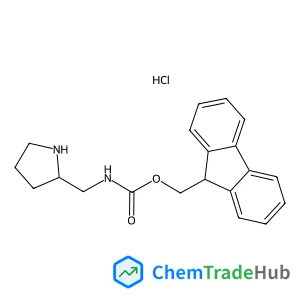
(S)-(9H-Fluoren-9-yl)methyl (pyrrolidin-2-ylmethyl)carbamate hydrochloride
CAS号:
1217813-15-4
分子式:
C20H23ClN2O2
![2-(7,7-Difluorobicyclo[4.1.0]hept-1-yl)ethanamine structure](https://cnstatic.chemtradehub.com/structs/209/2098065-08-6-ff24.webp "2-(7,7-Difluorobicyclo[4.1.0]hept-1-yl)ethanamine structure")
推荐供应商


免责声明
本页面提供的学术期刊信息仅供参考和研究使用。我们与任何期刊出版商均无关联,也不处理投稿事宜。如有投稿相关咨询,请直接联系相关期刊出版商。
如发现页面信息有误,请发送邮件至 support@chemtradehub.com 联系我们。我们将及时核实并处理您的问题。