





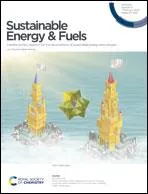
Design and optimization of a maglev electromagnetic–triboelectric hybrid energy converter for supplying power to intelligent sensing equipment
文献信息
发布日期
2022-01-11
DOI
10.1039/D1SE01582F
影响因子
6.367
作者
Fankai Kong, Songyan Yin, Chongfei Sun, Chunhui Yang, Hailong Chen, Hengxu Liu
查看原文
摘要
With the rapid development of the Internet of Things (IoT), there is a growing demand for electric energy in intelligent sensing equipment. Current smart sensors are mostly powered by lithium batteries, and it is necessary to develop a new self-powered device that can replace traditional lithium batteries. This paper designs a maglev electromagnetic–triboelectric hybrid energy converter (METHEC) containing both a triboelectric nanogenerator (TENG) and an electromagnetic generator (EMG), which can effectively collect low-frequency vibrational energy. This paper presents a complete device design and optimization system based on theoretical calculation and simulation verification, and establishes a test platform capable of evaluating the dynamic characteristics of METHEC and thus conducts some experiments for validation. In the past, the TENG related to vertical vibration only possessed the test part, and the current was less than 1 μA, with the power still less than 1 mW even with a large triboelectric area. Additionally, there is no complete research system for devices that utilize vertical vibration. The traditional EMG has a large starting torque, a large volume and can only be applied to higher frequencies, which is not convenient for wide application, and the power rarely exceeds 100 mW. According to this study, excited by the vibrational motion at a frequency of 5.2 Hz, the open-circuit voltages of TENG and EMG are 7.5 V and 9 V, respectively; the short-circuit currents of TENG and EMG are 1.1 μA and 87.7 mA, respectively; and the maximum power density of TENG reaches 7.5 mW m−2, while the peak power of EMG reaches 789.3 mW. This paper provides a complete set of innovative exploration systems combining theory, experiment and simulation optimization, which also includes the structural optimization of TENG. METHEC does not require a large starting torque and can also be adapted to low frequencies, and can thus be adapted to more environments. Compared with traditional EMG, METHEC makes it easier to realize the miniaturization of power generation equipment, and according to this research system, other models can be studied expansively.
相关文献
Cu-Catalyzed four-component polymerization of alkynes, sulfonyl azides, nucleophiles and electrophiles
Junnan He, Nan Zheng, Ming Li, YuBin Zheng, Wangze Song
2021-07-07
Paper
DOI: 10.1039/D1PY00650A
Synthesis of ethylene–norbornene–1-octene terpolymers with high 1-octene contents, molar masses, and tunable Tg values, in high yields using half-titanocene catalysts
Laura Boggioni, Hitoshi Harakawa, Simona Losio, Kotohiro Nomura, Incoronata Tritto
2021-07-02
Paper
DOI: 10.1039/D1PY00647A
Photophysics on surfaces: Absorption and luminescence properties of Pheophorbide-a on cellulose
M. Gabriela Lagorio, Enrique San Román, André Zeug, Jörg Zimmermann, Beate Röder
2001-03-19
Paper
DOI: 10.1039/B100077M
Structural refinement of the perfluorooctanesulfonate anion and its graphite intercalation compounds
Paper
DOI: 10.1039/A906986K
Equilibrium adsorption of linear and branched C6 alkanes on silicalite-1 studied by the tapered element oscillating microbalance
W. Zhu, F. Kapteijn, B. van der Linden, J. A. Moulijn
2001-03-22
Paper
DOI: 10.1039/B100941I
Solution self-assembly of fluorinated polymers, an overview
Marc Guerre, Gérald Lopez, Bruno Améduri, Mona Semsarilar, Vincent Ladmiral
2021-05-25
Review Article
DOI: 10.1039/D1PY00221J
您可能还喜欢
化合物问答
2-Bromo-4-chloro-1-(difluoromethyl)benzene(CAS号:1261476-50-9)的市场或研究趋势如何?
随着环保要求的提高和安全意识的增强,该化合物的研究和应用趋势正逐渐转向更安全、更环境友好的替代品。市场关注点主要集中在开发新型合成方法和绿色化学路径,以减少有害...
1261476-50-92-Bromo-4-chloro-1-(...
化合物问答
如何处理含有2,9 - 二苯基-1,10 - 菲罗啉(CAS号:25677-69-4)的废料?
处理含有2,9 - 二苯基 - 1,10 - 菲罗啉的废料时,应先将其收集在适当的容器中,避免与其他化学品混合。随后,可以通过水解或氧化等方法进行处理,直至达到...
25677-69-42,9-Diphenyl-1,10-ph...
化合物问答
处理(6-氯-吡嗪-3-基)-(4-乙基-哌嗪-1-基)-甲酮(CAS号:1178836-15-1)时应注意哪些实验室安全事项?
处理(6-氯-吡嗪-3-基)-(4-乙基-哌嗪-1-基)-甲酮时,应穿戴适当的个人防护装备(PPE),包括手套、护目镜和实验室外套。在通风橱中操作以确保良好的通...
1178836-15-1(6-Chloro-3-pyridazi...
化合物问答
处理(R)-2-氯-1-(2,4-二氯苯基)乙醇(CAS号:114446-57-0)时应注意哪些实验室安全事项?
在处理(R)-2-氯-1-(2,4-二氯苯基)乙醇时,应佩戴防护眼镜、实验室外套和手套,确保通风橱开启以减少接触和吸入的风险。避免直接接触皮肤和眼睛。处理过程中...
114446-57-0(1R)-2-Chloro-1-(2,4...
化合物问答
在合成中是否有3-氯-6-(3-氯哌啶-1-基)吡嗪(CAS号:1185310-37-5)的替代品?
可考虑使用类似结构的化合物作为替代品,如3-氯-6-(哌啶-1-基)吡嗪或3-氯-6-(2-氯哌啶-1-基)吡嗪,这些化合物在结构上与目标化合物相似,可能具有相...
1185310-37-53-Chloro-6-(3-chloro...
化合物问答
苯并三氮唑-5-甲酸乙酯(CAS号:73605-91-1)通常如何合成?
该化合物可以通过乙酸乙酯与5-溴-1H-苯并三氮唑的反应合成,通常在无水条件下进行。合成过程中,需要使用适当的溶剂如乙酸乙酯,并在适当的温度下反应。该反应具有较...
73605-91-1Ethyl 1H-benzotriazo...
化合物问答
什么是一水硫酸镁(CAS号:14168-73-1)?
一水硫酸镁是一种无机化合物,化学式为MgSO₄·H₂O,CAS号为14168-73-1。它由镁离子、硫酸根离子和一个结晶水分子组成,通常呈现为白色粉末或颗粒状固...
14168-73-1Magnesium sulfate hy...
化合物问答
氘代-1,3-二氯-2-丙醇(CAS号:1173020-20-6)应用于哪些行业?
氘代-1,3-二氯-2-丙醇主要应用于医药和有机合成领域,作为研究化合物的氘代替代品,用于标记和追踪反应过程。此外,在聚合物和半导体生产中也有一定的应用潜力。
1173020-20-61,3-Dichloro-2-(~2~H...
化合物问答
如何储存氰乙酸环己酯(CAS号:52688-11-6)?
氰乙酸环己酯应储存在阴凉、干燥、通风良好的环境中,远离火源和热源,防止阳光直射。储存容器应密封良好,避免与空气接触,防止发生不必要的反应。
52688-11-6Cyclohexyl cyanoacet...
化合物问答
2-碘-4-硝基苯胺(CAS号:6293-83-0)的市场或研究趋势如何?
目前,2-碘-4-硝基苯胺在医药和农药领域有一定的研究和应用,尤其是在开发新型药物和农药产品方面。然而,由于其潜在的环境和健康风险,行业正趋向于寻找更为安全和环...
6293-83-02-iodo-4-nitroanilin...
来源期刊
推荐化合物
推荐供应商


免责声明
本页面提供的学术期刊信息仅供参考和研究使用。我们与任何期刊出版商均无关联,也不处理投稿事宜。如有投稿相关咨询,请直接联系相关期刊出版商。
如发现页面信息有误,请发送邮件至 support@chemtradehub.com 联系我们。我们将及时核实并处理您的问题。