







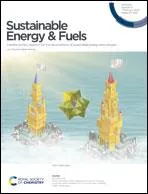
Enhancing CO2 photoreduction over ZIF-based reticular materials by morphology control of Au plasmonic nanoparticles
文献信息
发布日期
2021-12-06
DOI
10.1039/D1SE01890F
影响因子
6.367
作者
Jorge Becerra, Vishnu Nair Gopalakrishnan, Toan-Anh Quach, Trong-On Do
查看原文
摘要
Zeolitic imidazolate frameworks (ZIFs) are promising photocatalysts for CO2 reduction due to their appropriate energy band structure and crystalline properties. However, CO2 conversion is still low due to serious electron/hole recombination on these materials. In this work, the decoration of ZIF-67 with Au plasmonic nanotriangles and nanorods is studied as a strategy to improve catalytic performance during CO2 photoreduction under visible light irradiation. The introduction of Au nanoparticles on ZIF-67 based photocatalysts favors both the activity and selectivity of photocatalysts due to the injection of energetic electrons into the surface of the ZIF derived from the plasmonic response. Besides, Au nanorods promote methanol production, achieving an overall yield of 3.16 mmol gcat−1 h−1; meanwhile Au nanotriangles contribute to ethanol production, achieving an apparent quantum yield of 7.4% at 420 nm, and these yields are 35% higher in comparison with Au nanospheres. The high localized surface plasmon resonance on the edges of rod- and triangle-nanostructure favors the minimization of the recombination of electron–hole pairs during CO2 photoreduction. Therefore, our results revealed that the morphology control of Au plasmonic nanoparticles has a significant impact on the selectivity and activity of Au@ZIF-67 catalysts, which could be a starting point to develop efficient reticular materials for CO2 photoreduction.
相关文献
The elusive phosphorescence of pyrromethene–BF2 dyes revealed in new multicomponent species containing Ru(ii)–terpyridine subunits
Maurilio Galletta, Sebastiano Campagna, Manuel Quesada, Gilles Ulrich, Raymond Ziessel
2005-07-26
Communication
DOI: 10.1039/B507196H
Allosteric pitch length tuning of a dinuclear double helicate
Christian J. Baylies, John C. Jeffery, Tom A. Miller, Ryan Moon, Craig R. Rice, T. Riis-Johannessen
2005-07-21
Communication
DOI: 10.1039/B506199G
The synthesis of enantiomerically pure 4-substituted [2.2]paracyclophane derivatives by sulfoxide–metal exchange
Peter B. Hitchcock, Gareth J. Rowlands, Rakesh Parmar
2005-07-25
Communication
DOI: 10.1039/B507394D
Immobilization of ionic liquid with polyelectrolyte as carrier
Yanfei Shen, Yuanjian Zhang, Qixian Zhang, Tianyan You, Ari Ivaska
2005-07-20
Communication
DOI: 10.1039/B507688A
Layer-by-layer assembly of charged poly(phenylacetylene)s with induced macromolecular helicity
Katsuhiro Maeda, Yasuaki Matsushita, Muneyoshi Ezaka
2005-07-26
Communication
DOI: 10.1039/B507863F
Palladium(0) alkyne complexes as active species: a DFT investigation
Mårten Ahlquist, Giancarlo Fabrizi, Sandro Cacchi, Per-Ola Norrby
2005-07-20
Communication
DOI: 10.1039/B507784B
PNA C–C+i-motif: superior stability of PNA TC8 tetraplexes compared to DNA TC8 tetraplexes at low pH
Nagendra K. Sharma, Krishna N. Ganesh
2005-07-13
Communication
DOI: 10.1039/B506870C
Microporous organic crystals: an unusual case for l-leucyl–l-serine
Carl Henrik Görbitz, Mette Nilsen, Kai Szeto, Linda Wibecke Tangen
2005-07-28
Communication
DOI: 10.1039/B504976H
Effects of nanoconfinement on the morphology and reactivity of organic materials
2005-07-19
Feature Article
DOI: 10.1039/B502849N
您可能还喜欢
化合物问答
4-[[6-(3-苯基苯基)-7H-嘌呤-2-基]氨基]苯磺酰胺(CAS号:2079895-42-2)适用哪些法规指南?
该化合物需遵循REACH法规以确保其安全使用和管理。同时,根据其潜在的生物降解性和毒性,也需要符合GHS分类中的相应要求。此外,若用于医药或食品相关领域,则还需...
2079895-42-24-{[6-(3-Biphenylyl)...
化合物问答
反式-度骨化醇(CAS号:74007-20-8)的物理化学性质是什么?
反式-度骨化醇是一种脂溶性维生素D3的衍生物,呈无色或白色结晶性粉末,不溶于水,溶于乙醇、丙酮、氯仿等有机溶剂。其分子式为C28H44O,分子量为404.65。...
74007-20-8trans-Doxercalcifero...
化合物问答
莲花掌苷(CAS号:59282-56-3)的市场或研究趋势如何?
莲花掌苷作为一种天然产物,近年来在抗炎、抗癌等生物活性研究方面显示出一定的潜力,因此市场需求逐渐增长。市场动态方面,随着天然产物开发的深入,预计该化合物的研究会...
59282-56-3Lindleyin
化合物问答
2-溴-6-(吡咯烷-1-基)吡啶-4-硼酸频那醇酯(CAS号:1150271-64-9)应用于哪些行业?
2-溴-6-(吡咯烷-1-基)吡啶-4-硼酸频那醇酯在医药领域有着广泛的应用,它可以用作药物合成中的中间体。此外,它还可以用于有机合成,特别是在构建复杂杂环化合...
1150271-64-92-Bromo-6-(1-pyrroli...
化合物问答
什么是methyl 2-(4-bromophenyl)-3-methylbutanoate(CAS号:1061284-70-5)?
methyl 2-(4-溴苯基)-3-甲基丁酸甲酯是一种化学物质,分子式为C12H13BrO2。它是一种有机化合物,具有一定的挥发性和易燃性。
1061284-70-52-(4-Bromo-phenyl)-3...
化合物问答
CJC1-295(CAS号:863288-34-0)的物理化学性质是什么?
CJC1-295是一种具有复杂肽链结构的化合物,其分子量约为1875 Da。该化合物在水中具有一定的溶解性,但在有机溶剂中的溶解性不佳。它是一种反应活性化合物,...
863288-34-0L-tyrosyl-D-alanyl-L...
化合物问答
三正丁基锍碘(CAS号:18146-62-8)的市场或研究趋势如何?
三正丁基锍碘作为一种重要的有机硫化合物,主要用于有机合成中作为亲电试剂。近年来,由于其在合成中的广泛应用,市场对其需求持续增长。此外,随着绿色化学的发展,对其替...
18146-62-8Tributylsulfonium io...
化合物问答
雌二醇-[13C3]同位素内标(CAS号:1261254-48-1)通常如何合成?
雌二醇-[13C3]同位素内标通常通过在雌二醇分子中引入[13C3]同位素来合成。常见的方法是通过化学标记反应,如与[13C3]标记的甲基溴化物进行亲核取代反应...
1261254-48-117beta-Estradiol-2,3...
化合物问答
N1-(2-吡啶甲基)-N2-(2-甲基-1-萘基)草酰胺(CAS号:2611225-93-3)的物理化学性质是什么?
N1-(2-吡啶甲基)-N2-(2-甲基-1-萘基)草酰胺为固体化合物,具有良好的结晶形态,分子量为340.34 g/mol。该化合物在水中的溶解度较低,但在有...
2611225-93-3N-(2-Methyl-1-naphth...
化合物问答
如何处理含有十五碳烯酸甲酯(顺-10)(C15:1)标准品(CAS号:90176-52-6)的废料?
含有十五碳烯酸甲酯(顺-10)(C15:1)标准品的废料应首先进行适当收集和储存,避免与其他化学品混合。然后,可采用焚烧或交由专业废物处理公司进行处理。处理过程...
90176-52-6(Z)-10-Pentadecenoic...
来源期刊
推荐化合物
推荐供应商






免责声明
本页面提供的学术期刊信息仅供参考和研究使用。我们与任何期刊出版商均无关联,也不处理投稿事宜。如有投稿相关咨询,请直接联系相关期刊出版商。
如发现页面信息有误,请发送邮件至 support@chemtradehub.com 联系我们。我们将及时核实并处理您的问题。