




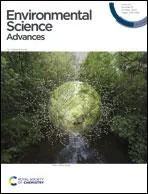
What do we know about the production and release of persistent organic pollutants in the global environment?
文献信息
发布日期
2022-10-26
DOI
10.1039/D2VA00145D
影响因子
0
作者
Li Li, Chengkang Chen, Dingsheng Li, Golnoush Abbasi
查看原文
摘要
Information on the global production and environmental releases of persistent organic pollutants (POPs) is of critical importance for regulating and eliminating these chemical substances of worldwide environmental and health concerns. Here, we conduct an extensive literature review to collect and curate quantitative information on the historical global production and multimedia environmental releases of 25 intentionally produced POPs. Our assembled data indicate that as of 2020, a cumulative total of 31 306 kilotonnes (kt) of the 25 POPs had been synthesized and commercialized worldwide, resulting in cumulative releases of 20 348 kt into the global environment. As of 2020, short-chain chlorinated paraffins were the most produced POP, with a historical global cumulative tonnage amounting to 8795 kt, whereas α-hexachlorocyclohexane (HCH) had the largest historical global cumulative environmental releases of 6567 kt among these 25 POPs. The 1970s witnessed the peak in the annual global production of the 25 investigated POPs. The United States and Europe used to be the hotspots of environmental releases of the 25 investigated POPs, notably in the 1960s and 1970s. By contrast, global environmental releases occurred primarily in China in the 2000s–2010s. Preliminary efforts are also made to integrate the production volume information with “hazard” attributes (persistence, bioaccumulation, toxicity, and long-range transport potential) in the evaluation of potential environmental impacts of the 25 POPs. The results show that dichlorodiphenyltrichloroethane (DDT) and polychlorinated biphenyls (PCBs) are potentially associated with higher environmental impacts than other POPs because they are among the top rankings in both the global cumulative production and hazard indicators. This work for the first time reveals the astonishing magnitudes of POP production and environmental releases in contemporary human history. It also underscores the importance of tonnage information in assessments of POPs, POP candidates, and other chemicals of emerging concern.
相关文献
Defect-induced semiconductor to metal transition in graphene monoxide
Jungwook Woo, Kyung-Han Yun, Sung Beom Cho, Yong-Chae Chung
2014-05-20
Paper
DOI: 10.1039/C4CP01518E
Astrochemistry of transition metals? The selected cases of [FeN]+, [FeNH]+ and [(CO)2FeN]+: pathways toward CH3NH2 and HNCO
2014-09-18
Paper
DOI: 10.1039/C4CP03218G
Complexation mechanism of cucurbit[6]uril with hexamethylene diammonium cations in saline solution
2014-10-06
Communication
DOI: 10.1039/C4CP04200J
Panchromatic symmetrical squaraines: a step forward in the molecular engineering of low cost blue-greenish sensitizers for dye-sensitized solar cells
J. Park, R. Borrelli, J.-H. Yum, D. Di Censo, M. Grätzel, Md. K. Nazeeruddin, C. Barolo, G. Viscardi
2014-09-30
Communication
DOI: 10.1039/C4CP04345F
Correction: Strong enhancement of parity violation effects in chiral uranium compounds
Michael Wormit, Małgorzata Olejniczak, Anna-Lena Deppenmeier, Trond Saue, Peter Schwerdtfeger
2014-10-28
Correction
DOI: 10.1039/C4CP90164A
Performance of thermally-chargeable supercapacitors in different solvents
Hyuck Lim, Cang Zhao
2014-05-08
Paper
DOI: 10.1039/C4CP01610F
Effects of hydrogen bonding interactions on the redox potential and molecular vibrations of plastoquinone as studied using density functional theory calculations
Ryota Ashizawa, Takumi Noguchi
2013-12-24
Paper
DOI: 10.1039/C3CP54742F
Micropore engineering of carbonized porous aromatic framework (PAF-1) for supercapacitors application
Yanqiang Li, Soumyajit Roy, Teng Ben, Shixian Xu, Shilun Qiu
2014-04-10
Paper
DOI: 10.1039/C4CP00550C
Correction: A reduced radial potential energy function for the halogen bond and the hydrogen bond in complexes B⋯XY and B⋯HX, where X and Y are halogen atoms
2014-10-17
Correction
DOI: 10.1039/C4CP90149E
Theoretical simulation of reduction mechanism of graphene oxide in sodium hydroxide solution
Chu Chen, Weixin Kong, Hai-Ming Duan, Jun Zhang
2014-04-10
Paper
DOI: 10.1039/C4CP01031K
您可能还喜欢
化合物问答
4-[4-三氟甲基苯基]恶唑(CAS号:1126636-40-5)通常如何合成?
4-[4-三氟甲基苯基]恶唑通常通过将4-三氟甲基苯酚与异硫氰酸苯酯在有机溶剂中进行酯化反应合成。该反应可在无水条件下,使用适当的催化剂,如四丁基氢氧化铵,以提...
1126636-40-54-(4-(Trifluoromethy...
59729-32-71-[3-(Dimethylamino)...
化合物问答
RockPhos Pd G3(CAS号:2009020-38-4)通常如何合成?
RockPhos Pd G3 通常通过钯催化偶联反应合成,使用配体 (2'-Amino-2-biphenylyl)(methanesulfonato-kappa...
2009020-38-4(2'-Amino-2-biphenyl...
化合物问答
1-哌啶甲酰胺(CAS号:2158-03-4)的市场或研究趋势如何?
1-哌啶甲酰胺作为有机合成中的重要中间体,其市场需求主要受医药、农药、染料等行业推动。近年来,随着新药开发和绿色化学的发展,该化合物的研究趋势集中在开发更高效、...
2158-03-41-Piperidinecarboxam...
化合物问答
2-(二苯基膦基)乙胺(CAS号:4848-43-5)适用哪些法规指南?
2-(二苯基膦基)乙胺适用于多种法规指南,包括但不限于《全球化学品统一分类和标签制度》(GHS),欧盟《化学品注册、评估、授权和限制》法规(REACH),以及美...
4848-43-52-(Diphenylphosphino...
化合物问答
如何储存间苯二甲酸二烯丙酯(CAS号:1087-21-4)?
间苯二甲酸二烯丙酯应储存在阴凉、干燥、通风良好的地方,远离火源和热源。储存容器应密封,避免光照和高温。储存温度应控制在25℃以下,相对湿度应低于80%。避免与其...
1087-21-4Diallyl isophthalate
化合物问答
什么是间甲苯异硫代异氰酸酯(CAS号:621-30-7)?
间甲苯异硫代异氰酸酯是一种有机化合物,分子式为C7H7NO2S,具有刺激性气味。它是一种重要的有机合成中间体,在合成其他化合物时广泛应用。
621-30-71-Isothiocyanato-3-m...
化合物问答
在合成中是否有N-Boc-D-苯丙氨醇(CAS号:106454-69-7)的替代品?
在合成中,可以考虑使用N-Cbz-D-苯丙氨醇或N-Fmoc-D-苯丙氨醇作为替代品。这些化合物同样具有保护氨基的功能,且在合成过程中表现出良好的反应性能。
106454-69-72-Methyl-2-propanyl ...
化合物问答
3-羟甲基-2-氧异丙基吡啶(CAS号:954240-50-7)的主要用途是什么?
3-羟甲基-2-氧异丙基吡啶主要用于有机合成领域,可以作为合成其他药物、农药或精细化学品的中间体。此外,它还可能在实验室研究中作为特定反应的前体或溶剂。
954240-50-7(2-Isopropoxy-3-pyri...
化合物问答
6-氨基-9-甲基嘌呤(CAS号:700-00-5)应用于哪些行业?
6-氨基-9-甲基嘌呤目前主要应用于医药行业,作为某些药物的中间体。此外,它还可能用于聚合物、传感器和半导体的某些领域,作为功能性单体或掺杂剂。
700-00-59-Methyl-9H-purin-6-...
来源期刊
推荐化合物
![[2',6'-bis(propan-2-yloxy)-[1,1'-biphenyl]-3-yl]dicyclohexylphosphane structure](https://cnstatic.chemtradehub.com/structs/787/787618-22-8-dda2.webp "[2',6'-bis(propan-2-yloxy)-[1,1'-biphenyl]-3-yl]dicyclohexylphosphane structure")
[2',6'-bis(propan-2-yloxy)-[1,1'-biphenyl]-3-yl]dicyclohexylphosphane
CAS号:
787618-22-8
分子式:
C30H43O2P
推荐供应商






免责声明
本页面提供的学术期刊信息仅供参考和研究使用。我们与任何期刊出版商均无关联,也不处理投稿事宜。如有投稿相关咨询,请直接联系相关期刊出版商。
如发现页面信息有误,请发送邮件至 support@chemtradehub.com 联系我们。我们将及时核实并处理您的问题。