





Fluorescent covalent organic frameworks for environmental pollutant detection sensors and enrichment sorbents: a mini-review
文献信息
发布日期
2023-10-18
DOI
10.1039/D3AY01166F
影响因子
2.896
作者
Qiuyi Liu, Yulian Yang, Yuemeng Zou, Luchun Wang, Zhu Li, Mingyue Wang, Lingling Li, Meng Tian, Dandan Wang, Die Gao
查看原文
摘要
Covalent organic frameworks (COFs) are a class of porous crystalline materials based on organic building blocks containing light elements, such as C, H, O, N, and B, interconnected by covalent bonds. Because of their regular crystal structure, high porosity, stable mechanical structure, satisfactory specific surface area, easy functionalization, and high tunability, they have important applications in several fields. Currently, most of the established methods based on COFs can only be used for individual detection or adsorption of the target. Impressively, fluorescent COFs as a special member of the COF family are able to achieve highly selective and sensitive detection of target pollutants by fluorescence enhancement or quenching. The construction of a dual-functional platform for detection and adsorption based on fluorescent COFs can enable the simultaneous realization of visual monitoring and adsorption of target pollutants. Therefore, this paper reviews the research progress of fluorescent COFs as fluorescence sensors and adsorbents. First, the fluorescent COFs were classified according to the different bonding modes between the building blocks, and then the applications of fluorescent COF-based detection and adsorption bifunctional materials for various environmental contaminants were highlighted. Finally, the challenges and future application prospects of fluorescent COFs are discussed.
相关文献
Entropy in multiple equilibria, compounds with different sites
2018-11-03
Paper
DOI: 10.1039/C8CP04145H
Optical properties and charge distribution in rod-shape DNA–silver cluster emitters
Matías Berdakin
2018-08-15
Paper
DOI: 10.1039/C8CP03895C
Energy loss analysis in photoelectrochemical water splitting: a case study of hematite photoanodes
Zhiliang Wang, Miaoqiang Lyu, Peng Chen, Songcan Wang, Lianzhou Wang
2018-08-16
Paper
DOI: 10.1039/C8CP04021D
Why does 4-biphenyl carbonyl azide have ultra-short lived excited states? An ultrafast UV-vis spectroscopic and computational study
2018-11-06
Paper
DOI: 10.1039/C8CP05963B
Quantum-classical dynamics of the capture of neon atoms by superfluid helium nanodroplets
Miquel Blancafort-Jorquera, Arnau Vilà, Miguel González
2018-11-06
Paper
DOI: 10.1039/C8CP05140B
Protonation-induced molecular permeation at the oil/water interface in an electric field
2018-09-15
Paper
DOI: 10.1039/C8CP04028A
Charge polarization in partially lithiated single-walled carbon nanotubes
A. A. Makarova
2018-07-23
Paper
DOI: 10.1039/C8CP01510D
Water-mediated curvature change in graphene by single-walled carbon nanotubes
Hrushikesh M. Gade, Piyush P. Wanjari, Srihas V. V. Velpuri
2018-08-14
Paper
DOI: 10.1039/C8CP02394H
Structural analysis of the initial lithiation of NiO thin film electrodes
Guennadi Evmenenko, Timothy T. Fister, Fernando C. Castro, Byeongdu Lee, D. Bruce Buchholz, Vinayak P. Dravid, Paul Fenter
2019-04-05
Paper
DOI: 10.1039/C9CP01527B
您可能还喜欢
化合物问答
如何储存1,2-环己二酮环乙缩醛(CAS号:4746-96-7)?
1,2-环己二酮环乙缩醛应储存在阴凉、干燥、通风良好的地方,避免阳光直射。建议使用密封容器保存,并保持环境温度在室温范围内,远离火源和热源。
4746-96-71,4-Dioxaspiro[4.5]d...
化合物问答
Ecopladib(CAS号:381683-92-7)的市场或研究趋势如何?
Ecopladib作为一种新型的药物,主要应用于治疗高胆固醇等疾病。目前,市场和研究趋势显示,Ecopladib因其独特的药理作用而受到关注。随着对心血管疾病治...
381683-92-7Ecopladib
化合物问答
2,3-Dimethyl-3H-imidazo[4,5-c]pyridine(CAS号:52538-09-7)通常如何合成?
2,3-二甲基-3H-咪唑[4,5-c]吡啶通常通过咪唑和2,3-二甲基吡啶的缩合反应合成。具体来说,将咪唑和2,3-二甲基吡啶在适当的溶剂中进行加热或加压反应...
52538-09-72,3-Dimethyl-3H-imid...
化合物问答
2,3,4,5-tetrahydro-1H-3-苯并氮杂环;盐酸盐(CAS号:17379-01-0)的市场或研究趋势如何?
该化合物在药物化学和有机合成中有一定的应用。近年来,随着对新型药物化合物的需求增加,该化合物的研究趋势主要集中在探索其生物活性,尤其是其在神经系统疾病治疗中的潜...
17379-01-02,3,4,5-Tetrahydro-1...
68-90-6(2-Ethyl-1-benzofura...
化合物问答
如何储存盐酸甘氨酸丁酯(CAS号:13048-99-2)?
盐酸甘氨酸丁酯应储存在阴凉、干燥、通风良好的地方,避免阳光直射和高温环境,温度应控制在25℃以下。储存容器应密封,避免与空气中的水分和酸性物质接触,以防发生水解...
13048-99-2Butyl glycinate hydr...
化合物问答
什么是2-Iodo-N,N-dimethylbenzamide(CAS号:54616-46-5)?
2-碘-N,N-二甲基苯胺是一种有机化合物,化学名为2-Iodo-N,N-dimethylbenzamide。其分子式为C<sub>9</sub>H<sub>1...
54616-46-52-Iodo-N,N-dimethylb...
16817-90-6N-Cyclohexylglycinam...
化合物问答
5-溴-2-(4H-1,2,4-三唑-4-基)吡啶(CAS号:959240-99-4)的市场或研究趋势如何?
随着医药、农药和新材料领域的发展,该化合物作为关键中间体的应用日益增多。特别是在药物合成中,由于其独特的化学性质,可以用于合成多种药物分子。未来的研究趋势可能集...
959240-99-45-Bromo-2-(4H-1,2,4-...
化合物问答
2,4-二溴-6-三氟甲基嘧啶(CAS号:785778-00-9)通常如何合成?
2,4-二溴-6-三氟甲基嘧啶通常通过溴化反应合成。首先,将6-三氟甲基嘧啶与溴化剂(如液溴)在适当的溶剂(如二氯甲烷、四氢呋喃)中反应,加入适当的催化剂(如四...
785778-00-92,4-Dibromo-6-(trifl...
来源期刊
Analytical Methods
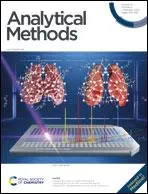
CiteScore:
5.1
自引率:
3.7%
年发文量:
655
Analytical Methods welcomes early applications of new analytical and bioanalytical methods and technology demonstrating the potential for societal impact. We require that methods and technology reported in the journal are sufficiently innovative, robust, accurate, and compared to other available methods for the intended application. Developments with interdisciplinary approaches are particularly welcome. Systems should be proven with suitably complex and analytically challenging samples. We encourage developments within, but not limited to, the following technologies and applications: global health, point-of-care and molecular diagnostics biosensors and bioengineering drug development and pharmaceutical analysis applied microfluidics and nanotechnology omics studies, such as proteomics, metabolomics or glycomics environmental, agricultural and food science neuroscience biochemical and clinical analysis forensic analysis industrial process and method development
推荐化合物

推荐供应商





免责声明
本页面提供的学术期刊信息仅供参考和研究使用。我们与任何期刊出版商均无关联,也不处理投稿事宜。如有投稿相关咨询,请直接联系相关期刊出版商。
如发现页面信息有误,请发送邮件至 support@chemtradehub.com 联系我们。我们将及时核实并处理您的问题。