




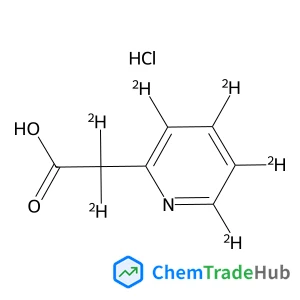
2,2-dideuterio-2-(3,4,5,6-tetradeuterio-2-pyridyl)acetic acid;hydrochloride
CAS号:
1329799-67-8
分子式:
C7H2ClD6NO2
Ju Hwa Lee, Yun Chang Pyun, Jonggyu Park, Tae Woong Kang, Jin Sol Seo, Dae Hoon Lee
Cartilage defects can be difficult to heal, potentially leading to complications such as osteoarthritis. Recently, a tissue engineering approach that uses scaffolds and growth factors has been proposed to regenerate new cartilage tissues. Herein, we investigated the application of hyaluronic acid (HA) gel loaded with transforming growth factor-beta 3 (TGF-β3) for enhanced cartilage regeneration. We assessed the clinical conditions required to efficiently enhance the ability of the modified HA gel to repair defective cartilage. Based on our findings, the prepared HA gel exhibited good physicochemical and mechanical properties and was non-toxic and non-inflammatory. Moreover, HA gel-loaded TGF-β3 (HAT) had improved biocompatibility and promoted the synthesis of cartilage-specific matrix and collagen, further improving its ability to repair defects. The application of HAT resulted in an initial burst release of HA, which degraded slowly in vivo. Finally, HAT combined with microfracture-inducing bone marrow stem cells could significantly improve the cartilage microenvironment and regeneration of cartilage defects. Our results indicate that HA is a suitable material for developing growth factor carriers, whereas HAT is a promising candidate for cartilage regeneration. Furthermore, this differentiated strategy provides a rapid and effective clinical approach for next-generation cartilage regeneration.
Tim K. Esser, Harald Knorke, Flavio Siro-Brigiano, Daria Ruth Galimberti, Knut R. Asmis, Marie-Pierre Gaigeot, James M. Lisy
DOI: 10.1039/C8CP06020G
Lin-Yan Feng, Peng-Fei Li, Hua-Jin Zhai
DOI: 10.1039/C8CP04332A
Sankar Ghorai, Pulak Naskar, Pinaki Chaudhury
DOI: 10.1039/C8CP03779E
Fuping Wang, Lang Chen, Deshen Geng, Jianying Lu, Junying Wu
DOI: 10.1039/C8CP03010C
Hrushikesh M. Gade, Piyush P. Wanjari, Srihas V. V. Velpuri
DOI: 10.1039/C8CP02394H
DOI: 10.1039/C8CP05517C
Jie Li, Yunrui Duan, Tao Li, Hui Li
DOI: 10.1039/C8CP03616K
Belisa R. H. de Aquino, H. Ghorbanfekr-Kalashami, M. Neek-Amal, F. M. Peeters
DOI: 10.1039/C9CP00075E
1,2-环己二酮环乙缩醛应储存在阴凉、干燥、通风良好的地方,避免阳光直射。建议使用密封容器保存,并保持环境温度在室温范围内,远离火源和热源。
Ecopladib作为一种新型的药物,主要应用于治疗高胆固醇等疾病。目前,市场和研究趋势显示,Ecopladib因其独特的药理作用而受到关注。随着对心血管疾病治...
2,3-二甲基-3H-咪唑[4,5-c]吡啶通常通过咪唑和2,3-二甲基吡啶的缩合反应合成。具体来说,将咪唑和2,3-二甲基吡啶在适当的溶剂中进行加热或加压反应...
该化合物在药物化学和有机合成中有一定的应用。近年来,随着对新型药物化合物的需求增加,该化合物的研究趋势主要集中在探索其生物活性,尤其是其在神经系统疾病治疗中的潜...
盐酸甘氨酸丁酯应储存在阴凉、干燥、通风良好的地方,避免阳光直射和高温环境,温度应控制在25℃以下。储存容器应密封,避免与空气中的水分和酸性物质接触,以防发生水解...
2-碘-N,N-二甲基苯胺是一种有机化合物,化学名为2-Iodo-N,N-dimethylbenzamide。其分子式为C<sub>9</sub>H<sub>1...
随着医药、农药和新材料领域的发展,该化合物作为关键中间体的应用日益增多。特别是在药物合成中,由于其独特的化学性质,可以用于合成多种药物分子。未来的研究趋势可能集...
2,4-二溴-6-三氟甲基嘧啶通常通过溴化反应合成。首先,将6-三氟甲基嘧啶与溴化剂(如液溴)在适当的溶剂(如二氯甲烷、四氢呋喃)中反应,加入适当的催化剂(如四...
Biomaterials Science is an international high impact journal exploring the science of biomaterials and their translation towards clinical use. Its scope encompasses new concepts in biomaterials design, studies into the interaction of biomaterials with the body, and the use of materials to answer fundamental biological questions. Papers do not necessarily need to report a new biomaterial but should provide novel insight into the biological applications of the biomaterial. Articles that primarily focus on demonstrating novel materials chemistry and bring a molecular picture to bear on a given material’s suitability as a biomaterial are more suited to our companion journal, Journal of Materials Chemistry B. Biomaterials Science publishes primary research and review-type articles in the following areas: molecular design of biomaterials, including translation of emerging chemistries to biomaterials science of cells and materials at the nanoscale and microscale materials as model systems for stem cell and human biology materials for tissue engineering and regenerative medicine (Nano)materials and (nano)systems for therapeutic delivery interactions at the biointerface biologically inspired and biomimetic materials, including bio-inspired self-assembly systems and cell-inspired synthetic tools next-generation biomaterials tools and methods
![(3R,5R)-1-[(Benzyloxy)carbonyl]-5-methyl-3-piperidinecarboxylic acid structure](https://cnstatic.chemtradehub.com/structs/126/1269757-29-0-c552.webp "(3R,5R)-1-[(Benzyloxy)carbonyl]-5-methyl-3-piperidinecarboxylic acid structure")
![(2E)-3-(3-Chlorophenyl)-N-{2-[4-(methylsulfonyl)-1-piperazinyl]-2-oxoethyl}acrylamide structure](https://cnstatic.chemtradehub.com/structs/250/2505001-54-5-c1e9.webp "(2E)-3-(3-Chlorophenyl)-N-{2-[4-(methylsulfonyl)-1-piperazinyl]-2-oxoethyl}acrylamide structure")