


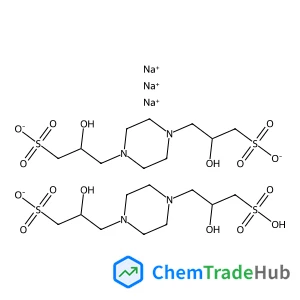
3,3'-(Piperazine-1,4-diyl)bis(2-hydroxypropane-1-sulfonic acid) Sodium Salt
CAS号:
108321-08-0
分子式:
C20H41N4Na3O16S4
Fei Tao, Qian Han, Peng Yang
The aggregation of proteins at interfaces has significant roles and can also lead to dysfunction of different physiological processes. The interfacial effects on the assembly and aggregation of biopolymers are not only crucial for a comprehensive understanding of protein biological functions, but also hold great potential for advancing the state-of-the-art applications of biopolymer materials. Recently, there has been remarkable progress in a collaborative context, as we strive to gain control over complex interfacial assembly structures of biopolymers. These biopolymer structures range from the nanoscale to mesoscale and even macroscale, and are attained through the rational design of interactions between biological building blocks and surfaces/interfaces. This review spotlights the recent advancements in interface-mediated assembly and properties of biopolymer materials. Initially, we introduce the solid–liquid interface (SIL)-mediated biopolymer assembly that includes the inorganic crystalline template effect and protein self-adoptive deposition through phase transition. Next, we display the advancement of biopolymer assembly instigated by the air–water interface (AWI) that acts as an energy conversion station. Lastly, we discuss succinctly the assembly of biopolymers at the liquid–liquid interface (LLI) along with their applications. It is our hope that this overview will stimulate the integration and progression of the science of interfacial assembled biopolymer materials and surfaces/interfaces.
Organic Process Research & Development

Current Opinion in Solid State & Materials Science

Chemical Communications
Journal of Saudi Chemical Society

Journal of Natural Medicines

Crystallography Reports
Russian Journal of Applied Chemistry

Chemistry Education Research and Practice

New Journal of Chemistry

Russian Journal of Coordination Chemistry
Yi Peng, Huan Zhang, Xiao-Wei Huang, Jian-Hua Huang, Meng-Bo Luo
DOI: 10.1039/C8CP05136D
Trevor C. Brown, David J. Miron, Christopher M. Fellows
DOI: 10.1039/C8CP06163G
Penggang Wang, Yuting Jia, Tao Li, Dongshuai Hou, Qi Zheng
DOI: 10.1039/C8CP02450B
Najoua Derbel, Ha Vinh Lam Nguyen, Halima Mouhib
DOI: 10.1039/C8CP04563A
Johannes Halle, Alexander Mehler, Nicolas Néel, Jörg Kröger
DOI: 10.1039/C8CP07569G
Yang Cai, Xiaoyi Liu, Xiaohu Yao
DOI: 10.1039/C8CP07477A
Haixia Zhang, Weiwei Liu, Zhenhua Zhang, Meifen Li, Bingshe Xu, Junjie Guo
DOI: 10.1039/C8CP03711F
Kyoko K. Tanaka, Yuki Kimura
DOI: 10.1039/C8CP06650G
该化合物适用的法规指南包括GHS(全球化学品统一分类和标签制度)分类为特定目标器官毒性-单次接触类别3;根据欧盟REACH法规,该化合物需要进行注册和评估;在美...
在合成中,可以考虑使用一些类似的化合物作为4-(4-氯苯基)-1H-咪唑的替代品,如4-(4-溴苯基)-1H-咪唑或4-(4-甲氧基苯基)-1H-咪唑。这些化合...
N~2~-甲基丙氨酸酰胺是一种有机化合物,其化学名为2-(Methylamino)propanamide。它是一种酰胺类化合物,分子式为C4H10N2O,相对分...
处理含有N-苄基-3-氨基氧杂环丁烷草酸盐(CAS号:1956341-96-0)的废料时,应首先确保遵循相关法规要求,如GHS和REACH等。通常,废液应先进行...
4-溴-2-氯-6-甲基苯甲酸是一种固体化合物,具有较高的熔点和较低的沸点。它的分子量为261.03 g/mol。该化合物在水中几乎不溶,在有机溶剂中溶解度适中...
该化合物通常通过缩合反应合成,典型的方法是将2,5-二氯嘧啶与N-甲基苯甲酰胺在碱性条件下进行偶联反应。常用的碱包括NaH、LDA等强碱。该合成路线具有较高的选...
3,5-二溴-4-甲基苯胺在某些合成路线中可能没有直接替代品。然而,在某些应用场景下,可以考虑使用其他类似结构的化合物如3,5-二溴-4-硝基苯胺或3,5-二碘...
2-氯喹啉-4-羧酸甲酯主要用于有机合成和药物合成领域,作为中间体或原料。它在合成某些药物和染料时具有重要作用。此外,该化合物还可能用于某些特定的化学研究中。
6-溴-8-氯咪唑[1,2-a]吡啶在操作过程中需要谨慎以确保安全。该化合物具有一定的毒性,吸入其蒸气或粉尘可能导致呼吸道刺激。处理时应佩戴适当的防护装备,如手...
ChemComm publishes urgent research which is of outstanding significance and interest to experts in the field, while also appealing to the journal’s broad chemistry readership. Our communication format is ideally suited to short, urgent studies that are of such importance that they require accelerated publication. Our scope covers all topics in chemistry, and research at the interface of chemistry and other disciplines (such as materials science, nanoscience, physics, engineering and biology) where there is a significant novelty in the chemistry aspects. Major topic areas covered include: Analytical Chemistry Catalysis Chemical Biology and medicinal chemistry Computational Chemistry and Machine Learning Energy and sustainable chemistry Environmental Chemistry Green Chemistry Inorganic Chemistry Materials Chemistry Nanoscience Organic Chemistry Physical Chemistry Polymer Chemistry Supramolecular Chemistry
![(3R)-3-(3-Fluorophenyl)-3-({[(2-methyl-2-propanyl)oxy]carbonyl}amino)propanoic acid structure](https://cnstatic.chemtradehub.com/structs/500/500789-04-8-20dd.webp "(3R)-3-(3-Fluorophenyl)-3-({[(2-methyl-2-propanyl)oxy]carbonyl}amino)propanoic acid structure")



