
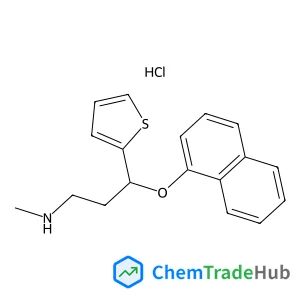
N-Methyl-3-(1-naphthyloxy)-3-(2-thienyl)-1-propanamine hydrochloride (1:1)
CAS号:
1188266-11-6
分子式:
C18H20ClNOS
Lin Li, Hang Li
The past decades have witnessed significant advancements in the growth of two-dimensional (2D) materials, offering a wide range of potential applications in the fields of electronics, optoelectronics, energy storage, sensors, catalysis, and biomedical treatments. Epitaxial heterostructures based on 2D materials, including vertical heterostructures, lateral structures, and superlattices, have emerged as novel material systems to manipulate the intrinsic properties and unlock new functionalities. Therefore, the development of controllable preparation methods for tailored epitaxial heterostructures serves as a fundamental basis for extensive property investigation and further application exploration. However, this pursuit presents formidable challenges due to the incomplete understanding of growth mechanisms and limited designable strategies. Chemical vapor deposition (CVD) is deemed as a promising and versatile platform for the controlled synthesis of 2D materials, especially with regard to achieving lattice matching, a critical factor in epitaxial growth. Consequently, CVD holds potential to overcome these hurdles. In this Feature Article, we present our recent breakthroughs in the controllable preparation of 2D epitaxial heterostructures using CVD. Our focus revolves around the processes of morphology engineering, interface engineering, size and density engineering, and striking the delicate balance between growth and etching. Using molten metals or alloys as primary catalysts, we have achieved remarkable control over the fabrication of graphene/hexagonal boron nitride (hBN) super-ordered arrays, enabled multistage etching of graphene/hBN heterostructures, and successfully realized the construction of graphene/MXene heterostructures. Furthermore, our research endeavors encompass both bottom-up and top-down fabrication methods, offering a novel perspective on the synthesis of 2D epitaxial heterostructures. The resulting products hold immense potential for enhancing the efficiency of critical reactions such as oxygen reduction, CO2 reduction, and hydrogen evolution reactions. By presenting our methodologies for obtaining 2D epitaxial heterostructures through CVD, we aspire to inspire fellow researchers in this field to devise more feasible and controllable fabrication techniques while also fostering the exploration of diverse heterostructure configurations. Together, these advancements will undoubtedly pave the way for further breakthroughs in atomic manufacturing and novel applications.
Ana Yañez-Aulestia, Yuhua Duan, Qiang Wang, Heriberto Pfeiffer
DOI: 10.1039/D1RE00319D
Jeffery A. Wood, Stefan Schlautmann, Han J. G. E. Gardeniers, Séverine Le Gac
DOI: 10.1039/D1RE00092F
Tanja Junkers, Sandy P. S. Koo, Christopher Barner-Kowollik
DOI: 10.1039/C0PY00019A
Qingteng Zhou, Kaijie Ni, Francesca M. Kerton
DOI: 10.1039/D1RE00111F
Julien Mahin, Christoph O. Franck, Luise Fanslau, Hirak K. Patra, Michael D. Mantle, Ljiljana Fruk, Laura Torrente-Murciano
DOI: 10.1039/D1RE00239B
Sankar Bhattacharya, Akkihebbal K. Suresh
DOI: 10.1039/D1RE00035G
Vedant Shah, Zhuo Cheng, Pinak Mohapatra, Liang-Shih Fan
DOI: 10.1039/D1RE00150G
Yongchun Zhong, Kam Sing Wong
DOI: 10.1039/C0PY00046A
Alex Kugel, Scott Ebert, Michael Jepperson, Laura Jarabek, Shane Stafslien
DOI: 10.1039/B9PY00309F
(5-氨基吡唑-3-基)乙酸是一种无色至白色固体,分子量为174.15 g/mol。它在水中具有较好的溶解性,在有机溶剂中的溶解度较低。该化合物具有较好的反应活...
3-氟-4,5-二氯苯胺受到多项法规指南的约束,包括但不限于GHS(全球化学品统一分类和标签制度)的危险分类标准、欧盟的REACH法规(注册、评估、授权和限制)...
这是一种有机化合物,化学名为(R)-(+)-2,2',6,6'-四甲氧基-4,4'-联(二(3,5-二甲苯基基)膦基)-3,3'-二联吡啶,CAS号为44290...
1-氨基-2-氰基萘在医药、聚合物、传感器和半导体等行业中有应用。在医药领域,它可用作中间体合成某些药物。在聚合物行业,它可以用于制备具有特定性能的聚合物。此外...
处理含1-溴-4-(异丙氧基甲基)苯的废料时,首先应确保废液收集在防渗漏的容器中,避免泄露。然后,可以考虑采用化学降解法或物理吸附法进行处理。在特定条件下,可通...
6-氯-8-三氟甲基-2,3-二氢-4H-色喃-4-酮主要用于有机合成中的中间体,也可作为研究试剂使用。
7-乙氧基-2-萘酚通常通过N-乙氧基化反应合成,首先将2-萘酚与乙醇钠在乙醇中反应生成7-乙氧基-2-萘酚钠盐,再通过酸化进一步得到7-乙氧基-2-萘酚。该合...
该化合物需遵循一系列的法规指南,包括但不限于GHS全球统一分类和标签制度,其分类可能包括易燃液体和可能危害水生环境。在欧洲,还需遵循REACH法规,确保物质和混...
4-甲氧基苄基叠氮甲酸酯是一种无色液体,具有一定的挥发性。其分子量为198.16,熔点为-69°C,沸点为105°C。该化合物在水中溶解度较低,在有机溶剂如乙醇...
含有4-氯-2-氟嘧啶的废料应按照危险废物处理。首先,应收集并分类这些废料,避免与其他废物混合。然后,可以采用焚烧处理或者交由专业机构进行处置。在处理过程中,需...

ChemComm publishes urgent research which is of outstanding significance and interest to experts in the field, while also appealing to the journal’s broad chemistry readership. Our communication format is ideally suited to short, urgent studies that are of such importance that they require accelerated publication. Our scope covers all topics in chemistry, and research at the interface of chemistry and other disciplines (such as materials science, nanoscience, physics, engineering and biology) where there is a significant novelty in the chemistry aspects. Major topic areas covered include: Analytical Chemistry Catalysis Chemical Biology and medicinal chemistry Computational Chemistry and Machine Learning Energy and sustainable chemistry Environmental Chemistry Green Chemistry Inorganic Chemistry Materials Chemistry Nanoscience Organic Chemistry Physical Chemistry Polymer Chemistry Supramolecular Chemistry