



Encapsulation of N-containing compounds in a new hydrophilic Cd-based crystalline sponge via coordinative alignment method
文献信息
发布日期
2023-08-11
DOI
10.1039/D3CE00592E
影响因子
3.545
作者
Faiza Habib, Derek A. Tocher, Claire J. Carmalt
查看原文
摘要
The crystalline sponge method (CSM) is a technology which allows precise molecular determination of non-crystalline compounds, without the need to crystallise them independently, by soaking them in a crystalline metal–organic framework (MOF). To expand the CSM to a wider range of guest molecules, the development of a new crystalline sponge is essential. In this study a new Cd-based MOF {[Cd7(4,4′4′′-[1,3,5-benzenetriyltris(carbonylimino)]-trisbenzoato)4(μ3-OH)2(H2O)4(DMF)4]·(solvent)x}n was synthesized and investigated as an alternative crystalline sponge (2). Sponge 2 demonstrated versatility in solvent stability compared to the well-studied [{(ZnI2)3(tris(4-pyridyl)-1,3,5-triazine)2·x(CHCl3)}n] (1) and was stable in the presence of polar aprotic, polar protic solvents and Lewis bases. Inclusion complexes with three solvents, acetonitrile, acetone, and isopropanol were prepared. These guest molecules were fixed in the pore via hydrogen bonding confirming the hydrophilic pore environment of sponge 2. Notably, sponge 2 also demonstrated the ability to accommodate N-containing compounds such as pyridine, 3,5-lutidine, and 4-aminopyridine via the coordinative alignment method (CAL). A study was conducted to compare the ability of sponge 2 and related pyridine containing sponge 3 by encapsulating the same pair of guests: N,N-dimethylaniline and propiophenone.
期刊推荐
相关文献
Sustainable, eco-friendly polyesters synthesized from renewable resources: preparation and thermal characteristics of poly(dimethyl-propylene furanoate)
Vasilios Tsanaktsis, Zoe Terzopoulou, Dimitrios N. Bikiaris, Dimitris S. Achilias, Dimitrios G. Papageorgiou, George Z. Papageorgiou
2015-10-05
Paper
DOI: 10.1039/C5PY01367D
ROS self-scavenging polythiophene materials for cell imaging
Rong Hu, Fengyan Wang, Shengliang Li, Chenyao Nie, Meng Li, Hui Chen, Libing Liu, Fengting Lv, Shu Wang
2015-10-01
Communication
DOI: 10.1039/C5PY01403D
pH-Responsive non-ionic diblock copolymers: protonation of a morpholine end-group induces an order–order transition
N. J. W. Penfold, J. R. Lovett, N. J. Warren, P. Verstraete, J. Smets, S. P. Armes
2015-10-13
Paper
DOI: 10.1039/C5PY01510C
Reductant-triggered rapid self-gelation and biological functionalization of hydrogels
Dawei Chen, Dongxia Wu, Guochen Cheng, Hanying Zhao
2015-10-05
Paper
DOI: 10.1039/C5PY01299F
Macro-RAFT agent mediated dispersion polymerization: the monomer concentration effect on the morphology of the in situ synthesized block copolymer nano-objects
Zhonglin Ding, Chengqiang Gao, Shuang Wang, Hui Liu, Wangqing Zhang
2015-09-25
Paper
DOI: 10.1039/C5PY01202C
The influence of surface grafting on the growth rate of polymer chains
Chengjun Kang, Rowena Crockett, Nicholas D. Spencer
2015-10-29
Paper
DOI: 10.1039/C5PY01521A
Saturated and stabilized white electroluminescence with simultaneous three-color emission from a six-armed star-shaped single-polymer system
Yuan-Da Jiu, Cheng-Fang Liu, Jian-Yun Wang, Yi Jiang, Wei-Dong Xu, Xin-Wen Zhang
2015-09-28
Paper
DOI: 10.1039/C5PY01480H
Classical photopolymerization kinetics, exceptional gelation, and improved diffraction efficiency and driving voltage in scaffolding morphological H-PDLCs afforded using a photoinitibitor
Guannan Chen, Mingli Ni, Yan Yan, Jiaqing Zhuang, V. A. L. Roy, Robert K. Y. Li
2015-10-26
Paper
DOI: 10.1039/C5PY01414J
Toughening of photo-curable polymer networks: a review
Martin Schwentenwein
2015-11-20
Review Article
DOI: 10.1039/C5PY01631B
Rheological behavior and molecular relaxation of polycations with macrocounterions in aqueous solutions
Shangguan Yonggang, Qiang Zheng
2015-10-12
Paper
DOI: 10.1039/C5PY01022E
您可能还喜欢
化合物问答
如何储存1,2-环己二酮环乙缩醛(CAS号:4746-96-7)?
1,2-环己二酮环乙缩醛应储存在阴凉、干燥、通风良好的地方,避免阳光直射。建议使用密封容器保存,并保持环境温度在室温范围内,远离火源和热源。
4746-96-71,4-Dioxaspiro[4.5]d...
化合物问答
Ecopladib(CAS号:381683-92-7)的市场或研究趋势如何?
Ecopladib作为一种新型的药物,主要应用于治疗高胆固醇等疾病。目前,市场和研究趋势显示,Ecopladib因其独特的药理作用而受到关注。随着对心血管疾病治...
381683-92-7Ecopladib
化合物问答
2,3-Dimethyl-3H-imidazo[4,5-c]pyridine(CAS号:52538-09-7)通常如何合成?
2,3-二甲基-3H-咪唑[4,5-c]吡啶通常通过咪唑和2,3-二甲基吡啶的缩合反应合成。具体来说,将咪唑和2,3-二甲基吡啶在适当的溶剂中进行加热或加压反应...
52538-09-72,3-Dimethyl-3H-imid...
化合物问答
2,3,4,5-tetrahydro-1H-3-苯并氮杂环;盐酸盐(CAS号:17379-01-0)的市场或研究趋势如何?
该化合物在药物化学和有机合成中有一定的应用。近年来,随着对新型药物化合物的需求增加,该化合物的研究趋势主要集中在探索其生物活性,尤其是其在神经系统疾病治疗中的潜...
17379-01-02,3,4,5-Tetrahydro-1...
68-90-6(2-Ethyl-1-benzofura...
化合物问答
如何储存盐酸甘氨酸丁酯(CAS号:13048-99-2)?
盐酸甘氨酸丁酯应储存在阴凉、干燥、通风良好的地方,避免阳光直射和高温环境,温度应控制在25℃以下。储存容器应密封,避免与空气中的水分和酸性物质接触,以防发生水解...
13048-99-2Butyl glycinate hydr...
化合物问答
什么是2-Iodo-N,N-dimethylbenzamide(CAS号:54616-46-5)?
2-碘-N,N-二甲基苯胺是一种有机化合物,化学名为2-Iodo-N,N-dimethylbenzamide。其分子式为C<sub>9</sub>H<sub>1...
54616-46-52-Iodo-N,N-dimethylb...
16817-90-6N-Cyclohexylglycinam...
化合物问答
5-溴-2-(4H-1,2,4-三唑-4-基)吡啶(CAS号:959240-99-4)的市场或研究趋势如何?
随着医药、农药和新材料领域的发展,该化合物作为关键中间体的应用日益增多。特别是在药物合成中,由于其独特的化学性质,可以用于合成多种药物分子。未来的研究趋势可能集...
959240-99-45-Bromo-2-(4H-1,2,4-...
化合物问答
2,4-二溴-6-三氟甲基嘧啶(CAS号:785778-00-9)通常如何合成?
2,4-二溴-6-三氟甲基嘧啶通常通过溴化反应合成。首先,将6-三氟甲基嘧啶与溴化剂(如液溴)在适当的溶剂(如二氯甲烷、四氢呋喃)中反应,加入适当的催化剂(如四...
785778-00-92,4-Dibromo-6-(trifl...
来源期刊
CrystEngComm

CiteScore:
5.5
自引率:
7.7%
年发文量:
643
CrystEngComm is the forum for the design and understanding of crystalline materials. We welcome studies on the investigation of molecular behaviour within crystals, control of nucleation and crystal growth, engineering of crystal structures, and construction of crystalline materials with tuneable properties and functions. We publish hypothesis-driven research into… how crystal design affects thermodynamics, phase transitional behaviours, polymorphism, morphology control, solid state reactivity (crystal-crystal solution-crystal, and gas-crystal reactions), optoelectronics, ferroelectric materials, non-linear optics, molecular and bulk magnetism, conductivity and quantum computing, catalysis, absorption and desorption, and mechanical properties. Using Techniques and methods including… Single crystal and powder X-ray, electron, and neutron diffraction, solid-state spectroscopy, spectrometry, and microscopy, modelling and data mining, and empirical, semi-empirical and ab-initio theoretical evaluations. On crystalline and solid-state materials. We particularly welcome work on MOFs, coordination polymers, nanocrystals, host-guest and multi-component molecular materials. We also accept work on peptides and liquid crystals. All papers should involve the use or development of a design or optimisation strategy. Routine structural reports or crystal morphology descriptions, even when combined with an analysis of properties or potential applications, are generally considered to be outside the scope of the journal and are unlikely to be accepted.
推荐化合物
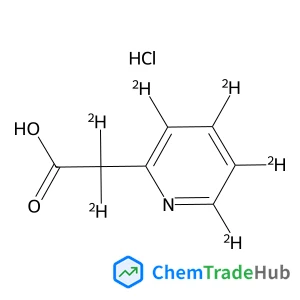
2,2-dideuterio-2-(3,4,5,6-tetradeuterio-2-pyridyl)acetic acid;hydrochloride
CAS号:
1329799-67-8
分子式:
C7H2ClD6NO2
推荐供应商






免责声明
本页面提供的学术期刊信息仅供参考和研究使用。我们与任何期刊出版商均无关联,也不处理投稿事宜。如有投稿相关咨询,请直接联系相关期刊出版商。
如发现页面信息有误,请发送邮件至 support@chemtradehub.com 联系我们。我们将及时核实并处理您的问题。