





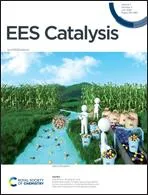
Single atom catalysts for water electrolysis: from catalyst-coated substrate to catalyst-coated membrane
文献信息
发布日期
2023-10-05
DOI
10.1039/D3EY00165B
影响因子
0
作者
Sun Hwa Park, Ki Chang Kwon, Jong Hun Kang, Min Sang Kwon
查看原文
摘要
Green hydrogen production through water electrolysis is considered the next-generation technology capable of industrial-scale hydrogen production to achieve carbon neutrality. The core of constructing a water electrolyzer lies in designing the membrane electrode assembly (MEA) with optimal integration of the membrane, electrocatalysts, and gas diffusion layer. Among the two representative MEA fabrication methods, catalyst-coated substrates (CCS) and catalyst-coated membranes (CCM), CCM shows great promise due to its catalyst layer/membrane interface contact and scalability. The key factor in the CCM method is the effective application of the powdered catalyst onto the membrane. In this respect, the utilization of single-atom catalysts (SACs) has emerged as a noteworthy focus due to their unprecedented catalytic activity resulting from unique electronic/atomic configurations and high atomic utilization efficiency. Incorporating SACs into CCM–MEA has the potential to be a cutting-edge water electrolysis technology. However, it is still in its infancy due to the instability of the components (SACs, membranes, ionomers, supports) and degradation during the SACs–CCM–MEA fabrication and cell operation. Herein, we outline the representative fabrication method of MEA and provide a comprehensive analysis of SACs applicable to MEA. Then, we discuss the advantages of SACs–CCM–MEA and the challenges for industrial hydrogen production. Finally, this review concludes with future perspectives on the development of single-atom catalyst-coated membranes and the expected achievements.
相关文献
Degradability, thermal stability, and high thermal properties in spiro polycycloacetals partially derived from lignin
Minjie Shen, Srikanth Vijjamarri, Hongda Cao, Karla Solis
2021-10-05
Paper
DOI: 10.1039/D1PY01017D
Design, synthesis and characterization of fused bithiazole- and dithiophene-based low bandgap thienylenevinylene copolymers
Dhananjaya Patra, Marc Comí, Xianhe Zhang, Gururaj P. Kini, Malsha Udayakantha, Alexander J. Kalin, Sarbajit Banerjee, Lei Fang, Xugang Guo, Mohammed Al-Hashimi
2021-09-30
Paper
DOI: 10.1039/D1PY00773D
Supramolecular dendrimer-containing layer-by-layer nanoassemblies for bioapplications: current status and future prospects
Cristiana F. V. Sousa, Eduardo Fernandez-Megia, João Borges, João F. Mano
2021-10-05
Review Article
DOI: 10.1039/D1PY00988E
One-pot synthesis and aqueous solution properties of pH-responsive schizophrenic diblock copolymer nanoparticles prepared via RAFT aqueous dispersion polymerization
S. M. North, S. P. Armes
2021-09-29
Paper
DOI: 10.1039/D1PY01114F
Fully amorphous atactic and isotactic block copolymers and their self-assembly into nano- and microscopic vesicles
Riccardo Wehr, Elena C. dos Santos, Moritz S. Muthwill, Vittoria Chimisso, Wolfgang Meier
2021-09-06
Paper
DOI: 10.1039/D1PY00952D
Catalyst-free room-temperature self-healing polymer networks based on dynamic covalent quinone methide-secondary amine chemistry
Ying Wu
2021-09-29
Paper
DOI: 10.1039/D1PY00957E
Facile fabrication of robust gel poly(ionic liquid) electrolytes via base treatment at room temperature
Chongrui Zhang, Yong Zhang, Qiang Zhao, Zhigang Xue
2021-09-13
Paper
DOI: 10.1039/D1PY00736J
您可能还喜欢
化合物问答
什么是5-Fluoro-4-iodo-2-methylaniline(CAS号:307306-08-7)?
5-氟-4-碘-2-甲氨基苯属于芳香族化合物,其分子式为C8H7FN2I。该化合物具有一定的反应活性,在有机合成和药物化学领域有一定的应用。
307306-08-75-Fluoro-4-iodo-2-me...
化合物问答
4-氟-3-硝基三氟甲苯(CAS号:367-86-2)通常如何合成?
4-氟-3-硝基三氟甲苯通常通过将三氟甲基苯在酸性条件下催化氧化为三氟甲基硝基苯,然后进行氟化反应得到目标化合物。该过程需要使用催化剂,如三氟乙酸,反应产率较高...
367-86-21-Fluoro-2-nitro-4-(...
化合物问答
6-氯-9-(2,3,5-三苯甲酰氧基-2-C-甲基-beta-D-呋喃核糖基)-9H-嘌呤(CAS号:205171-05-7)的物理化学性质是什么?
该化合物为白色至类白色晶体,分子量约为1046.95。它在水中几乎不溶,在有机溶剂如乙腈和甲醇中具有一定的溶解性。该化合物具有良好的化学稳定性和生物活性。
205171-05-76-Chloro-9-(2-C-meth...
化合物问答
如何储存6-氟喹啉-4-羧酸(CAS号:220844-73-5)?
6-氟喹啉-4-羧酸应储存在阴凉、干燥、通风良好的地方,避免阳光直射。储存在密闭容器中,避免与空气中的水分接触。储存温度应控制在室温以下,避免高温。
220844-73-56-Fluoroquinoline-4-...
化合物问答
(2S,2'S,3S,3'S)-3,3'-di-tert-butyl-4,4'-bis(2,6-dimethoxyphenyl)-2,2',3,3'-tetrahydro-2,2'-bibenzo[d][1,3]oxaphosphole(CAS号:1435940-21-8)通常如何合成?
该化合物通常通过芳香族化合物的亲核取代反应合成,首先将2,6-二甲氧基苯基引入到双环结构中,然后通过特定条件下的还原或氧化反应引入二叔丁基。反应过程中使用了钯作...
1435940-21-8(2S,2'S,3S,3'S)-4,4'...
化合物问答
如何储存KY02111(CAS号:1118807-13-8)?
KY02111应储存于阴凉、干燥、通风良好的地方,避免阳光直射和高温环境。应使用合适的密闭容器储存,并确保容器密封良好,防止水分和潮气进入。在储存期间,应注意检...
1118807-13-8N-(6-chlorobenzo[d]t...
化合物问答
如何储存4-(4-氯苯氧基)丁酸乙酯(CAS号:59227-79-1)?
4-(4-氯苯氧基)丁酸乙酯应储存在阴凉、干燥、通风良好的地方,远离火源和热源。避免阳光直射,防止容器破裂导致泄漏。储存时应保持容器密封,避免与空气中的水蒸气接...
59227-79-1Ethyl 4-(4-chlorophe...
化合物问答
4-庚基苯乙酮(CAS号:37593-03-6)安全吗?
4-庚基苯乙酮相对安全,但在使用和储存时仍需注意。应避免吸入其蒸气,避免皮肤接触,使用时需佩戴防护眼镜和手套。储存时应远离火源和热源,保持容器密封,放置于阴凉、...
37593-03-61-(4-Heptylphenyl)et...
化合物问答
什么是乙基2-氨基-4-(3-溴苯基)噻吩-3-羧酸乙酯(CAS号:438218-48-5)?
乙基2-氨基-4-(3-溴苯基)噻吩-3-羧酸乙酯是一种有机化合物,分子式为C16H12BrN2O2S。它是一种含有噻吩环、氨基、溴苯基和羧酸酯结构的化合物。这...
438218-48-5ethyl 2-amino-4-(3-b...
化合物问答
什么是(9ci)-2-氨基-6-甲基-苯甲酰胺(CAS号:1885-31-0)?
(9ci)-2-氨基-6-甲基-苯甲酰胺是一种化学化合物,其英文名称为2-Amino-6-methylbenzamide,CAS号为1885-31-0。该化合物...
1885-31-02-Amino-6-methylbenz...
来源期刊
推荐化合物
推荐供应商




免责声明
本页面提供的学术期刊信息仅供参考和研究使用。我们与任何期刊出版商均无关联,也不处理投稿事宜。如有投稿相关咨询,请直接联系相关期刊出版商。
如发现页面信息有误,请发送邮件至 support@chemtradehub.com 联系我们。我们将及时核实并处理您的问题。