




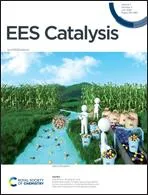
Activating iodine redox by enabling single-atom coordination to dormant nitrogen sites to realize durable zinc–iodine batteries
文献信息
发布日期
2023-11-07
DOI
10.1039/D3EY00228D
影响因子
0
作者
Jisung Lee, Wooseok Lee, Seungho Back, Seung Yeop Yi, Seongseop Kim, Joonhee Moon, Dong-Yeun Koh, Kyeounghak Kim, Seoin Back, Jinwoo Lee
查看原文
摘要
Aqueous rechargeable static zinc–iodine (Zn–I2) batteries are regarded as competitive candidates for next-generation energy storage devices owing to their safety and high energy density. However, their inherent limitations such as the shuttle effect, sluggish electrochemical kinetics, and the poor electrical conductivity of iodine have been challenging to mitigate when using methods that confer polarity to the surface of the carbon host through nitrogen doping. Moreover, the considerable prevalence of inactive pyridinic N sites significantly impedes the establishment of approaches to overcome issues associated with redox kinetics and iodine utilization. Herein, single Ni atoms were incorporated into an electrochemically inactive N-doped carbon matrix by carbonizing a zeolitic imidazolate framework and then thermally activating the Ni ions adsorbed onto the carbonized product. The single Ni atoms modulated the electronic structure of the surrounding N-doped carbon matrix, thereby improving its ability to adsorb polyiodides and exhibit bifunctional catalytic activity for iodine reduction and oxidation reactions. Consequently, the assembled Zn–I2 battery delivered an outstanding rate performance (193 mA h g−1 at a current density of 6 A g−1) and ultralong cyclability (10 000 cycles at a current density of 4 A g−1). Overall, this study illuminates the merits of using single-atom catalysts to revitalize inactive N pyridinic sites, thereby providing a promising direction for further advancement of Zn–I2 batteries.
相关文献
Cationic tungsten imido alkylidene N-heterocyclic carbene complexes for stereospecific ring-opening metathesis polymerization of norbornene derivatives
Janis V. Musso, Mathis Benedikter, Paul Gebel, Vincent Gramm, Dongren Wang, Roman Schowner
2021-09-27
Paper
DOI: 10.1039/D1PY01158H
Reversible-deactivation radical polymerization of vinyl acetate mediated by tralen, an organomediator
Chun-Wei Chang, Yu-Yu Jen, Shan-Cheng Tang, Pan Zhang, Changle Chen, Chi-How Peng
2021-08-26
Paper
DOI: 10.1039/D1PY00904D
Organocatalytic sequential ring-opening polymerization of cyclic ester/epoxide and N-sulfonyl aziridine: metal-free and easy access to block copolymers
Huishan Huang, Wenyi Luo, Linlin Zhu, Ying Wang
2021-08-26
Paper
DOI: 10.1039/D1PY00890K
Design and application of covalent organic frameworks for ionic conduction
Xiuyu Zhao
2021-07-13
Review Article
DOI: 10.1039/D1PY00776A
Green light LED activated ligation of a scalable, versatile chalcone chromophore
Kevin De Bruycker, Aaron S. Micallef
2021-06-21
Paper
DOI: 10.1039/D1PY00533B
Emissive semi-interpenetrating polymer networks for ink-jet printed multilayer OLEDs
Susanna V. Kunz, Cameron M. Cole, Thomas Baumann, Prashant Sonar, Soniya D. Yambem, James P. Blinco
2021-08-20
Communication
DOI: 10.1039/D1PY00794G
One-pot synthesis and aqueous solution properties of pH-responsive schizophrenic diblock copolymer nanoparticles prepared via RAFT aqueous dispersion polymerization
S. M. North, S. P. Armes
2021-09-29
Paper
DOI: 10.1039/D1PY01114F
The synthesis of degradable sulfur-containing polymers: precise control of structure and stereochemistry
Tian-Jun Yue, Li-Yang Wang, Wei-Min Ren
2021-10-21
Review Article
DOI: 10.1039/D1PY01065D
您可能还喜欢
化合物问答
什么是5-Fluoro-4-iodo-2-methylaniline(CAS号:307306-08-7)?
5-氟-4-碘-2-甲氨基苯属于芳香族化合物,其分子式为C8H7FN2I。该化合物具有一定的反应活性,在有机合成和药物化学领域有一定的应用。
307306-08-75-Fluoro-4-iodo-2-me...
化合物问答
4-氟-3-硝基三氟甲苯(CAS号:367-86-2)通常如何合成?
4-氟-3-硝基三氟甲苯通常通过将三氟甲基苯在酸性条件下催化氧化为三氟甲基硝基苯,然后进行氟化反应得到目标化合物。该过程需要使用催化剂,如三氟乙酸,反应产率较高...
367-86-21-Fluoro-2-nitro-4-(...
化合物问答
6-氯-9-(2,3,5-三苯甲酰氧基-2-C-甲基-beta-D-呋喃核糖基)-9H-嘌呤(CAS号:205171-05-7)的物理化学性质是什么?
该化合物为白色至类白色晶体,分子量约为1046.95。它在水中几乎不溶,在有机溶剂如乙腈和甲醇中具有一定的溶解性。该化合物具有良好的化学稳定性和生物活性。
205171-05-76-Chloro-9-(2-C-meth...
化合物问答
如何储存6-氟喹啉-4-羧酸(CAS号:220844-73-5)?
6-氟喹啉-4-羧酸应储存在阴凉、干燥、通风良好的地方,避免阳光直射。储存在密闭容器中,避免与空气中的水分接触。储存温度应控制在室温以下,避免高温。
220844-73-56-Fluoroquinoline-4-...
化合物问答
(2S,2'S,3S,3'S)-3,3'-di-tert-butyl-4,4'-bis(2,6-dimethoxyphenyl)-2,2',3,3'-tetrahydro-2,2'-bibenzo[d][1,3]oxaphosphole(CAS号:1435940-21-8)通常如何合成?
该化合物通常通过芳香族化合物的亲核取代反应合成,首先将2,6-二甲氧基苯基引入到双环结构中,然后通过特定条件下的还原或氧化反应引入二叔丁基。反应过程中使用了钯作...
1435940-21-8(2S,2'S,3S,3'S)-4,4'...
化合物问答
如何储存KY02111(CAS号:1118807-13-8)?
KY02111应储存于阴凉、干燥、通风良好的地方,避免阳光直射和高温环境。应使用合适的密闭容器储存,并确保容器密封良好,防止水分和潮气进入。在储存期间,应注意检...
1118807-13-8N-(6-chlorobenzo[d]t...
化合物问答
如何储存4-(4-氯苯氧基)丁酸乙酯(CAS号:59227-79-1)?
4-(4-氯苯氧基)丁酸乙酯应储存在阴凉、干燥、通风良好的地方,远离火源和热源。避免阳光直射,防止容器破裂导致泄漏。储存时应保持容器密封,避免与空气中的水蒸气接...
59227-79-1Ethyl 4-(4-chlorophe...
化合物问答
4-庚基苯乙酮(CAS号:37593-03-6)安全吗?
4-庚基苯乙酮相对安全,但在使用和储存时仍需注意。应避免吸入其蒸气,避免皮肤接触,使用时需佩戴防护眼镜和手套。储存时应远离火源和热源,保持容器密封,放置于阴凉、...
37593-03-61-(4-Heptylphenyl)et...
化合物问答
什么是乙基2-氨基-4-(3-溴苯基)噻吩-3-羧酸乙酯(CAS号:438218-48-5)?
乙基2-氨基-4-(3-溴苯基)噻吩-3-羧酸乙酯是一种有机化合物,分子式为C16H12BrN2O2S。它是一种含有噻吩环、氨基、溴苯基和羧酸酯结构的化合物。这...
438218-48-5ethyl 2-amino-4-(3-b...
化合物问答
什么是(9ci)-2-氨基-6-甲基-苯甲酰胺(CAS号:1885-31-0)?
(9ci)-2-氨基-6-甲基-苯甲酰胺是一种化学化合物,其英文名称为2-Amino-6-methylbenzamide,CAS号为1885-31-0。该化合物...
1885-31-02-Amino-6-methylbenz...
来源期刊
推荐化合物
![5-Bromoimidazo[1,2-a]pyridine structure](https://cnstatic.chemtradehub.com/structs/692/69214-09-1-d8e2.webp "5-Bromoimidazo[1,2-a]pyridine structure")
![2,2'-{2,2-Propanediylbis[(2,6-dibromo-4,1-phenylene)oxy]}diethanol structure](https://cnstatic.chemtradehub.com/structs/416/4162-45-2-b3d6.webp "2,2'-{2,2-Propanediylbis[(2,6-dibromo-4,1-phenylene)oxy]}diethanol structure")
推荐供应商






免责声明
本页面提供的学术期刊信息仅供参考和研究使用。我们与任何期刊出版商均无关联,也不处理投稿事宜。如有投稿相关咨询,请直接联系相关期刊出版商。
如发现页面信息有误,请发送邮件至 support@chemtradehub.com 联系我们。我们将及时核实并处理您的问题。