


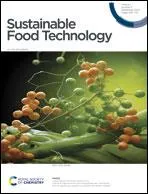
Sustainable production of prodigiosin from rice straw derived xylose by using isolated Serratia marcescens (CMS 2): statistical optimization, characterization, encapsulation & cost analysis
文献信息
发布日期
2023-10-02
DOI
10.1039/D3FB00100H
影响因子
0
作者
Kanika Miglani, Saumya Singh, Devendra Pratap Singh, Meena Krishania
查看原文
摘要
Prodigiosin, a pigment renowned for its multifaceted utility in biomedical, nutraceutical, and food domains, encounters impediments stemming from its expensive production process, limited accessibility, and modest yield. To address this challenge, the present investigation centered on the cultivation of naturally isolated Serratia marcescens CMS2, and the primary objective was to fine-tune fermentation conditions employing response surface methodology (RSM) to bolster prodigiosin synthesis. This endeavor leveraged xylose derived from rice straw as an economical carbon source. The cost-effective growth medium was enriched with peanut de-oiled cake, resulting in a remarkable 1.9-fold amplification in prodigiosin output. Under optimized conditions of pH (6.5), substrate concentration (1.5%), inoculum size (1.25%) and agitation rate (150 rpm), 0.5048 color value units per mg of prodigiosin were obtained. The purified prodigiosin underwent a comprehensive characterization utilizing various analytical techniques such as UV-vis spectroscopy, FT-IR spectroscopy, UPLC (ultra-performance liquid chromatography), TLC (thin-layer chromatography), and GC-MS (gas chromatography-mass spectrometry). The UV-vis spectra unveiled a pronounced absorption peak at 535 nm, while GC-MS analysis disclosed a distinctive peak at 324.96 m/z, accompanied by its derivatives. A significant breakthrough was realized when prodigiosin was encapsulated with polysaccharides, resulting in heightened water solubility and an expansion of its potential applications within the food industry. By implementing the cost-effective growth medium developed in this study, a substantial economic benefit of $578.41 was achieved, with the total scalable cost amounting to 8986.84 INR for 1 mg of prodigiosin. These findings position prodigiosin as an economically viable option in a competitive market landscape.
期刊推荐
Topics in Catalysis
Polycyclic Aromatic Compounds
Critical Reviews in Solid State and Materials Sciences
Journal of Chemical Sciences
Herald of the Russian Academy of Sciences
Colloid Journal
Acta Metallurgica Sinica-English Letters
Cellulose
Journal of the Indian Institute of Science
Chinese Journal of Chemistry
相关文献
In vitro antibacterial activity of oxide and non-oxide bioceramics for arthroplastic devices: I. In situ time-lapse Raman spectroscopy
Ryan M. Bock, Bryan J. McEntire, Tetsuya Adachi, Wenliang Zhu, Osam Mazda
2018-06-15
Paper
DOI: 10.1039/C8AN00233A
Fluorescence hyperspectral imaging for live monitoring of multiple spheroids in microfluidic chips
Mathieu Masse, Mathias Strupler
2018-07-12
Paper
DOI: 10.1039/C8AN00536B
ChemComm proves itself to be a truly international journal of exceptional standard
2003-12-16
Editorial
DOI: 10.1039/B315302A
您可能还喜欢
化合物问答
如何处理含有8-氯咪唑并[1,2-A]吡嗪(CAS号:69214-33-1)的废料?
处理含有8-氯咪唑并[1,2-A]吡嗪的废料时,应首先将其收集并进行化学回收或降解。如果无法回收,需采用安全的化学处理方法,如中和、氧化还原或沉淀。处理过程中需...
69214-33-18-chloroimidazo[1,2-...
化合物问答
Calhex 231 hydrochloride(CAS号:2387505-78-2)适用哪些法规指南?
Calhex 231 hydrochloride 需要遵循《全球化学品统一分类和标签制度》(GHS)的分类和标签要求,以及欧盟的《化学品注册、评估、授权和限制条...
2387505-78-24-Chloro-N-[(1S,2S)-...
化合物问答
11-Beta,17-alpha,21-三羟基-5-beta-孕烯-3,20-二酮(CAS号:1482-50-4)的物理化学性质是什么?
11-Beta,17-alpha,21-三羟基-5-beta-孕烯-3,20-二酮是一种无色结晶性粉末,分子量为372.45 g/mol。该化合物在水中的溶解度...
1482-50-45β-Dihydrocortisol
化合物问答
处理5-异丙基-1,3,4-恶二唑-2-羧酸(CAS号:944907-13-5)时应注意哪些实验室安全事项?
处理5-异丙基-1,3,4-恶二唑-2-羧酸时应注意以下安全事项:穿戴适当的个人防护装备,包括实验室外套、手套和护目镜;操作应在通风橱中进行,以减少吸入或接触有...
944907-13-55-Isopropyl-1,3,4-ox...
化合物问答
benzyl 3-bromopropanoate(CAS号:90841-55-7)安全吗?
Benzyl 3-bromopropanoate属于有毒物质,吸入、摄入或皮肤接触均可能对人体造成伤害。操作时应佩戴防护眼镜、口罩和手套,避免吸入蒸汽和直接接触...
90841-55-7Benzyl 3-bromopropan...
化合物问答
什么是(R)-N-苄氧羰基-3,4-二氢-1H-异喹啉羧酸(CAS号:151004-88-5)?
(R)-N-苄氧羰基-3,4-二氢-1H-异喹啉羧酸是一种含有苄氧羰基和异喹啉环结构的化合物,分子式为C17H15NO3。它是一种有机化合物,具有一定的生物活性...
151004-88-5(1R)-2-[(Benzyloxy)c...
化合物问答
在合成中是否有1-苄基吡啶嗡-3-羧酸盐(CAS号:15990-43-9)的替代品?
可以考虑使用1-苄基吡啶-3-羧酸盐作为1-苄基吡啶嗡-3-羧酸盐的替代品。此外,还可以探索其他类似物,如1-苄基吡啶-3-氨基甲酸酯等。具体的替代品选择需根据...
15990-43-91-Benzyl-3-pyridiniu...
化合物问答
(2,6-二甲基吡啶-3-基)甲醇(CAS号:582303-10-4)安全吗?
(2,6-二甲基吡啶-3-基)甲醇在使用时需注意安全,应避免吸入其蒸汽,接触皮肤和眼睛。操作应在通风良好的环境中进行,佩戴适当的个人防护装备。
582303-10-4(2,6-Dimethyl-3-pyri...
化合物问答
5-溴-2-乙烯基吡啶(CAS号:226883-52-9)的物理化学性质是什么?
5-溴-2-乙烯基吡啶是一种有机化合物,外观为白色固体,具有良好的结晶性。分子量约为190.03 g/mol。它的溶解性在水中较差,但在有机溶剂如二氯甲烷、甲醇...
226883-52-95-Bromo-2-vinylpyrid...
化合物问答
2-羟基-3-硝基-5-甲基吡啶(CAS号:7464-14-4)应用于哪些行业?
2-羟基-3-硝基-5-甲基吡啶主要应用于医药、聚合物和半导体行业。在医药领域,它可以用作合成其他药物的中间体。在聚合物领域,它可以作为功能性单体参与聚合反应,...
7464-14-45-Methyl-3-nitro-2(1...
来源期刊
推荐化合物
推荐供应商






免责声明
本页面提供的学术期刊信息仅供参考和研究使用。我们与任何期刊出版商均无关联,也不处理投稿事宜。如有投稿相关咨询,请直接联系相关期刊出版商。
如发现页面信息有误,请发送邮件至 support@chemtradehub.com 联系我们。我们将及时核实并处理您的问题。