


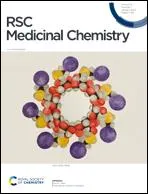
Design, synthesis, and biological evaluation of 3,3′-diindolylmethane N-linked glycoconjugate as a leishmanial topoisomerase IB inhibitor with reduced cytotoxicity
文献信息
发布日期
2023-08-30
DOI
10.1039/D3MD00214D
影响因子
0
作者
Parampreet Kour, Pallavi Saha, Srija Bhattacharya, Abhipsa Debnath, Amit Roy, Deepak K. Sharma
查看原文
摘要
Leishmaniasis, one of the neglected diseases, ranks second to malaria in the cause of parasitic mortality and morbidity. The present chemotherapeutic regimen faces the limitations of drug resistance and toxicity concerns, raising a great need to develop new chemotherapeutic leads that are orally administrable, potent, non-toxic, and cost-effective. Several research groups came forward to fill this therapeutic gap with new classes of active compounds against leishmaniasis, one such being 3,3′-diindolylmethane (DIM) derivatives. We tried to link this concept with another promising approach of glycoconjugation to study how glycosylated groups work differently from non-glycosylated ones. In the present study, a series of 3,3′-DIM derivatives have been synthesized and screened for their anti-leishmanial potency on Leishmania donovani promastigotes. Next, we synthesized the β-N,N′ glycoside of potent compound 3d using indole–indoline conversion, Fischer-type glycosylation, 2,3-dichloro-5,6-dicyano-1,4-benzoquionone (DDQ) oxidation, and molecular iodine catalyzed coupling with a suitable aldehyde in reasonable overall yield. The biological evaluation revealed that glycosides had reduced cytotoxic effects on the J774A.1 macrophage cell line. The enzyme inhibition study confirms that the glycoside derivatives have significant inhibitory activity against the leishmanial topoisomerase IB enzyme. Molecular docking further displayed the better binding efficiency of glycoside 13 with the target enzyme, suggesting the involvement of more H-bond interactions in the case of glycosides as compared to free drugs. Therefore, this work helps in proposing the fact that the addition of sugar moieties adds some favorable characteristics to free inhibitors, making it a promising approach for future clinical diagnostic and therapeutic applications, which can prove to be a valuable arsenal in combating such neglected diseases.
期刊推荐

Journal of Peptide Science
Crystallography Reports
Russian Journal of Organic Chemistry
Current Opinion in Colloid & Interface Science
Journal of Saudi Chemical Society
Russian Journal of Coordination Chemistry

Acta Materialia

Current Opinion in Solid State & Materials Science

Chemical Communications
Organic Process Research & Development
相关文献
Orientational order-dependent thermal expansion and compressibility of ZrW2O8 and ZrMo2O8
Leighanne C. Gallington, Karena W. Chapman, Cody R. Morelock, Peter J. Chupas
2013-10-11
Paper
DOI: 10.1039/C3CP52876F
Estimation of the refractive indices of imidazolium-based ionic liquids using their polarisability values
Pablo Díaz-Rodríguez, John C. Cancilla, Natalia V. Plechkova, Gemma Matute, Kenneth R. Seddon, José S. Torrecilla
2013-10-28
Paper
DOI: 10.1039/C3CP53685H
Combining ionic liquids and polyethylene glycols to boost the hydrophobic–hydrophilic range of aqueous biphasic systems
Jorge F. B. Pereira, Luís Paulo N. Rebelo, Robin D. Rogers, João A. P. Coutinho
2013-10-04
Communication
DOI: 10.1039/C3CP53701C
Controllable electronic energy structure of size-controlled Cu2ZnSnS4 nanoparticles prepared by a solution-based approach
Hiroyasu Nishi, Takahito Nagano, Susumu Kuwabata, Tsukasa Torimoto
2013-11-04
Communication
DOI: 10.1039/C3CP53946F
Electrochemical studies of silver nanoparticles: a guide for experimentalists and a perspective
Kristina Tschulik, Christopher Batchelor-McAuley, Her-Shuang Toh, Emma J. E. Stuart, Richard G. Compton
2013-11-12
Perspective
DOI: 10.1039/C3CP54221A
Ground state spectroscopy of hydroxyquinolines: evidence for the formation of protonated species in water-rich dioxane–water mixtures
Osama K. Abou-Zied, John Husband, Najla Al-Lawatia, Thomas B. Steinbrecher
2013-10-10
Paper
DOI: 10.1039/C3CP52811A
Strain relaxation and order–disorder phase transition in irradiated MgAl2O4
2013-11-18
Paper
DOI: 10.1039/C3CP53532K
Influence of La-doping on phase transformation and photocatalytic properties of ZnTiO3 nanoparticles synthesized via modified sol–gel method
T. Surendar, Santosh Kumar, Vishnu Shanker
2013-10-21
Paper
DOI: 10.1039/C3CP53855A
Panchromatic porous specular back reflectors for efficient transparent dye solar cells
Carmen López-López, Silvia Colodrero, Hernán Míguez
2013-10-15
Communication
DOI: 10.1039/C3CP53939C
您可能还喜欢
化合物问答
什么是2-氨基戊烷(CAS号:63493-28-7)?
2-氨基戊烷,又名pentan-2-amine,是一种有机化合物,分子式为C5H11NH2。它是一种无色透明液体,有氨味。该化合物在工业和研究中有一定的应用。
63493-28-7pentan-2-amine
化合物问答
反式-4-[4-[[[5-[(3,4-二氟苯基)氨基]-1,3,4-恶二唑-2-基]羰基]氨基]苯基]环己烷乙酸(CAS号:892489-52-0)的物理化学性质是什么?
该化合物为白色固体,分子量为552.31 g/mol。它在水中溶解度较低,在有机溶剂如乙腈、乙酸乙酯中有较好的溶解性。该化合物具有较高的化学稳定性,对酸和碱具有...
892489-52-0Trans-4-[4-[[[5-[(3,...
化合物问答
如何处理含有Pyrotinib dimaleate(CAS号:1397922-61-0)的废料?
处理含有Pyrotinib dimaleate 的废料时,应遵循当地的法规要求。首先,收集废料并进行分类,确保没有与其他化学品混合。然后,采取适当的物理和化学处...
1397922-61-0(2E)-N-(4-{[3-Chloro...
化合物问答
在合成中是否有4-(5-5-乙基-1,2,4-噁二唑-3-基)苯甲酸乙酯(CAS号:1166756-79-1)的替代品?
在合成过程中,可以考虑使用其他结构类似的化合物作为替代品,例如苯甲酸酯类化合物,如2-乙基-5-甲基噁二唑基苯甲酸乙酯等。这些替代品可能具有相似的化学性质,但在...
1166756-79-1Ethyl 4-(5-ethyl-1,2...
化合物问答
如何处理含有1-((叔丁氧基羰基)氨基)环丁烷甲酸甲酯(CAS号:880166-10-9)的废料?
处理含有该化合物的废液时,应先确保其完全反应并转化为无害物质。对于未反应的化合物,建议采用中和处理后进行蒸馏回收,剩余物可使用化学氧化法或焚烧法进行无害化处理。...
880166-10-9Methyl 1-({[(2-methy...
化合物问答
2-({[3,5-二(三氟甲基)苯基]磺酰基}氨基)-4-(甲基硫代)丁酸甲酯(CAS号:175202-21-8)的市场或研究趋势如何?
目前该化合物主要应用于药物合成领域,尤其在开发新型抗癌药物方面具有潜在应用。随着制药行业的持续发展,对于高效、低毒的合成中间体需求增加,预计该化合物的研究和应用...
175202-21-8Methyl N-{[3,5-bis(t...
化合物问答
N,N-乙烯双(碘乙酰胺)(CAS号:7250-43-3)的物理化学性质是什么?
N,N-乙烯双(碘乙酰胺)是一种白色或类白色固体,易溶于乙醇、丙酮等有机溶剂,但在水中溶解度较低。该化合物具有较高的反应活性,可以与其他含有活性氢的化合物发生酰...
7250-43-3N,N'-1,2-Ethanediylb...
化合物问答
7-Fluoro-1H-spiro[furo[3,4-c]pyridine-3,4'-piperidine](CAS号:1283090-73-2)通常如何合成?
该化合物可以通过环合反应合成,首先合成吡啶和哌啶的衍生物,然后在合适的条件下进行环合反应得到目标化合物。常用的催化剂包括某些金属盐类,产率一般在70%-90%之...
1283090-73-27-Fluoro-1H-spiro[fu...
化合物问答
处理3-乙酰滇乌碱(CAS号:80787-51-5)时应注意哪些实验室安全事项?
在处理3-乙酰滇乌碱时,应穿戴适当的个人防护装备(PPE),如实验服、手套(丁腈手套或PVC手套)、护目镜和口罩。实验应在通风橱中进行,以减少吸入或皮肤接触的风...
80787-51-54-Methylaconitane-1,...
化合物问答
如何储存2-溴-5-硝基-4-羧酸(CAS号:1053655-82-5)?
2-溴-5-硝基-4-羧酸应存放在阴凉、干燥、通风良好的地方,远离火源和热源。避免与还原剂、碱性物质接触。储存容器应密封,防止吸湿。
1053655-82-52-Bromo-5-nitropyrid...
来源期刊
推荐化合物
![4-{[4-(Trifluoromethoxy)benzyl]oxy}benzonitrile structure](https://cnstatic.chemtradehub.com/structs/103/1036629-63-6-2172.webp "4-{[4-(Trifluoromethoxy)benzyl]oxy}benzonitrile structure")
推荐供应商



免责声明
本页面提供的学术期刊信息仅供参考和研究使用。我们与任何期刊出版商均无关联,也不处理投稿事宜。如有投稿相关咨询,请直接联系相关期刊出版商。
如发现页面信息有误,请发送邮件至 support@chemtradehub.com 联系我们。我们将及时核实并处理您的问题。