








Reply to the ‘Comment on “Lewis acid-surfactant complex catalyzed polymerization in aqueous dispersed media: cationic or radical polymerization?”’ by I. V. Vasilenko, F. Ganachaud and S. V. Kostjuk, Polym. Chem., 2024, 15, DOI: 10.1039/D3PY00661A
文献信息
发布日期
2024-01-03
DOI
10.1039/D3PY01067H
影响因子
5.582
作者
Aurelie Destephen
查看原文
摘要
In our previous work we concluded that the Lewis acid-surfactant complex catalyzed polymerization of styrene and other monomers in aqueous dispersed media does not proceed by a cationic polymerization. In a subsequent reply, Vasilenko et al. have suggested that this conclusion is incorrect. Here, we respond to the points raised by Vasilenko et al. and reassert our position that the experimental evidence is more consistent with a radical polymerization than a cationic polymerization and that achieving high molecular weight polymers by a cationic polymerization is not possible in aqueous systems at elevated temperatures unless chain transfer reactions are suppressed.
期刊推荐
相关文献
A colorimetric aptasensor for the simple and rapid detection of human papillomavirus type 16 L1 proteins
Li Zhu, Yu Zhao, Shangchen Yao, Mingzhe Xu, Lihui Yin, Xihai Zhai, Xu Teng
2021-02-24
Paper
DOI: 10.1039/D1AN00251A
Lighting up of carbon dots for copper(ii) detection using an aggregation-induced enhanced strategy
Long Chuan Zhang, Yu Meng Yang, Ling Liang, Yong Jian Jiang, Chun Mei Li, Yuan Fang Li, Lei Zhan, Hong Yan Zou
2021-12-23
Paper
DOI: 10.1039/D1AN02147H
A novel ratiometric electrochemical biosensing strategy based on T7 exonuclease-assisted homogenous target recycling coupling hairpin assembly-triggered double-signal output for the multiple amplified detection of miRNA
Qing-Yun Zhou, Rong-Na Ma, Chao-Long Hu, Fei Sun, Li-Ping Jia, Wei Zhang, Lei Shang, Qing-Wang Xue, Wen-Li Jia, Huai-Sheng Wang
2021-02-25
Paper
DOI: 10.1039/D1AN00204J
Laminin-511 and recombinant vitronectin supplementation enables human pluripotent stem cell culture and differentiation on conventional tissue culture polystyrene surfaces in xeno-free conditions
Ya-Chu Liu, Lee-Kiat Ban, Hsin-Ting Lee, Yu-Tang Chang, Yun-Ting Lin, Her-Young Su, Shih-Tien Hsu
2021-09-24
Paper
DOI: 10.1039/D1TB01878G
ATR-FTIR spectroscopy as a tool to probe surface adsorption on nanoparticles at the liquid–solid interface in environmentally and biologically relevant media
Imali A. Mudunkotuwa, Alaa Al Minshid, Vicki H. Grassian
2013-12-02
Minireview
DOI: 10.1039/C3AN01684F
Rational design of water-dispersible and biocompatible nanoprobes with H2S-triggered NIR emission for cancer cell imaging
Hengyan Liu, Ge Xu, Tianli Zhu, Rongchen Wang, Jiahui Tan, Chunchang Zhao, Xianfeng Gu
2020-06-29
Communication
DOI: 10.1039/D0TB00173B
A turn-on homodimer fluorescent probe based on homo-FRET for the sensing of biothiols in lysosome: a trial of a new turn-on strategy
Ying-Jie Tang, Wen-Le Fang, Kui Ren, Xiao-Feng Guo, Hong Wang
2021-03-11
Paper
DOI: 10.1039/D1AN00161B
An overview of recent developments in the determination of aluminium in serum by furnace atomic absorption spectrometry
Paper
DOI: 10.1039/JA9860100281
您可能还喜欢
化合物问答
(5-氨基吡唑-3-基)乙酸(CAS号:174891-10-2)的物理化学性质是什么?
(5-氨基吡唑-3-基)乙酸是一种无色至白色固体,分子量为174.15 g/mol。它在水中具有较好的溶解性,在有机溶剂中的溶解度较低。该化合物具有较好的反应活...
174891-10-2(3-Amino-1H-pyrazol-...
化合物问答
3-氟-4,5-二氯苯胺(CAS号:35754-38-2)适用哪些法规指南?
3-氟-4,5-二氯苯胺受到多项法规指南的约束,包括但不限于GHS(全球化学品统一分类和标签制度)的危险分类标准、欧盟的REACH法规(注册、评估、授权和限制)...
35754-38-23,4-Dichloro-5-fluor...
化合物问答
什么是(R)-(+)-2,2',6,6'-四甲氧基-4,4'-联(二(3,5-二甲苯基基)膦基)-3,3'-二联吡啶(CAS号:442905-33-1)?
这是一种有机化合物,化学名为(R)-(+)-2,2',6,6'-四甲氧基-4,4'-联(二(3,5-二甲苯基基)膦基)-3,3'-二联吡啶,CAS号为44290...
442905-33-14,4'-Bis[bis(3,5-dim...
化合物问答
1-氨基-2-氰基萘(CAS号:3100-67-2)应用于哪些行业?
1-氨基-2-氰基萘在医药、聚合物、传感器和半导体等行业中有应用。在医药领域,它可用作中间体合成某些药物。在聚合物行业,它可以用于制备具有特定性能的聚合物。此外...
3100-67-21-Amino-2-naphthonit...
化合物问答
如何处理含有1-溴-4-(异丙氧基甲基)苯(CAS号:98446-84-5)的废料?
处理含1-溴-4-(异丙氧基甲基)苯的废料时,首先应确保废液收集在防渗漏的容器中,避免泄露。然后,可以考虑采用化学降解法或物理吸附法进行处理。在特定条件下,可通...
98446-84-51-Bromo-4-(isopropox...
化合物问答
6-Chloro-8-(trifluoromethyl)chroman-4-one(CAS号:1344889-75-3)的主要用途是什么?
6-氯-8-三氟甲基-2,3-二氢-4H-色喃-4-酮主要用于有机合成中的中间体,也可作为研究试剂使用。
1344889-75-36-Chloro-8-(trifluor...
化合物问答
7-乙氧基-2-萘酚(CAS号:57944-44-2)通常如何合成?
7-乙氧基-2-萘酚通常通过N-乙氧基化反应合成,首先将2-萘酚与乙醇钠在乙醇中反应生成7-乙氧基-2-萘酚钠盐,再通过酸化进一步得到7-乙氧基-2-萘酚。该合...
57944-44-27-Ethoxy-2-naphthol
化合物问答
4-(1,1-二氧硫代吗啉)丁醇(CAS号:59801-41-1)适用哪些法规指南?
该化合物需遵循一系列的法规指南,包括但不限于GHS全球统一分类和标签制度,其分类可能包括易燃液体和可能危害水生环境。在欧洲,还需遵循REACH法规,确保物质和混...
59801-41-14-(4-Hydroxybutyl)th...
化合物问答
4-甲氧基苄基叠氮甲酸酯(CAS号:25474-85-5)的物理化学性质是什么?
4-甲氧基苄基叠氮甲酸酯是一种无色液体,具有一定的挥发性。其分子量为198.16,熔点为-69°C,沸点为105°C。该化合物在水中溶解度较低,在有机溶剂如乙醇...
25474-85-54-Methoxybenzyl carb...
化合物问答
如何处理含有4-氯-2-氟嘧啶(CAS号:51422-00-5)的废料?
含有4-氯-2-氟嘧啶的废料应按照危险废物处理。首先,应收集并分类这些废料,避免与其他废物混合。然后,可以采用焚烧处理或者交由专业机构进行处置。在处理过程中,需...
51422-00-54-Chloro-2-fluoropyr...
来源期刊
Polymer Chemistry

CiteScore:
8.6
自引率:
7.3%
年发文量:
457
Polymer Chemistry welcomes submissions in all areas of polymer science that have a strong focus on macromolecular chemistry. Manuscripts may cover a broad range of fields, yet no direct application focus is required.
推荐化合物
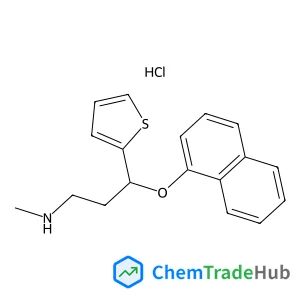
N-Methyl-3-(1-naphthyloxy)-3-(2-thienyl)-1-propanamine hydrochloride (1:1)
CAS号:
1188266-11-6
分子式:
C18H20ClNOS
推荐供应商





免责声明
本页面提供的学术期刊信息仅供参考和研究使用。我们与任何期刊出版商均无关联,也不处理投稿事宜。如有投稿相关咨询,请直接联系相关期刊出版商。
如发现页面信息有误,请发送邮件至 support@chemtradehub.com 联系我们。我们将及时核实并处理您的问题。