










![1-[6-(1H-Imidazol-1-yl)-3-pyridinyl]methanamine structure](https://cnstatic.chemtradehub.com/structs/914/914637-08-4-8825.webp "1-[6-(1H-Imidazol-1-yl)-3-pyridinyl]methanamine structure")
Dynamic poly(hindered urea) hybrid network materials crosslinked with reactive methacrylate polymer
文献信息
发布日期
2023-10-27
DOI
10.1039/D3PY01107K
影响因子
5.582
作者
Twinkal Patel, Junyoung Park, Zhibin Ye, Hyunhyub Ko, Hyun Wook Jung, Jung Kwon Oh
查看原文
摘要
Covalent adaptive networks (CANs) crosslinked with dynamic covalent bonds, particularly hindered urea bonds (HUBs), have gained significant attention in the development of advanced materials exhibiting self-healability and reprocessability for various applications. Multifunctional crosslinkers bearing bulky t-butylamino groups, as small molecules or macromolecules, have been incorporated into the fabrication of dynamic HUB-based CAN materials. Herein, we report a well-defined polymethacrylate homopolymer (PM) bearing t-butylamino pendants as a multifunctional bulky amine crosslinker synthesized by a controlled radical polymerization. The polyaddition of the synthesized PM with polyisocyanate and polyamine allows for the fabrication of dynamic poly(hindered urea) (PHU) networks crosslinked through the formation of reversible HUBs. Their structure–property relationship and self-healing mechanism are explored with varying amounts of PM crosslinker. The fabricated PM-PHU hybrid networks designed with excess t-butylamino pendants (e.g., more PM) exhibit rapid void-filling and network relaxation with lower activation energy, even though they possess higher mechanical strength, thus leading to excellent reprocessability with high recovery of tensile/mechanical properties upon many recycles. Our work demonstrates that the design of multifunctional polymeric crosslinkers bearing t-butylamino pendants is a promising strategy for the development of advanced HUB-based hybrid network materials with improved reprocessability.
相关文献
Development and comparison of various rod-shaped mini-reference electrode compositions based on Ag/AgCl for potentiometric applications
Mustafa Nigde, Ismail Agir, Rıdvan Yıldırım, Ibrahim Isildak
2021-12-17
Paper
DOI: 10.1039/D1AN01754C
Detection of multiply charged protein ions using matrix-assisted laser desorption/ionization mass spectrometry and a force-dried droplet method with a 2-nitrophloroglucinol matrix
Kangseok Yun, Iqbal Jalaludin, Shinhee Jung, Kyoung-Soon Jang
2022-01-07
Paper
DOI: 10.1039/D1AN02114A
DNA nanolantern-based split aptamer probes for in situ ATP imaging in living cells and lighting up mitochondria‡
Ya-Xin Wang, Dong-Xia Wang, Jia-Yi Ma, Jing Wang, Yi-Chen Du, De-Ming Kong
2021-03-02
Paper
DOI: 10.1039/D1AN00275A
An “off–on–off” fluorescence chemosensor for the sensitive detection of Cu2+ in aqueous solution based on multiple fluorescence emission mechanisms
Aimei Zhou, Shuhua Han
2021-02-12
Paper
DOI: 10.1039/D0AN02472D
Cell-inspired biointerfaces constructed from patterned smart hydrogels for immunoassays in whole blood
Jianwen Hou, Runhai Chen, Zhirong Xin, Hengchong Shi, Shing-Chung Wong, Jinghua Yin, Qiang Shi
2017-02-27
Paper
DOI: 10.1039/C6TB03385G
Lighting up of carbon dots for copper(ii) detection using an aggregation-induced enhanced strategy
Long Chuan Zhang, Yu Meng Yang, Ling Liang, Yong Jian Jiang, Chun Mei Li, Yuan Fang Li, Lei Zhan, Hong Yan Zou
2021-12-23
Paper
DOI: 10.1039/D1AN02147H
Flexible thread-based electrochemical sensors for oxygen monitoring
2021-03-09
Paper
DOI: 10.1039/D0AN02400G
A metal–organic framework with multienzyme activity as a biosensing platform for real-time electrochemical detection of nitric oxide and hydrogen peroxide
Ping-hua Ling, Xiao-na Zang, Cai-hua Qian, Feng Gao
2021-03-02
Paper
DOI: 10.1039/D1AN00142F
A Pt–Ir nanocube amplified lateral flow immunoassay for dehydroepiandrosterone
Huiyi Yang, Qiyi He, Junkang Pan, Ding Shen, Huanxin Xiao, Xiping Cui, Suqing Zhao
2021-02-25
Paper
DOI: 10.1039/D0AN02293D
您可能还喜欢
化合物问答
(5-氨基吡唑-3-基)乙酸(CAS号:174891-10-2)的物理化学性质是什么?
(5-氨基吡唑-3-基)乙酸是一种无色至白色固体,分子量为174.15 g/mol。它在水中具有较好的溶解性,在有机溶剂中的溶解度较低。该化合物具有较好的反应活...
174891-10-2(3-Amino-1H-pyrazol-...
化合物问答
3-氟-4,5-二氯苯胺(CAS号:35754-38-2)适用哪些法规指南?
3-氟-4,5-二氯苯胺受到多项法规指南的约束,包括但不限于GHS(全球化学品统一分类和标签制度)的危险分类标准、欧盟的REACH法规(注册、评估、授权和限制)...
35754-38-23,4-Dichloro-5-fluor...
化合物问答
什么是(R)-(+)-2,2',6,6'-四甲氧基-4,4'-联(二(3,5-二甲苯基基)膦基)-3,3'-二联吡啶(CAS号:442905-33-1)?
这是一种有机化合物,化学名为(R)-(+)-2,2',6,6'-四甲氧基-4,4'-联(二(3,5-二甲苯基基)膦基)-3,3'-二联吡啶,CAS号为44290...
442905-33-14,4'-Bis[bis(3,5-dim...
化合物问答
1-氨基-2-氰基萘(CAS号:3100-67-2)应用于哪些行业?
1-氨基-2-氰基萘在医药、聚合物、传感器和半导体等行业中有应用。在医药领域,它可用作中间体合成某些药物。在聚合物行业,它可以用于制备具有特定性能的聚合物。此外...
3100-67-21-Amino-2-naphthonit...
化合物问答
如何处理含有1-溴-4-(异丙氧基甲基)苯(CAS号:98446-84-5)的废料?
处理含1-溴-4-(异丙氧基甲基)苯的废料时,首先应确保废液收集在防渗漏的容器中,避免泄露。然后,可以考虑采用化学降解法或物理吸附法进行处理。在特定条件下,可通...
98446-84-51-Bromo-4-(isopropox...
化合物问答
6-Chloro-8-(trifluoromethyl)chroman-4-one(CAS号:1344889-75-3)的主要用途是什么?
6-氯-8-三氟甲基-2,3-二氢-4H-色喃-4-酮主要用于有机合成中的中间体,也可作为研究试剂使用。
1344889-75-36-Chloro-8-(trifluor...
化合物问答
7-乙氧基-2-萘酚(CAS号:57944-44-2)通常如何合成?
7-乙氧基-2-萘酚通常通过N-乙氧基化反应合成,首先将2-萘酚与乙醇钠在乙醇中反应生成7-乙氧基-2-萘酚钠盐,再通过酸化进一步得到7-乙氧基-2-萘酚。该合...
57944-44-27-Ethoxy-2-naphthol
化合物问答
4-(1,1-二氧硫代吗啉)丁醇(CAS号:59801-41-1)适用哪些法规指南?
该化合物需遵循一系列的法规指南,包括但不限于GHS全球统一分类和标签制度,其分类可能包括易燃液体和可能危害水生环境。在欧洲,还需遵循REACH法规,确保物质和混...
59801-41-14-(4-Hydroxybutyl)th...
化合物问答
4-甲氧基苄基叠氮甲酸酯(CAS号:25474-85-5)的物理化学性质是什么?
4-甲氧基苄基叠氮甲酸酯是一种无色液体,具有一定的挥发性。其分子量为198.16,熔点为-69°C,沸点为105°C。该化合物在水中溶解度较低,在有机溶剂如乙醇...
25474-85-54-Methoxybenzyl carb...
化合物问答
如何处理含有4-氯-2-氟嘧啶(CAS号:51422-00-5)的废料?
含有4-氯-2-氟嘧啶的废料应按照危险废物处理。首先,应收集并分类这些废料,避免与其他废物混合。然后,可以采用焚烧处理或者交由专业机构进行处置。在处理过程中,需...
51422-00-54-Chloro-2-fluoropyr...
来源期刊
Polymer Chemistry

CiteScore:
8.6
自引率:
7.3%
年发文量:
457
Polymer Chemistry welcomes submissions in all areas of polymer science that have a strong focus on macromolecular chemistry. Manuscripts may cover a broad range of fields, yet no direct application focus is required.
推荐化合物
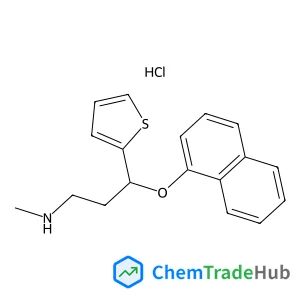
N-Methyl-3-(1-naphthyloxy)-3-(2-thienyl)-1-propanamine hydrochloride (1:1)
CAS号:
1188266-11-6
分子式:
C18H20ClNOS
![1-oxaspiro[4.4]nonan-6-one structure](https://cnstatic.chemtradehub.com/structs/134/134179-01-4-e051.webp "1-oxaspiro[4.4]nonan-6-one structure")
推荐供应商





免责声明
本页面提供的学术期刊信息仅供参考和研究使用。我们与任何期刊出版商均无关联,也不处理投稿事宜。如有投稿相关咨询,请直接联系相关期刊出版商。
如发现页面信息有误,请发送邮件至 support@chemtradehub.com 联系我们。我们将及时核实并处理您的问题。