


Energetics of acid catalyzed biomass reactions: how and why does the solvent model matter?
文献信息
发布日期
2023-10-03
DOI
10.1039/D3RE00340J
影响因子
4.239
作者
José Carlos Velasco Calderón, Samir H. Mushrif
查看原文
摘要
Condensed phase selective transformation of biomass to platform chemicals is susceptible to the solvent environment. Selectivities and conversions in several key acid-catalyzed biomass reactions change significantly with the addition of a co-solvent to the reacting system. Hence, when molecular modeling tools are implemented to investigate these reactions, it is imperative to select a solvent model that can compute reaction energetics accurately and can capture and explain the “role” of solvent in altering them. Hence in this paper, we systematically compare popularly used implicit and explicit solvation approaches to model the protonation reaction of a biomass derived moiety, with and without reaction and solvent dynamics, using water and DMSO as co-solvents. This systematic comparison reveals that unlike routinely performed DFT calculations in implicit solvents, where the free energy profiles do not change significantly due to changes in solvent composition, the reaction free energy using explicit equilibrated solvation without solvent and reaction dynamics was found to be ∼67 kJ mol−1 higher at 75 wt% DMSO compared to lower DMSO proportions. However, the effect of solvent environment on free energy barriers was only captured when solvent and reaction dynamics were considered. The increase in activation-free energy with the addition of the co-solvent is due to changes in the solvent reorganization energy and non-equilibrium solvation.
期刊推荐
Journal of Organometallic Chemistry

European Journal of Wood and Wood Products
Kinetics and Catalysis

Proceedings of the National Academy of Sciences of the United States of America
Nature
Journal of Heterocyclic Chemistry

Science Progress
Organic Preparations and Procedures International
Pure and Applied Chemistry
Planta Medica
相关文献
From solvated ions to ion-pairing: a THz study of lanthanum(iii) hydration
Vinay Sharma, Fabian Böhm, Michael Seitz, Gerhard Schwaab, Martina Havenith
2013-04-10
Paper
DOI: 10.1039/C3CP50865J
The interaction of H2S with the ZnO(100) surface
Jakub Goclon, Bernd Meyer
2013-04-26
Paper
DOI: 10.1039/C3CP44546A
Confirmation of disordered structure of ultrasmall CdSe nanoparticles from X-ray atomic pair distribution function analysis
Xiaohao Yang, Ahmad S. Masadeh, James R. McBride, Emil S. Božin, Sandra J. Rosenthal
2013-03-12
Paper
DOI: 10.1039/C3CP00111C
A multi-scale molecular dynamics study of the assembly of micron-size supraparticles from 30 nm alkyl-coated nanoparticles
Damien Thompson, Mateusz Sikora, Piotr Szymczak, Marek Cieplak
2013-04-09
Paper
DOI: 10.1039/C3CP50523E
Organic spin-valves: from unipolar to bipolar devices
Z. Valy Vardeny
2013-04-25
Perspective
DOI: 10.1039/C3CP50639H
Raman spectral characteristics of 4-aminobenzenethiol adsorbed on ZnO nanorod arrays
Kwan Kim, Kyung Lock Kim, Kuan Soo Shin
2013-05-09
Paper
DOI: 10.1039/C3CP51204E
In situ pair distribution function study on lanthanum doped ceria
Mauro Coduri, Michela Brunelli, Paolo Masala
2013-01-24
Paper
DOI: 10.1039/C3CP44300K
A simple reduction process to synthesize MoO2/C composites with cage-like structure for high-performance lithium-ion batteries
Bing Liu, Xinyu Zhao, Yuan Tian, Di Zhao, Changwen Hu, Minhua Cao
2013-03-28
Paper
DOI: 10.1039/C3CP44707C
Self-assembly of semiconductor/insulator interfaces in one-step spin-coating: a versatile approach for organic field-effect transistors
Chuan Liu, Yun Li, Michael V. Lee, Akichika Kumatani, Kazuhito Tsukagoshi
2013-02-27
Perspective
DOI: 10.1039/C3CP44715D
Lone-pair distribution and plumbite network formation in high lead silicate glass, 80PbO·20SiO2
Oliver L. G. Alderman, Alex C. Hannon, Diane Holland, Steve Feller, Gloria Lehr, Adam J. Vitale, Uwe Hoppe, Martin v. Zimmerman, Anke Watenphul
2013-04-29
Paper
DOI: 10.1039/C3CP51348C
您可能还喜欢
化合物问答
(5-氨基吡唑-3-基)乙酸(CAS号:174891-10-2)的物理化学性质是什么?
(5-氨基吡唑-3-基)乙酸是一种无色至白色固体,分子量为174.15 g/mol。它在水中具有较好的溶解性,在有机溶剂中的溶解度较低。该化合物具有较好的反应活...
174891-10-2(3-Amino-1H-pyrazol-...
化合物问答
3-氟-4,5-二氯苯胺(CAS号:35754-38-2)适用哪些法规指南?
3-氟-4,5-二氯苯胺受到多项法规指南的约束,包括但不限于GHS(全球化学品统一分类和标签制度)的危险分类标准、欧盟的REACH法规(注册、评估、授权和限制)...
35754-38-23,4-Dichloro-5-fluor...
化合物问答
什么是(R)-(+)-2,2',6,6'-四甲氧基-4,4'-联(二(3,5-二甲苯基基)膦基)-3,3'-二联吡啶(CAS号:442905-33-1)?
这是一种有机化合物,化学名为(R)-(+)-2,2',6,6'-四甲氧基-4,4'-联(二(3,5-二甲苯基基)膦基)-3,3'-二联吡啶,CAS号为44290...
442905-33-14,4'-Bis[bis(3,5-dim...
化合物问答
1-氨基-2-氰基萘(CAS号:3100-67-2)应用于哪些行业?
1-氨基-2-氰基萘在医药、聚合物、传感器和半导体等行业中有应用。在医药领域,它可用作中间体合成某些药物。在聚合物行业,它可以用于制备具有特定性能的聚合物。此外...
3100-67-21-Amino-2-naphthonit...
化合物问答
如何处理含有1-溴-4-(异丙氧基甲基)苯(CAS号:98446-84-5)的废料?
处理含1-溴-4-(异丙氧基甲基)苯的废料时,首先应确保废液收集在防渗漏的容器中,避免泄露。然后,可以考虑采用化学降解法或物理吸附法进行处理。在特定条件下,可通...
98446-84-51-Bromo-4-(isopropox...
化合物问答
6-Chloro-8-(trifluoromethyl)chroman-4-one(CAS号:1344889-75-3)的主要用途是什么?
6-氯-8-三氟甲基-2,3-二氢-4H-色喃-4-酮主要用于有机合成中的中间体,也可作为研究试剂使用。
1344889-75-36-Chloro-8-(trifluor...
化合物问答
7-乙氧基-2-萘酚(CAS号:57944-44-2)通常如何合成?
7-乙氧基-2-萘酚通常通过N-乙氧基化反应合成,首先将2-萘酚与乙醇钠在乙醇中反应生成7-乙氧基-2-萘酚钠盐,再通过酸化进一步得到7-乙氧基-2-萘酚。该合...
57944-44-27-Ethoxy-2-naphthol
化合物问答
4-(1,1-二氧硫代吗啉)丁醇(CAS号:59801-41-1)适用哪些法规指南?
该化合物需遵循一系列的法规指南,包括但不限于GHS全球统一分类和标签制度,其分类可能包括易燃液体和可能危害水生环境。在欧洲,还需遵循REACH法规,确保物质和混...
59801-41-14-(4-Hydroxybutyl)th...
化合物问答
4-甲氧基苄基叠氮甲酸酯(CAS号:25474-85-5)的物理化学性质是什么?
4-甲氧基苄基叠氮甲酸酯是一种无色液体,具有一定的挥发性。其分子量为198.16,熔点为-69°C,沸点为105°C。该化合物在水中溶解度较低,在有机溶剂如乙醇...
25474-85-54-Methoxybenzyl carb...
化合物问答
如何处理含有4-氯-2-氟嘧啶(CAS号:51422-00-5)的废料?
含有4-氯-2-氟嘧啶的废料应按照危险废物处理。首先,应收集并分类这些废料,避免与其他废物混合。然后,可以采用焚烧处理或者交由专业机构进行处置。在处理过程中,需...
51422-00-54-Chloro-2-fluoropyr...
来源期刊
Reaction Chemistry & Engineering
CiteScore:
0
自引率:
8.8%
年发文量:
284
Reaction Chemistry & Engineering is an interdisciplinary journal reporting cutting-edge research focused on enhancing the understanding and efficiency of reactions. Reaction engineering leverages the interface where fundamental molecular chemistry meets chemical engineering and technology. Challenges in chemistry can be overcome by the application of new technologies, while engineers may find improved solutions for process development from the latest developments in reaction chemistry. Reaction Chemistry & Engineering is a unique forum for researchers whose interests span the broad areas of chemical engineering and chemical sciences to come together in solving problems of importance to wider society. All papers should be written to be approachable by readers across the engineering and chemical sciences. Papers that consider multiple scales, from the laboratory up to and including plant scale, are particularly encouraged.
推荐化合物
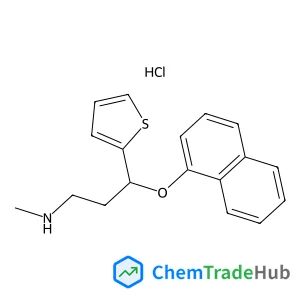
N-Methyl-3-(1-naphthyloxy)-3-(2-thienyl)-1-propanamine hydrochloride (1:1)
CAS号:
1188266-11-6
分子式:
C18H20ClNOS
推荐供应商





免责声明
本页面提供的学术期刊信息仅供参考和研究使用。我们与任何期刊出版商均无关联,也不处理投稿事宜。如有投稿相关咨询,请直接联系相关期刊出版商。
如发现页面信息有误,请发送邮件至 support@chemtradehub.com 联系我们。我们将及时核实并处理您的问题。