



Integrative electrochemical and biological catalysis for the mild and efficient utilization of renewable electricity and carbon resources
文献信息
发布日期
2023-12-06
DOI
10.1039/D3SE00876B
影响因子
6.367
作者
Licheng Liu, Deepak Pant
查看原文
摘要
Chemical catalysis and biological catalysis both play important roles in producing various fuels, chemicals, and materials conventionally. In view of renewable resource (biomass and CO2) utilization, combining both chemical and biological catalysis would create revolutionary routes that are more sustainable and efficient for the processing of these resources. Considering that electricity is usually the main form of renewable energy, electrocatalysis also plays an important role. Therefore, integrative electrochemical and biological catalysis for the simultaneous utilization of renewable energy and resources is attracting significant attention. In this review, such integrative processes and methods are summarized and discussed in depth and two integration modes are distinguished based on the use of electroactive/non-electroactive microorganisms. Intermediate mediated consecutive synthesis from CO2 or biomass to specific chemicals is shown to play a pivotal role, such as H2 enhanced microbial electrosynthesis (MES) and CO or formate mediated longer carbon chain product synthesis. Accordingly, the synthesis efficiency was improved significantly following the collaborative design of abiotic and biological catalysts, as well as route innovation. For example, an acetate productivity of 1330 g m−2 day−1 in MES and a low cost of 45 g kW h−1 for producing butanol and hexanol could be achieved, which shows great potential for industrial application. Integrative electrochemical and biological catalysis can convert CO2 or biomass feedstocks to a wide product distribution from C1 to C6+, and even large molecules such as sugars, lipids, starch, etc. This article exhibits the importance of integrative electrochemical and biological catalysis for efficient utilization of renewable carbon resources, the ways to integrate two different processes and some reflections for future research.
期刊推荐

Russian Journal of Organic Chemistry

Russian Journal of Coordination Chemistry
Russian Journal of Bioorganic Chemistry

Current Opinion in Colloid & Interface Science

Russian Journal of Applied Chemistry

Journal of Natural Medicines
Journal of Saudi Chemical Society
Drug Discovery Today

New Journal of Chemistry

Chemical Communications
相关文献
Synthesis and characterization of a benzene-centered, phthalocyanine hexamer
Giovanni Bottari, Tomás Torres
2004-10-14
Communication
DOI: 10.1039/B411960F
Selective growth of a less stable polymorph of 2-iodo-4-nitroaniline on a self-assembled monolayer template
Rupa Hiremath, Stephen W. Varney, Jennifer A. Swift
2004-10-15
Communication
DOI: 10.1039/B411649F
Poly(9,9′-spirobifluorene-manganese porphyrin): a new catalytic material for oxidation of alkenes by iodobenzene diacetate and iodosylbenzene
Cyril Poriel, Yann Ferrand, Paul le Maux, Joëlle Raul-Berthelot, Gerard Simonneaux
2003-04-02
Communication
DOI: 10.1039/B301717F
Iron(iii) salen-type catalysts for the cross-coupling of aryl Grignards with alkyl halides bearing β-hydrogens
Robin B. Bedford, Duncan W. Bruce, Robert M. Frost, John W. Goodby, Michael Hird
2004-10-27
Communication
DOI: 10.1039/B413790F
Regioselective Hula-twist photoisomerization of cinnamate esters in organic glass
Stefan Schieffer, John Pescatore, Richard Ulsh, Robert S. H. Liu
2004-10-18
Communication
DOI: 10.1039/B411306N
Synthesis of meso-β doubly linked porphyrin tapes
Akihiko Tsuda, Yasuyuki Nakamura, Atsuhiro Osuka
2003-04-07
Communication
DOI: 10.1039/B302032K
Al(OPri)3-catalysed halogen exchange processes of relevance to atom transfer radical polymerization: the effect depends on the metal electronic structure
François Stoffelbach, Rinaldo Poli
2004-10-13
Communication
DOI: 10.1039/B409992C
Chiral Co(iii)(salen)-catalysed hydrolytic kinetic resolution of racemic epoxides in ionic liquids
Dong Joon Choo, Woo Ho Shim, Dong Hoon Lee, Eun Joo Roh, Sang-gi Lee, Choong Eui Song
2003-04-02
Communication
DOI: 10.1039/B301490H
Direction control in DNA binding of chiral d-lysine-based peptide nucleic acid (PNA) probed by electrospray mass spectrometry
Stefano Sforza, Tullia Tedeschi, Roberto Corradini, Arnaldo Dossena, Rosangela Marchelli
2003-04-02
Communication
DOI: 10.1039/B212718K
Fabrication and electrochemical properties of novel nanoporous platinum network electrodes
Xinsheng Peng, Kallum Koczkur, Stephanie Nigro, Aicheng Chen
2004-10-25
Communication
DOI: 10.1039/B412677G
您可能还喜欢
化合物问答
如何处理含有8-氯咪唑并[1,2-A]吡嗪(CAS号:69214-33-1)的废料?
处理含有8-氯咪唑并[1,2-A]吡嗪的废料时,应首先将其收集并进行化学回收或降解。如果无法回收,需采用安全的化学处理方法,如中和、氧化还原或沉淀。处理过程中需...
69214-33-18-chloroimidazo[1,2-...
化合物问答
Calhex 231 hydrochloride(CAS号:2387505-78-2)适用哪些法规指南?
Calhex 231 hydrochloride 需要遵循《全球化学品统一分类和标签制度》(GHS)的分类和标签要求,以及欧盟的《化学品注册、评估、授权和限制条...
2387505-78-24-Chloro-N-[(1S,2S)-...
化合物问答
11-Beta,17-alpha,21-三羟基-5-beta-孕烯-3,20-二酮(CAS号:1482-50-4)的物理化学性质是什么?
11-Beta,17-alpha,21-三羟基-5-beta-孕烯-3,20-二酮是一种无色结晶性粉末,分子量为372.45 g/mol。该化合物在水中的溶解度...
1482-50-45β-Dihydrocortisol
化合物问答
处理5-异丙基-1,3,4-恶二唑-2-羧酸(CAS号:944907-13-5)时应注意哪些实验室安全事项?
处理5-异丙基-1,3,4-恶二唑-2-羧酸时应注意以下安全事项:穿戴适当的个人防护装备,包括实验室外套、手套和护目镜;操作应在通风橱中进行,以减少吸入或接触有...
944907-13-55-Isopropyl-1,3,4-ox...
化合物问答
benzyl 3-bromopropanoate(CAS号:90841-55-7)安全吗?
Benzyl 3-bromopropanoate属于有毒物质,吸入、摄入或皮肤接触均可能对人体造成伤害。操作时应佩戴防护眼镜、口罩和手套,避免吸入蒸汽和直接接触...
90841-55-7Benzyl 3-bromopropan...
化合物问答
什么是(R)-N-苄氧羰基-3,4-二氢-1H-异喹啉羧酸(CAS号:151004-88-5)?
(R)-N-苄氧羰基-3,4-二氢-1H-异喹啉羧酸是一种含有苄氧羰基和异喹啉环结构的化合物,分子式为C17H15NO3。它是一种有机化合物,具有一定的生物活性...
151004-88-5(1R)-2-[(Benzyloxy)c...
化合物问答
在合成中是否有1-苄基吡啶嗡-3-羧酸盐(CAS号:15990-43-9)的替代品?
可以考虑使用1-苄基吡啶-3-羧酸盐作为1-苄基吡啶嗡-3-羧酸盐的替代品。此外,还可以探索其他类似物,如1-苄基吡啶-3-氨基甲酸酯等。具体的替代品选择需根据...
15990-43-91-Benzyl-3-pyridiniu...
化合物问答
(2,6-二甲基吡啶-3-基)甲醇(CAS号:582303-10-4)安全吗?
(2,6-二甲基吡啶-3-基)甲醇在使用时需注意安全,应避免吸入其蒸汽,接触皮肤和眼睛。操作应在通风良好的环境中进行,佩戴适当的个人防护装备。
582303-10-4(2,6-Dimethyl-3-pyri...
化合物问答
5-溴-2-乙烯基吡啶(CAS号:226883-52-9)的物理化学性质是什么?
5-溴-2-乙烯基吡啶是一种有机化合物,外观为白色固体,具有良好的结晶性。分子量约为190.03 g/mol。它的溶解性在水中较差,但在有机溶剂如二氯甲烷、甲醇...
226883-52-95-Bromo-2-vinylpyrid...
化合物问答
2-羟基-3-硝基-5-甲基吡啶(CAS号:7464-14-4)应用于哪些行业?
2-羟基-3-硝基-5-甲基吡啶主要应用于医药、聚合物和半导体行业。在医药领域,它可以用作合成其他药物的中间体。在聚合物领域,它可以作为功能性单体参与聚合反应,...
7464-14-45-Methyl-3-nitro-2(1...
来源期刊
推荐化合物

![N-[(1S,2R,4S)-2-Amino-4-(dimethylcarbamoyl)cyclohexyl]-N'-(5-chloro-2-pyridinyl)ethanediamide structure](https://cnstatic.chemtradehub.com/structs/480/480452-37-7-0898.webp "N-[(1S,2R,4S)-2-Amino-4-(dimethylcarbamoyl)cyclohexyl]-N'-(5-chloro-2-pyridinyl)ethanediamide structure")
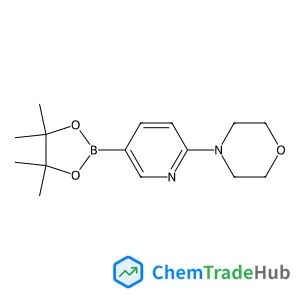
4-(5-(4,4,5,5-tetramethyl-1,3,2-dioxaborolan-2-yl)pyridin-2-yl)morpholine
CAS号:
485799-04-0
分子式:
C15H23BN2O3
推荐供应商






免责声明
本页面提供的学术期刊信息仅供参考和研究使用。我们与任何期刊出版商均无关联,也不处理投稿事宜。如有投稿相关咨询,请直接联系相关期刊出版商。
如发现页面信息有误,请发送邮件至 support@chemtradehub.com 联系我们。我们将及时核实并处理您的问题。