


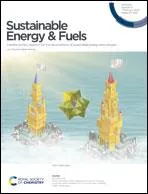

To flow or not to flow. A perspective on large-scale stationary electrochemical energy storage
文献信息
发布日期
2023-10-31
DOI
10.1039/D3SE00955F
影响因子
6.367
作者
Anukriti Pokhriyal, Daniel Rueda-García
查看原文
摘要
Energy storage is experiencing a renaissance as a result of the growing number of vital applications such as internet of things, smart grids, electric vehicles, renewable energy storage, etc. In particular, stationary energy storage must be urgently deployed at a large-scale to support full deployment of renewables and a sustainable grid. Electrochemical energy storage systems (EESS) will be key in this pursuit. Yet, present mature technologies are all sub-optimal. A myriad of new battery chemistries are being developed in research labs, each with specific strengths and drawbacks. EESS technologies such as lithium-ion batteries, lithium–sulfur, metal–air and other post-lithium technologies, but also supercapacitors, hybrid devices and redox flow batteries (RFBs), could benefit from collaborative development between top-down systems engineering and bottom-up material science. Lithium and post-lithium systems have been extensively researched and reviewed. This perspective article examines the energy storage landscape that goes from state-of-the-art flow cells to novel flowing and stationary technologies. While there is a wide scope for improvement of first generation RFBs, a wealth of novel concepts such as ambipolar electrolytes or shuttle cells to semisolid electrodes are also emerging. This could boost the energy density of these flowing systems. In our analysis we also propose other new concepts which could eventually lead to non-flowing large-scale electrochemical energy storage.
期刊推荐
Pharmacological Reviews
Russian Chemical Reviews

Proceedings of the National Academy of Sciences of the United States of America
Nature

Journal of Catalysis
Israel Journal of Chemistry

Journal of Heterocyclic Chemistry

Kinetics and Catalysis

Organic Preparations and Procedures International
Molecular Pharmacology
相关文献
Shock wave studies of the pyrolysis of fluorocarbon oxygenates. I. The thermal dissociation of C3F6O and CF3COF
C. J. Cobos, K. Hintzer, L. Sölter, E. Tellbach, A. Thaler
2016-12-19
Paper
DOI: 10.1039/C6CP06816B
Atomic-scale computational design of hydrophobic RE surface-doped Al2O3 and TiO2
Kamil Czelej, Marcin Roland Zemła, Piotr Śpiewak, Tomasz Wejrzanowski, Krzysztof Jan Kurzydłowski
2017-07-20
Paper
DOI: 10.1039/C7CP03109B
Inhibition of GNNQQNY prion peptide aggregation by trehalose: a mechanistic view
Nidhi Katyal, Shashank Deep
2017-06-27
Paper
DOI: 10.1039/C7CP02912H
Solvation of a chiral carboxylic acid: effects of hydrogen bonding on the IR and VCD spectra of α-methoxyphenylacetic acid
Karoline Bünnemann, Christian Merten
2017-06-12
Paper
DOI: 10.1039/C7CP02049J
Time-resolved spectroscopic analysis of the light-energy harvesting mechanism in carbazole-dendrimers with a blue-phosphorescent Ir-complex core
Yang-Jin Cho, So-Yoen Kim, Mi Rang Son, Ho-Jin Son, Sang Ook Kang
2017-07-10
Paper
DOI: 10.1039/C7CP01989K
Substantial enhancement of energy storage capability in polymer nanocomposites by encapsulation of BaTiO3 NWs with variable shell thickness
Guanyao Wang, Yanhui Huang, Yuxin Wang, Pingkai Jiang, Xingyi Huang
2017-07-12
Paper
DOI: 10.1039/C7CP04096B
An investigation of Na-related defects in Cu2ZnSnSe4
Xiaoli Zhang
2017-06-20
Paper
DOI: 10.1039/C7CP02192E
Two different critical regimes enclosed in the Bean–Rodbell model and their implications for the field dependence and universal scaling of the magnetocaloric effect
C. Romero-Muñiz, V. Franco, A. Conde
2016-12-20
Paper
DOI: 10.1039/C6CP06291A
您可能还喜欢
化合物问答
2-Bromo-4-chloro-1-(difluoromethyl)benzene(CAS号:1261476-50-9)的市场或研究趋势如何?
随着环保要求的提高和安全意识的增强,该化合物的研究和应用趋势正逐渐转向更安全、更环境友好的替代品。市场关注点主要集中在开发新型合成方法和绿色化学路径,以减少有害...
1261476-50-92-Bromo-4-chloro-1-(...
化合物问答
如何处理含有2,9 - 二苯基-1,10 - 菲罗啉(CAS号:25677-69-4)的废料?
处理含有2,9 - 二苯基 - 1,10 - 菲罗啉的废料时,应先将其收集在适当的容器中,避免与其他化学品混合。随后,可以通过水解或氧化等方法进行处理,直至达到...
25677-69-42,9-Diphenyl-1,10-ph...
化合物问答
处理(6-氯-吡嗪-3-基)-(4-乙基-哌嗪-1-基)-甲酮(CAS号:1178836-15-1)时应注意哪些实验室安全事项?
处理(6-氯-吡嗪-3-基)-(4-乙基-哌嗪-1-基)-甲酮时,应穿戴适当的个人防护装备(PPE),包括手套、护目镜和实验室外套。在通风橱中操作以确保良好的通...
1178836-15-1(6-Chloro-3-pyridazi...
化合物问答
处理(R)-2-氯-1-(2,4-二氯苯基)乙醇(CAS号:114446-57-0)时应注意哪些实验室安全事项?
在处理(R)-2-氯-1-(2,4-二氯苯基)乙醇时,应佩戴防护眼镜、实验室外套和手套,确保通风橱开启以减少接触和吸入的风险。避免直接接触皮肤和眼睛。处理过程中...
114446-57-0(1R)-2-Chloro-1-(2,4...
化合物问答
在合成中是否有3-氯-6-(3-氯哌啶-1-基)吡嗪(CAS号:1185310-37-5)的替代品?
可考虑使用类似结构的化合物作为替代品,如3-氯-6-(哌啶-1-基)吡嗪或3-氯-6-(2-氯哌啶-1-基)吡嗪,这些化合物在结构上与目标化合物相似,可能具有相...
1185310-37-53-Chloro-6-(3-chloro...
化合物问答
苯并三氮唑-5-甲酸乙酯(CAS号:73605-91-1)通常如何合成?
该化合物可以通过乙酸乙酯与5-溴-1H-苯并三氮唑的反应合成,通常在无水条件下进行。合成过程中,需要使用适当的溶剂如乙酸乙酯,并在适当的温度下反应。该反应具有较...
73605-91-1Ethyl 1H-benzotriazo...
化合物问答
什么是一水硫酸镁(CAS号:14168-73-1)?
一水硫酸镁是一种无机化合物,化学式为MgSO₄·H₂O,CAS号为14168-73-1。它由镁离子、硫酸根离子和一个结晶水分子组成,通常呈现为白色粉末或颗粒状固...
14168-73-1Magnesium sulfate hy...
化合物问答
氘代-1,3-二氯-2-丙醇(CAS号:1173020-20-6)应用于哪些行业?
氘代-1,3-二氯-2-丙醇主要应用于医药和有机合成领域,作为研究化合物的氘代替代品,用于标记和追踪反应过程。此外,在聚合物和半导体生产中也有一定的应用潜力。
1173020-20-61,3-Dichloro-2-(~2~H...
化合物问答
如何储存氰乙酸环己酯(CAS号:52688-11-6)?
氰乙酸环己酯应储存在阴凉、干燥、通风良好的环境中,远离火源和热源,防止阳光直射。储存容器应密封良好,避免与空气接触,防止发生不必要的反应。
52688-11-6Cyclohexyl cyanoacet...
化合物问答
2-碘-4-硝基苯胺(CAS号:6293-83-0)的市场或研究趋势如何?
目前,2-碘-4-硝基苯胺在医药和农药领域有一定的研究和应用,尤其是在开发新型药物和农药产品方面。然而,由于其潜在的环境和健康风险,行业正趋向于寻找更为安全和环...
6293-83-02-iodo-4-nitroanilin...
来源期刊
推荐化合物
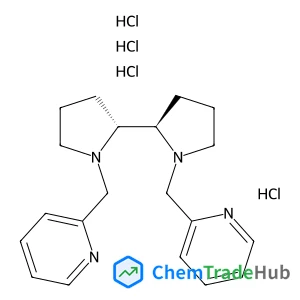
(2R,2'R)-1,1'-Bis(2-pyridinylmethyl)-2,2'-bipyrrolidine tetrahydrochloride
CAS号:
1228077-88-0
分子式:
C20H30Cl4N4
![5,7-Dihydroxy-3-(4-hydroxyphenyl)-6-[(1R,6R)-3-methyl-6-prop-1-en-2-ylcyclohex-2-en-1-yl]chromen-4-one structure](https://cnstatic.chemtradehub.com/structs/191/1914963-20-4-2b05.webp "5,7-Dihydroxy-3-(4-hydroxyphenyl)-6-[(1R,6R)-3-methyl-6-prop-1-en-2-ylcyclohex-2-en-1-yl]chromen-4-one structure")
![4-[(4-Bromophenyl)sulfonyl]thiomorpholine structure](https://cnstatic.chemtradehub.com/structs/223/223555-81-5-2d67.webp "4-[(4-Bromophenyl)sulfonyl]thiomorpholine structure")

1-(3',5'-Di-O-benzoyl-2'-deoxy-2'-fluoro-b-D-arabinofuranosyl)thymine
CAS号:
97614-47-6
分子式:
C24H21FN2O7
推荐供应商





免责声明
本页面提供的学术期刊信息仅供参考和研究使用。我们与任何期刊出版商均无关联,也不处理投稿事宜。如有投稿相关咨询,请直接联系相关期刊出版商。
如发现页面信息有误,请发送邮件至 support@chemtradehub.com 联系我们。我们将及时核实并处理您的问题。