






Heat-transfer enhancement and optimization design of a roadway with typical angles using field synergy theory
文献信息
发布日期
2023-11-21
DOI
10.1039/D3SE00989K
影响因子
6.367
作者
Yongliang Zhang, Xilong Zhang, Mingjie Li, Yunfei Liu, Zhen Hu
查看原文
摘要
Heat damage in underground mines has always been a difficult problem that troubles mining work. Many scholars are committed to studying its heat-transfer mechanism, exploring the heat-transfer characteristics between airflow and the surrounding rock under different influencing factors, so as to lay a theoretical foundation for the development of underground cooling technology. However, there is no research on the essence of convective heat transfer. In this study, we conducted numerical simulations of roadway models from different acute angles under the guidance of field synergy theory, explored the synergy between the velocity field and temperature-gradient field in the process of convective heat transfer, and obtained the roadway model with the least heat transfer. This should provide theoretical guidance for the selection of excavation plans for roadways in the underground mining process. This study first analyzed the influence of different typical angles of the roadway on the heat transfer performance of the airflow and the surrounding rock when the acute angles were 60°, 75°, and 90°, respectively, and also analyzed the influences of the Reynolds number and roadway angles on the heat transfer according to the field synergy theory, which revealed that the 90° roadway had the least heat transfer. Then, based on the 90° roadway model, 8 different types of turning radius (R) were added to the corners, and their heat-transfer performance and comprehensive performance were explored based on the field synergy theory. The results indicated that when R = 3.5 m, the convective heat transfer between the airflow and the surrounding rock was the least; when R = 4 m, the resistance of the airflow was the smallest; when R = 3.5 m, the comprehensive performance was the best, with an average comprehensive performance improvement of 2.7% compared to the 90° roadway. Therefore, in underground excavation operations, an excavation path with a turning radius of 3.5 meters should be selected.
相关文献
Synthesis of meso-β doubly linked porphyrin tapes
Akihiko Tsuda, Yasuyuki Nakamura, Atsuhiro Osuka
2003-04-07
Communication
DOI: 10.1039/B302032K
Palladium catalysed cyclisation–carbonylation of enynes to give cyclic γ,δ-unsaturated acids
Varinder K. Aggarwal, Mike Butters, Paul W. Davies
2003-04-02
Communication
DOI: 10.1039/B300719G
A neutral self-assembled coordination cage organized for inclusion of aromatic guests
Amir H. Mahmoudkhani, Adrien P. Côté, George K. H. Shimizu
2004-10-15
Communication
DOI: 10.1039/B412325E
Iron(iii) salen-type catalysts for the cross-coupling of aryl Grignards with alkyl halides bearing β-hydrogens
Robin B. Bedford, Duncan W. Bruce, Robert M. Frost, John W. Goodby, Michael Hird
2004-10-27
Communication
DOI: 10.1039/B413790F
Silica coated fullerenols: seeded growth of silica spheres under acidic conditions
Elizabeth A. Whitsitt, Andrew R. Barron
2003-04-04
Communication
DOI: 10.1039/B212808J
Cyclopropyl fatty acids implicate a radical but not a cation as an intermediate in P450BM3-catalysed hydroxylations
Max J. Cryle, Julia M. U. Stuthe, Paul R. Ortiz de Montellano, James J. De Voss
2004-01-27
Communication
DOI: 10.1039/B315911F
Thermosensitive PNIPAAm cryogel with superfast and stable oscillatory properties
Xian-Zheng Zhang, Chih-Chang Chu
2003-05-19
Communication
DOI: 10.1039/B301423A
A new type of bromide anion conducting solid
Nobuhito Imanaka, Yasuhiro Kato
2003-05-02
Communication
DOI: 10.1039/B300691C
Direction control in DNA binding of chiral d-lysine-based peptide nucleic acid (PNA) probed by electrospray mass spectrometry
Stefano Sforza, Tullia Tedeschi, Roberto Corradini, Arnaldo Dossena, Rosangela Marchelli
2003-04-02
Communication
DOI: 10.1039/B212718K
Synthesis of C-arylglycosides via Ru(ii)-catalyzed [2 + 2 + 2] cycloaddition
Yoshihiko Yamamoto, Tomoaki Saigoku, Takashige Ohgai, Hisao Nishiyama, Kenji Itoh
2004-10-07
Communication
DOI: 10.1039/B411442F
您可能还喜欢
化合物问答
如何处理含有8-氯咪唑并[1,2-A]吡嗪(CAS号:69214-33-1)的废料?
处理含有8-氯咪唑并[1,2-A]吡嗪的废料时,应首先将其收集并进行化学回收或降解。如果无法回收,需采用安全的化学处理方法,如中和、氧化还原或沉淀。处理过程中需...
69214-33-18-chloroimidazo[1,2-...
化合物问答
Calhex 231 hydrochloride(CAS号:2387505-78-2)适用哪些法规指南?
Calhex 231 hydrochloride 需要遵循《全球化学品统一分类和标签制度》(GHS)的分类和标签要求,以及欧盟的《化学品注册、评估、授权和限制条...
2387505-78-24-Chloro-N-[(1S,2S)-...
化合物问答
11-Beta,17-alpha,21-三羟基-5-beta-孕烯-3,20-二酮(CAS号:1482-50-4)的物理化学性质是什么?
11-Beta,17-alpha,21-三羟基-5-beta-孕烯-3,20-二酮是一种无色结晶性粉末,分子量为372.45 g/mol。该化合物在水中的溶解度...
1482-50-45β-Dihydrocortisol
化合物问答
处理5-异丙基-1,3,4-恶二唑-2-羧酸(CAS号:944907-13-5)时应注意哪些实验室安全事项?
处理5-异丙基-1,3,4-恶二唑-2-羧酸时应注意以下安全事项:穿戴适当的个人防护装备,包括实验室外套、手套和护目镜;操作应在通风橱中进行,以减少吸入或接触有...
944907-13-55-Isopropyl-1,3,4-ox...
化合物问答
benzyl 3-bromopropanoate(CAS号:90841-55-7)安全吗?
Benzyl 3-bromopropanoate属于有毒物质,吸入、摄入或皮肤接触均可能对人体造成伤害。操作时应佩戴防护眼镜、口罩和手套,避免吸入蒸汽和直接接触...
90841-55-7Benzyl 3-bromopropan...
化合物问答
什么是(R)-N-苄氧羰基-3,4-二氢-1H-异喹啉羧酸(CAS号:151004-88-5)?
(R)-N-苄氧羰基-3,4-二氢-1H-异喹啉羧酸是一种含有苄氧羰基和异喹啉环结构的化合物,分子式为C17H15NO3。它是一种有机化合物,具有一定的生物活性...
151004-88-5(1R)-2-[(Benzyloxy)c...
化合物问答
在合成中是否有1-苄基吡啶嗡-3-羧酸盐(CAS号:15990-43-9)的替代品?
可以考虑使用1-苄基吡啶-3-羧酸盐作为1-苄基吡啶嗡-3-羧酸盐的替代品。此外,还可以探索其他类似物,如1-苄基吡啶-3-氨基甲酸酯等。具体的替代品选择需根据...
15990-43-91-Benzyl-3-pyridiniu...
化合物问答
(2,6-二甲基吡啶-3-基)甲醇(CAS号:582303-10-4)安全吗?
(2,6-二甲基吡啶-3-基)甲醇在使用时需注意安全,应避免吸入其蒸汽,接触皮肤和眼睛。操作应在通风良好的环境中进行,佩戴适当的个人防护装备。
582303-10-4(2,6-Dimethyl-3-pyri...
化合物问答
5-溴-2-乙烯基吡啶(CAS号:226883-52-9)的物理化学性质是什么?
5-溴-2-乙烯基吡啶是一种有机化合物,外观为白色固体,具有良好的结晶性。分子量约为190.03 g/mol。它的溶解性在水中较差,但在有机溶剂如二氯甲烷、甲醇...
226883-52-95-Bromo-2-vinylpyrid...
化合物问答
2-羟基-3-硝基-5-甲基吡啶(CAS号:7464-14-4)应用于哪些行业?
2-羟基-3-硝基-5-甲基吡啶主要应用于医药、聚合物和半导体行业。在医药领域,它可以用作合成其他药物的中间体。在聚合物领域,它可以作为功能性单体参与聚合反应,...
7464-14-45-Methyl-3-nitro-2(1...
来源期刊
推荐化合物
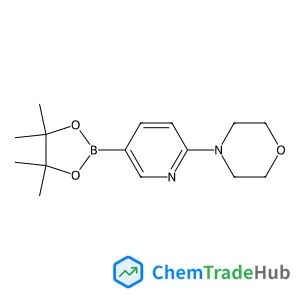
4-(5-(4,4,5,5-tetramethyl-1,3,2-dioxaborolan-2-yl)pyridin-2-yl)morpholine
CAS号:
485799-04-0
分子式:
C15H23BN2O3
推荐供应商






免责声明
本页面提供的学术期刊信息仅供参考和研究使用。我们与任何期刊出版商均无关联,也不处理投稿事宜。如有投稿相关咨询,请直接联系相关期刊出版商。
如发现页面信息有误,请发送邮件至 support@chemtradehub.com 联系我们。我们将及时核实并处理您的问题。