











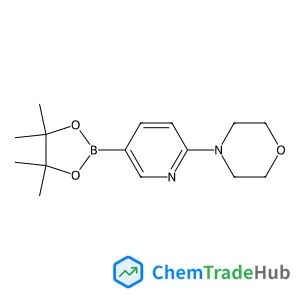
4-(5-(4,4,5,5-tetramethyl-1,3,2-dioxaborolan-2-yl)pyridin-2-yl)morpholine
CAS号:
485799-04-0
分子式:
C15H23BN2O3
Li-Ting Cui, Wen-Feng Lin, Shi-Gang Sun
After decades of effort, the performance of low-cost transition metal–nitrogen–carbon (M–N–C) catalysts has been significantly improved, positioning them as promising catalysts for the oxygen reduction reaction in proton-exchange-membrane fuel cells (PEMFCs). Despite this progress, compared to traditional commercial Pt/C catalysts, the practical application of M–N–C catalysts in PEMFCs is hindered by their inferior performance in acidic environments. In this perspective, we first summarize the current status of M–N–C catalysts in terms of activity and stability, and compare their performance with that of Pt/C catalysts. Then we discuss the fundamental research challenges associated with M–N–C catalysts, which are primarily related to (i) conducting basic research with tests exclusively using oversimplified aqueous electrolytes that limits exploration in practical fuel cell environments; (ii) lacking operando characterization methods under fuel cell working conditions; and (iii) the complexity of catalyst structures and fuel cell operating environments causing difficulty in M–N–C catalyst research. Lastly, we propose key advances that need to be made in the future to address these fundamental challenges, including the rational design of fit-for-purpose catalysts based on more cost-effective and efficient modelling, preparing model/quasi-model catalysts with defined and controllable structures, and developing operando characterization techniques for PEMFCs. By combined study using model/quasi-model catalysts, operando characterization methods and atomistic modeling, we can deeply understand the “structure-performance” relationship of the catalysts at various scales and develop next generation M–N–C catalysts that can meet the increased demand for PEMFCs.
Kumaranand Palaniappan, Stephen A. Hackney, Jian Liu
DOI: 10.1039/B409075F
Feihe Huang, Liang Zhou, Jason W. Jones, Harry W. Gibson, Mehdi Ashraf-Khorassani
DOI: 10.1039/B411234B
Dongliang Chang, Zunsheng Wang, Maarten F. Heringa, Renato Wirthner, Bernard Witholt, Zhi Li
DOI: 10.1039/B300435J
Xianying Li, Hongzhi Wang, Kouzou Inoue, Masato Uehara, Hiroyuki Nakamura, Masaya Miyazaki, Eiichi Abe, Hideaki Maeda
DOI: 10.1039/B300765K
Akihiko Tsuda, Yasuyuki Nakamura, Atsuhiro Osuka
DOI: 10.1039/B302032K
Tae-Jin Park, Yuanbing Mao
DOI: 10.1039/B409988E
Paula Alvarez-Bercedo, Andrew D. Bond, Robert Haigh, Alexander D. Hopkins, Gavin T. Lawson, Mary McPartlin, David Moncrieff, Marta E. Gonzalez Mosquera, Jeremy M. Rawson, Anthony D. Woods, Dominic S. Wright
DOI: 10.1039/B300522D
Dong Joon Choo, Woo Ho Shim, Dong Hoon Lee, Eun Joo Roh, Sang-gi Lee, Choong Eui Song
DOI: 10.1039/B301490H
Yuyang Liu, Jing Tang, J. H. Xin
DOI: 10.1039/B412282H
Hiroshi Shiigi, Yojiro Yamamoto, Hidetaka Yakabe, Shiho Tokonami, Tsutomu Nagaoka
DOI: 10.1039/B212226J
处理含有8-氯咪唑并[1,2-A]吡嗪的废料时,应首先将其收集并进行化学回收或降解。如果无法回收,需采用安全的化学处理方法,如中和、氧化还原或沉淀。处理过程中需...
Calhex 231 hydrochloride 需要遵循《全球化学品统一分类和标签制度》(GHS)的分类和标签要求,以及欧盟的《化学品注册、评估、授权和限制条...
11-Beta,17-alpha,21-三羟基-5-beta-孕烯-3,20-二酮是一种无色结晶性粉末,分子量为372.45 g/mol。该化合物在水中的溶解度...
处理5-异丙基-1,3,4-恶二唑-2-羧酸时应注意以下安全事项:穿戴适当的个人防护装备,包括实验室外套、手套和护目镜;操作应在通风橱中进行,以减少吸入或接触有...
Benzyl 3-bromopropanoate属于有毒物质,吸入、摄入或皮肤接触均可能对人体造成伤害。操作时应佩戴防护眼镜、口罩和手套,避免吸入蒸汽和直接接触...
(R)-N-苄氧羰基-3,4-二氢-1H-异喹啉羧酸是一种含有苄氧羰基和异喹啉环结构的化合物,分子式为C17H15NO3。它是一种有机化合物,具有一定的生物活性...
可以考虑使用1-苄基吡啶-3-羧酸盐作为1-苄基吡啶嗡-3-羧酸盐的替代品。此外,还可以探索其他类似物,如1-苄基吡啶-3-氨基甲酸酯等。具体的替代品选择需根据...
(2,6-二甲基吡啶-3-基)甲醇在使用时需注意安全,应避免吸入其蒸汽,接触皮肤和眼睛。操作应在通风良好的环境中进行,佩戴适当的个人防护装备。
5-溴-2-乙烯基吡啶是一种有机化合物,外观为白色固体,具有良好的结晶性。分子量约为190.03 g/mol。它的溶解性在水中较差,但在有机溶剂如二氯甲烷、甲醇...
2-羟基-3-硝基-5-甲基吡啶主要应用于医药、聚合物和半导体行业。在医药领域,它可以用作合成其他药物的中间体。在聚合物领域,它可以作为功能性单体参与聚合反应,...
![N-[(5,6-Dichloro-1H-benzimidazol-2-yl)methyl]-9-(1-methyl-1H-pyrazol-4-yl)-2-(4-morpholinyl)-9H-purin-6-amine structure](https://cnstatic.chemtradehub.com/structs/238/2387704-62-1-25f4.webp "N-[(5,6-Dichloro-1H-benzimidazol-2-yl)methyl]-9-(1-methyl-1H-pyrazol-4-yl)-2-(4-morpholinyl)-9H-purin-6-amine structure")







