


![2-Bromodibenzo[b,d]furan structure](https://cnstatic.chemtradehub.com/structs/86-/86-76-0-1814.webp "2-Bromodibenzo[b,d]furan structure")
Bioconjugate Chemistry
基本信息
期刊简写:
Bioconjugate Chem.
影响因子:
4
ISSN:
1043-1802
研究领域:
CHEMICAL
h-index:
161
自引率:
5%
年发文量:
209
SCI收录来源:
Science Citation Index Expanded
期刊官网:
https://pubs.acs.org/journal/bcches
期刊介绍:
Bioconjugate Chemistry invites original contributions on all research at the interface between synthetic and biological materials. The journal intends to provide a forum for presentation of research relevant to all aspects of bioconjugates, including the preparation, properties and applications of biomolecular conjugates. The mission of the journal is to communicate to advances in fields including: Biomolecular/macromolecular conjugates, conjugation reactions, and assemblies Bioorthogonal chemistry Bioconjugation reactions Antibody-drug conjugates Glycoconjugates Peptide and nucleic acid conjugates Glycopolymers, peptide and nucleotide-containing polymers Synthetic biology Therapeutic delivery Tissue targeting and tropism of macromolecules and assemblies Vaccine delivery, immunotherapies, and immune engineering Covalent and noncovalent inhibitors and degraders Drug, DNA, RNA, and gene editing system delivery and toxicity Probiotic and antimicrobial delivery Photodynamic/photothermal therapies Imaging, Sensing, and Analysis Imaging and diagnostic agent synthesis and delivery Chemical and macromolecular probes Theranostics Biosensors Computational and simulation of bioconjugates Artificial intelligence and machine learning of bioconjugate chemistry Assemblies, targeting, and controlled release Biomolecular and macromolecular assemblies and bionanotechnology Biopolymer and biomaterials chemistry and engineering Cell culture and stem cell scaffolds, tissue engineering, and regenerative medicine Macromolecular scaffolds for in vitro, ex vivo, and in vivo controlled release Covalent and noncovalent interactions, biophysics, and mechanisms of macromolecules and biological systems Tissue, cell, and/or microbiome-macromolecular Interactions and mechanisms
CiteScore
CiteScore
9
SJR
1.085
SNIP
0.861
| 学科 | 排名 | 百分位 |
|---|---|---|
ChemistryOrganic Chemistry |
23 / 211 | 89% |
期刊统计
Monthly
期/年
Submission to First Editorial Decision (Median Days): 4
Submission to First Decision with Peer Review (Median Days): 23.1
Submission to Accept (Median Days): 41
Accept to ASAP Publication (Median Days): 14
审稿周期
论文处理费
投稿信息
投稿网址:
https://acs.manuscriptcentral.com/acs收录体裁:
Communications
Articles
Reviews
Comments
Articles
Reviews
Comments
期刊推荐
Green Chemistry
Photochemical & Photobiological Sciences
Nature Reviews Drug Discovery

Coloration Technology
Angewandte Chemie International Edition
Contact Lens & Anterior Eye
Journal of Enzyme inhibition and Medicinal Chemistry
Foundations of Chemistry
Journal of Medical Biochemistry
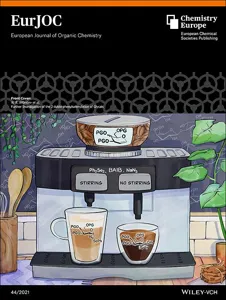
European Journal of Organic Chemistry
相关文献
Structure of palladium nanoparticles under oxidative conditions
Cristina Popa, Tianwei Zhu, Ionut Tranca, Payam Kaghazchi, Emiel J. M. Hensen
2014-12-08
Paper
DOI: 10.1039/C4CP01761G
Revisiting the conundrum of trehalose stabilization
Nidhi Katyal, Shashank Deep
2014-10-28
Paper
DOI: 10.1039/C4CP02914C
Nano-design of quantum dot-based photocatalysts for hydrogen generation using advanced surface molecular chemistry
Dalal Noureldine, Tayirjan Isimjan, Bin Lin, Silvano Del Gobbo, Mutalifu Abulikemu, Mohamed Nejib Hedhili, Dalaver H. Anjum, Kazuhiro Takanabe
2014-11-12
Paper
DOI: 10.1039/C4CP04365K
NMR studies of DNA microcapsules prepared using sonochemical methods
Keren Keinan-Adamsky, Jordan H. Chill, Hugo E. Gottlieb, Gil Goobes
2014-11-21
Paper
DOI: 10.1039/C4CP04312J
Re-visiting the O/Cu(111) system – when metastable surface oxides could become an issue!
Norina A. Richter, Chang-Eun Kim, Catherine Stampfl, Aloysius Soon
2014-10-28
Paper
DOI: 10.1039/C4CP04473H
Effects of 3d transition-metal doping on electronic and magnetic properties of MoS2 nanoribbons
Xiaoqing Tian, Lin Liu, Yu Du, Juan Gu, Jian-bin Xu, Boris I. Yakobson
2014-11-26
Paper
DOI: 10.1039/C4CP04579C
Intra-residue interactions in proteins: interplay between serine or cysteine side chains and backbone conformations, revealed by laser spectroscopy of isolated model peptides
Himansu S. Biswal
2014-11-27
Paper
DOI: 10.1039/C4CP04449E
Growth of axial nested P–N heterojunction nanowires for high performance diodes
Nan Chen, Zheng Xue, Hui Yang, Zhou Zhang, Juan Gao, Yongjun Li, Huibiao Liu
2014-11-25
Paper
DOI: 10.1039/C4CP04397A
The planar electric double layer capacitance for the solvent primitive model electrolyte
Stanisław Lamperski, Monika Płuciennik, Christopher W. Outhwaite
2014-11-12
Paper
DOI: 10.1039/C4CP03513E
Autocatalytic growth of ZnO nanorods from flat Au(111)-supported ZnO films
Leandro Pascua, Hans-Joachim Freund
2014-10-27
Paper
DOI: 10.1039/C4CP03730H
您可能还喜欢
化合物问答
4-[4-三氟甲基苯基]恶唑(CAS号:1126636-40-5)通常如何合成?
4-[4-三氟甲基苯基]恶唑通常通过将4-三氟甲基苯酚与异硫氰酸苯酯在有机溶剂中进行酯化反应合成。该反应可在无水条件下,使用适当的催化剂,如四丁基氢氧化铵,以提...
1126636-40-54-(4-(Trifluoromethy...
59729-32-71-[3-(Dimethylamino)...
化合物问答
RockPhos Pd G3(CAS号:2009020-38-4)通常如何合成?
RockPhos Pd G3 通常通过钯催化偶联反应合成,使用配体 (2'-Amino-2-biphenylyl)(methanesulfonato-kappa...
2009020-38-4(2'-Amino-2-biphenyl...
化合物问答
1-哌啶甲酰胺(CAS号:2158-03-4)的市场或研究趋势如何?
1-哌啶甲酰胺作为有机合成中的重要中间体,其市场需求主要受医药、农药、染料等行业推动。近年来,随着新药开发和绿色化学的发展,该化合物的研究趋势集中在开发更高效、...
2158-03-41-Piperidinecarboxam...
化合物问答
2-(二苯基膦基)乙胺(CAS号:4848-43-5)适用哪些法规指南?
2-(二苯基膦基)乙胺适用于多种法规指南,包括但不限于《全球化学品统一分类和标签制度》(GHS),欧盟《化学品注册、评估、授权和限制》法规(REACH),以及美...
4848-43-52-(Diphenylphosphino...
化合物问答
如何储存间苯二甲酸二烯丙酯(CAS号:1087-21-4)?
间苯二甲酸二烯丙酯应储存在阴凉、干燥、通风良好的地方,远离火源和热源。储存容器应密封,避免光照和高温。储存温度应控制在25℃以下,相对湿度应低于80%。避免与其...
1087-21-4Diallyl isophthalate
化合物问答
什么是间甲苯异硫代异氰酸酯(CAS号:621-30-7)?
间甲苯异硫代异氰酸酯是一种有机化合物,分子式为C7H7NO2S,具有刺激性气味。它是一种重要的有机合成中间体,在合成其他化合物时广泛应用。
621-30-71-Isothiocyanato-3-m...
化合物问答
在合成中是否有N-Boc-D-苯丙氨醇(CAS号:106454-69-7)的替代品?
在合成中,可以考虑使用N-Cbz-D-苯丙氨醇或N-Fmoc-D-苯丙氨醇作为替代品。这些化合物同样具有保护氨基的功能,且在合成过程中表现出良好的反应性能。
106454-69-72-Methyl-2-propanyl ...
化合物问答
3-羟甲基-2-氧异丙基吡啶(CAS号:954240-50-7)的主要用途是什么?
3-羟甲基-2-氧异丙基吡啶主要用于有机合成领域,可以作为合成其他药物、农药或精细化学品的中间体。此外,它还可能在实验室研究中作为特定反应的前体或溶剂。
954240-50-7(2-Isopropoxy-3-pyri...
化合物问答
6-氨基-9-甲基嘌呤(CAS号:700-00-5)应用于哪些行业?
6-氨基-9-甲基嘌呤目前主要应用于医药行业,作为某些药物的中间体。此外,它还可能用于聚合物、传感器和半导体的某些领域,作为功能性单体或掺杂剂。
700-00-59-Methyl-9H-purin-6-...
推荐化合物
![Bis[(1,2,3,4,5-eta)-1-(diphenylphosphino)cyclopentadienyl]iron structure](https://cnstatic.chemtradehub.com/structs/121/12150-46-8-ecd2.webp "Bis[(1,2,3,4,5-eta)-1-(diphenylphosphino)cyclopentadienyl]iron structure")
![2-{3-[4-(3-Chlorophenyl)-1-piperazinyl]propyl}[1,2,4]triazolo[4,3-a]pyridin-3(2H)-one hydrochloride (1:1) structure](https://cnstatic.chemtradehub.com/structs/253/25332-39-2-496e.webp "2-{3-[4-(3-Chlorophenyl)-1-piperazinyl]propyl}[1,2,4]triazolo[4,3-a]pyridin-3(2H)-one hydrochloride (1:1) structure")
推荐供应商




免责声明
本页面提供的学术期刊信息仅供参考和研究使用。我们与任何期刊出版商均无关联,也不处理投稿事宜。如有投稿相关咨询,请直接联系相关期刊出版商。
如发现页面信息有误,请发送邮件至 support@chemtradehub.com 联系我们。我们将及时核实并处理您的问题。