








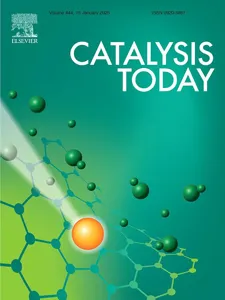
Catalysis Today
基本信息
期刊简写:
CATAL TODAY
影响因子:
5.2
ISSN:
0920-5861
研究领域:
CHEMICAL
h-index:
190
自引率:
3.8%
年发文量:
482
SCI收录来源:
Science Citation Index Expanded
期刊官网:
https://www.sciencedirect.com/journal/catalysis-today
期刊介绍:
A Serial Publication Featuring Topical Themes in Catalysis and Related Subjects: Click Here for the Full List of Special Issues Published in Catalysis Today. Catalysis Today focuses on the rapid publication of original invited papers devoted to currently important topics in catalysis and related subjects. The journal only publishes special issues (Proposing a Catalysis Today Special Issue), each of which is supervised by Guest Editors who recruit individual papers and oversee the peer review process. Catalysis Today offers researchers in the field of catalysis in-depth overviews of topical issues. Both fundamental and applied aspects of catalysis are covered. Subjects such as catalysis of immobilized organometallic and biocatalytic systems are welcome. Subjects related to catalysis such as experimental techniques, adsorption, process technology, synthesis, in situ characterization, computational, theoretical modeling, imaging and others are included if there is a clear relationship to catalysis. Each issue of Catalysis Today covers a distinct topic. Types of publication are: Selected papers based on a symposia, workshop, or conference. Review articles, in-depth tutorials, or original publications on a common theme. Monographs (detailed papers covering a specific subject, typically of sufficient scope to constitute a full journal issue). Researchers who would like to serve as Guest Editors are encouraged to contact any of the journal Editors to answer specific questions.
CiteScore
CiteScore
11.5
SJR
1.022
SNIP
1.024
| 学科 | 排名 | 百分位 |
|---|---|---|
ChemistryGeneral Chemistry |
45 / 408 | 89% |
期刊统计
Monthly
期/年
Submission to acceptance: 109days
Acceptance to publication: 5days
审稿周期
$3790
论文处理费
投稿信息
投稿网址:
https://www.editorialmanager.com/CATTOD收录体裁:
review articles
Monographs
Proceedings of short meetings
Monographs
Proceedings of short meetings
相关文献
Intersystem crossing driven by vibronic spin–orbit coupling: a case study on psoralen
Jörg Tatchen, Natalie Gilka, Christel M. Marian
2007-09-03
Paper
DOI: 10.1039/B706410A
Influence of the d orbital occupation on the nature and strength of copper cation–π interactions: threshold collision-induced dissociation and theoretical studies
Chunhai Ruan, Zhibo Yang, M. T. Rodgers
2007-09-25
Paper
DOI: 10.1039/B709820K
Coverage dependent structures of oligopyridine adlayers on (111) oriented Ag films
Matthias Roos, Harry E. Hoster, Achim Breitruck, R. Jürgen Behm
2007-08-30
Paper
DOI: 10.1039/B708578H
A coupled cluster study of the electronic spectroscopy and photochemistry of Cr(CO)6
Sébastien Villaume, Alain Strich, Chantal Daniel, S. Ajith Perera, Rodney J. Bartlett
2007-10-11
Paper
DOI: 10.1039/B709050A
Frequency-dependent response properties and excitation energies from one-electron density matrix functionals
Jerzy Cioslowski
2007-07-23
Perspective
DOI: 10.1039/B704797E
Global exploration of the energy landscape of solids on the ab initio level
K. Doll, J. C. Schön, M. Jansen
2007-10-16
Paper
DOI: 10.1039/B709943F
Constraints at the transition state of the D + H2 reaction: quantum bottlenecks vs. stereodynamics
F. J. Aoiz, V. J. Herrero, M. P. de Miranda, V. Sáez Rábanos
2007-08-14
Paper
DOI: 10.1039/B709161C
On the origin of the forward peak and backward oscillations in the F + H2(v = 0) → HF(v′ = 2) + H reaction
D. Sokolovski, S. Cavalli, V. Aquilanti
2007-09-13
Paper
DOI: 10.1039/B709427B
Chemorheological analysis and model-free kinetics of acid catalysed furfuryl alcohol polymerization
Nathanael Guigo, Alice Mija, Luc Vincent, Nicolas Sbirrazzuoli
2007-08-08
Paper
DOI: 10.1039/B707950H
您可能还喜欢
化合物问答
4-[4-三氟甲基苯基]恶唑(CAS号:1126636-40-5)通常如何合成?
4-[4-三氟甲基苯基]恶唑通常通过将4-三氟甲基苯酚与异硫氰酸苯酯在有机溶剂中进行酯化反应合成。该反应可在无水条件下,使用适当的催化剂,如四丁基氢氧化铵,以提...
1126636-40-54-(4-(Trifluoromethy...
59729-32-71-[3-(Dimethylamino)...
化合物问答
RockPhos Pd G3(CAS号:2009020-38-4)通常如何合成?
RockPhos Pd G3 通常通过钯催化偶联反应合成,使用配体 (2'-Amino-2-biphenylyl)(methanesulfonato-kappa...
2009020-38-4(2'-Amino-2-biphenyl...
化合物问答
1-哌啶甲酰胺(CAS号:2158-03-4)的市场或研究趋势如何?
1-哌啶甲酰胺作为有机合成中的重要中间体,其市场需求主要受医药、农药、染料等行业推动。近年来,随着新药开发和绿色化学的发展,该化合物的研究趋势集中在开发更高效、...
2158-03-41-Piperidinecarboxam...
化合物问答
2-(二苯基膦基)乙胺(CAS号:4848-43-5)适用哪些法规指南?
2-(二苯基膦基)乙胺适用于多种法规指南,包括但不限于《全球化学品统一分类和标签制度》(GHS),欧盟《化学品注册、评估、授权和限制》法规(REACH),以及美...
4848-43-52-(Diphenylphosphino...
化合物问答
如何储存间苯二甲酸二烯丙酯(CAS号:1087-21-4)?
间苯二甲酸二烯丙酯应储存在阴凉、干燥、通风良好的地方,远离火源和热源。储存容器应密封,避免光照和高温。储存温度应控制在25℃以下,相对湿度应低于80%。避免与其...
1087-21-4Diallyl isophthalate
化合物问答
什么是间甲苯异硫代异氰酸酯(CAS号:621-30-7)?
间甲苯异硫代异氰酸酯是一种有机化合物,分子式为C7H7NO2S,具有刺激性气味。它是一种重要的有机合成中间体,在合成其他化合物时广泛应用。
621-30-71-Isothiocyanato-3-m...
化合物问答
在合成中是否有N-Boc-D-苯丙氨醇(CAS号:106454-69-7)的替代品?
在合成中,可以考虑使用N-Cbz-D-苯丙氨醇或N-Fmoc-D-苯丙氨醇作为替代品。这些化合物同样具有保护氨基的功能,且在合成过程中表现出良好的反应性能。
106454-69-72-Methyl-2-propanyl ...
化合物问答
3-羟甲基-2-氧异丙基吡啶(CAS号:954240-50-7)的主要用途是什么?
3-羟甲基-2-氧异丙基吡啶主要用于有机合成领域,可以作为合成其他药物、农药或精细化学品的中间体。此外,它还可能在实验室研究中作为特定反应的前体或溶剂。
954240-50-7(2-Isopropoxy-3-pyri...
化合物问答
6-氨基-9-甲基嘌呤(CAS号:700-00-5)应用于哪些行业?
6-氨基-9-甲基嘌呤目前主要应用于医药行业,作为某些药物的中间体。此外,它还可能用于聚合物、传感器和半导体的某些领域,作为功能性单体或掺杂剂。
700-00-59-Methyl-9H-purin-6-...
推荐化合物
![1-(Hexopyranosyloxy)-4a,5-dihydroxy-7-methyl-1,4a,5,6,7,7a-hexahydrocyclopenta[c]pyran-7-yl 3-phenylacrylate structure](https://cnstatic.chemtradehub.com/structs/192/19210-12-9-ecae.webp "1-(Hexopyranosyloxy)-4a,5-dihydroxy-7-methyl-1,4a,5,6,7,7a-hexahydrocyclopenta[c]pyran-7-yl 3-phenylacrylate structure")
![[2',6'-bis(propan-2-yloxy)-[1,1'-biphenyl]-3-yl]dicyclohexylphosphane structure](https://cnstatic.chemtradehub.com/structs/787/787618-22-8-dda2.webp "[2',6'-bis(propan-2-yloxy)-[1,1'-biphenyl]-3-yl]dicyclohexylphosphane structure")
[2',6'-bis(propan-2-yloxy)-[1,1'-biphenyl]-3-yl]dicyclohexylphosphane
CAS号:
787618-22-8
分子式:
C30H43O2P
推荐供应商




免责声明
本页面提供的学术期刊信息仅供参考和研究使用。我们与任何期刊出版商均无关联,也不处理投稿事宜。如有投稿相关咨询,请直接联系相关期刊出版商。
如发现页面信息有误,请发送邮件至 support@chemtradehub.com 联系我们。我们将及时核实并处理您的问题。