


Heteroatom Chemistry
基本信息
期刊简写:
HETEROATOM CHEM
影响因子:
1.1
ISSN:
1042-7163
研究领域:
CHEMICAL
h-index:
38
自引率:
6.6%
年发文量:
3
SCI收录来源:
Science Citation Index Expanded
期刊官网:
https://www.hindawi.com/journals/htrc
期刊介绍:
Heteroatom Chemistry brings together a broad, interdisciplinary group of chemists who work with compounds containing main-group elements of groups 13 through 17 of the Periodic Table, and certain other related elements. The fundamental reactivity under investigation should, in all cases, be concentrated about the heteroatoms. It does not matter whether the compounds being studied are acyclic or cyclic; saturated or unsaturated; monomeric, polymeric or solid state in nature; inorganic, organic, or naturally occurring, so long as the heteroatom is playing an essential role. Computational, experimental, and combined studies are equally welcome. Subject areas include (but are by no means limited to): Reactivity about heteroatoms for accessing new products or synthetic pathways Unusual valency main-group element compounds and their properties Highly strained (e.g. bridged) main-group element compounds and their properties Photochemical or thermal cleavage of heteroatom bonds and the resulting reactivity Uncommon and structurally interesting heteroatom-containing species (including those containing multiple bonds and catenation) Stereochemistry of compounds due to the presence of heteroatoms Neighboring group effects of heteroatoms on the properties of compounds Main-group element compounds as analogues of transition metal compounds Variations and new results from established and named reactions (including Wittig, Kabachnik–Fields, Pudovik, Arbuzov, Hirao, and Mitsunobu) Catalysis and green syntheses enabled by heteroatoms and their chemistry Applications of compounds where the heteroatom plays a critical role In addition to original research articles on heteroatom chemistry, the journal welcomes focused review articles that examine the state of the art, identify emerging trends, and suggest future directions for developing fields.
CiteScore
CiteScore
1.2
SJR
0.167
SNIP
0.407
| 学科 | 排名 | 百分位 |
|---|---|---|
ChemistryGeneral Chemistry |
319 / 408 | 21% |
期刊统计
Bimonthly
期/年
Submission to first decision:12 days
Submission to acceptance:127 days
审稿周期
$1550 USD
论文处理费
投稿信息
投稿网址:
http://mc.manuscriptcentral.com/hc相关文献
Correction: Fused ambipolar aza-isoindigos with NIR absorption
Danlei Zhu, Hailiang Liao, Sheik Haseena, Mahesh Kumar Ravva, Shengyu Cong, Liuyuan Lan, Yazhou Wang, Zhengke Li, Lang Jiang, Wan Yue
2021-03-03
Correction
DOI: 10.1039/D1QO90017J
α-C–H difluoroalkylation of alkyl sulfoxides via intermolecular Pummerer reaction
Xin Huang, Weizhao Zhao, Yuchen Liang, Minghui Wang, Yaling Zhan, Yage Zhang, Lichun Kong, Zhi-Xiang Wang, Bo Peng
2021-01-22
Research Article
DOI: 10.1039/D0QO01513J
Synthesis, biological evaluation and DNA binding properties of novel mono and bisnaphthalimides
Miguel F. Braña, Mónica Cacho, Ana Ramos, M. Teresa Domínguez, Jose M. Pozuelo, Cristina Abradelo, M. Fernanda Rey-Stolle, Mercedes Yuste, Carolina Carrasco, Christian Bailly
2003-01-24
Paper
DOI: 10.1039/B209042B
(±)-Pinnatifidaones A–D, four pairs of highly modified neolignan enantiomers with a rare spirocyclohexenone skeleton from Crataegus pinnatifida
Rui Guo, Peng Zhao, Xiaoqi Yu, Guodong Yao, Bin Lin, Xiaoxiao Huang, Shaojiang Song
2021-01-06
Research Article
DOI: 10.1039/D0QO01475C
Experimental and quantum-mechanical investigation of the vinylsilane-iminium ion cyclization
Lisbet Kværnø, Per-Ola Norrby, David Tanner
2003-02-24
Paper
DOI: 10.1039/B212333A
Recent advances in cascade radical cyclization of radical acceptors for the synthesis of carbo- and heterocycles
Jianhua Liao, Xiao Yang, Lu Ouyang, Yinlong Lai, Jiuzhong Huang, Renshi Luo
2021-01-08
Review Article
DOI: 10.1039/D0QO01453B
New cytotoxic cembrane based diterpenes from the soft corals Sarcophyton cherbonnieri and Nephthea sp.
Harald Gross, Stefan Kehraus, Markus Nett, Gabriele M. König, Winfried Beil, Anthony D. Wright
2003-02-24
Paper
DOI: 10.1039/B210039H
Copper-catalyzed three-component oxycyanation of alkenes
Yuehua Zeng, Yajun Li, Daqi Lv
2020-12-25
Research Article
DOI: 10.1039/D0QO01437K
您可能还喜欢
化合物问答
4-[4-三氟甲基苯基]恶唑(CAS号:1126636-40-5)通常如何合成?
4-[4-三氟甲基苯基]恶唑通常通过将4-三氟甲基苯酚与异硫氰酸苯酯在有机溶剂中进行酯化反应合成。该反应可在无水条件下,使用适当的催化剂,如四丁基氢氧化铵,以提...
1126636-40-54-(4-(Trifluoromethy...
59729-32-71-[3-(Dimethylamino)...
化合物问答
RockPhos Pd G3(CAS号:2009020-38-4)通常如何合成?
RockPhos Pd G3 通常通过钯催化偶联反应合成,使用配体 (2'-Amino-2-biphenylyl)(methanesulfonato-kappa...
2009020-38-4(2'-Amino-2-biphenyl...
化合物问答
1-哌啶甲酰胺(CAS号:2158-03-4)的市场或研究趋势如何?
1-哌啶甲酰胺作为有机合成中的重要中间体,其市场需求主要受医药、农药、染料等行业推动。近年来,随着新药开发和绿色化学的发展,该化合物的研究趋势集中在开发更高效、...
2158-03-41-Piperidinecarboxam...
化合物问答
2-(二苯基膦基)乙胺(CAS号:4848-43-5)适用哪些法规指南?
2-(二苯基膦基)乙胺适用于多种法规指南,包括但不限于《全球化学品统一分类和标签制度》(GHS),欧盟《化学品注册、评估、授权和限制》法规(REACH),以及美...
4848-43-52-(Diphenylphosphino...
化合物问答
如何储存间苯二甲酸二烯丙酯(CAS号:1087-21-4)?
间苯二甲酸二烯丙酯应储存在阴凉、干燥、通风良好的地方,远离火源和热源。储存容器应密封,避免光照和高温。储存温度应控制在25℃以下,相对湿度应低于80%。避免与其...
1087-21-4Diallyl isophthalate
化合物问答
什么是间甲苯异硫代异氰酸酯(CAS号:621-30-7)?
间甲苯异硫代异氰酸酯是一种有机化合物,分子式为C7H7NO2S,具有刺激性气味。它是一种重要的有机合成中间体,在合成其他化合物时广泛应用。
621-30-71-Isothiocyanato-3-m...
化合物问答
在合成中是否有N-Boc-D-苯丙氨醇(CAS号:106454-69-7)的替代品?
在合成中,可以考虑使用N-Cbz-D-苯丙氨醇或N-Fmoc-D-苯丙氨醇作为替代品。这些化合物同样具有保护氨基的功能,且在合成过程中表现出良好的反应性能。
106454-69-72-Methyl-2-propanyl ...
化合物问答
3-羟甲基-2-氧异丙基吡啶(CAS号:954240-50-7)的主要用途是什么?
3-羟甲基-2-氧异丙基吡啶主要用于有机合成领域,可以作为合成其他药物、农药或精细化学品的中间体。此外,它还可能在实验室研究中作为特定反应的前体或溶剂。
954240-50-7(2-Isopropoxy-3-pyri...
化合物问答
6-氨基-9-甲基嘌呤(CAS号:700-00-5)应用于哪些行业?
6-氨基-9-甲基嘌呤目前主要应用于医药行业,作为某些药物的中间体。此外,它还可能用于聚合物、传感器和半导体的某些领域,作为功能性单体或掺杂剂。
700-00-59-Methyl-9H-purin-6-...
推荐化合物
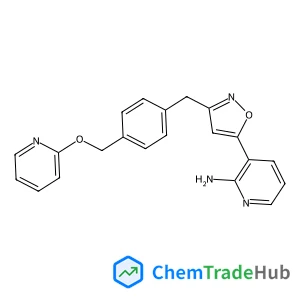
3-(3-(4-((Pyridin-2-yloxy)methyl)benzyl)isoxazol-5-yl)pyridin-2-amine
CAS号:
936339-60-5
分子式:
C21H18N4O2
![1,4-Dioxaspiro[4.5]dec-7-en-8-ylboronic acid structure](https://cnstatic.chemtradehub.com/structs/850/850567-90-7-6fff.webp "1,4-Dioxaspiro[4.5]dec-7-en-8-ylboronic acid structure")
推荐供应商






免责声明
本页面提供的学术期刊信息仅供参考和研究使用。我们与任何期刊出版商均无关联,也不处理投稿事宜。如有投稿相关咨询,请直接联系相关期刊出版商。
如发现页面信息有误,请发送邮件至 support@chemtradehub.com 联系我们。我们将及时核实并处理您的问题。