



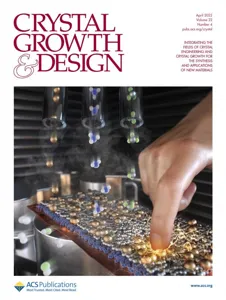
Crystal Growth & Design
基本信息
期刊简写:
Cryst. Growth Des.
影响因子:
3.2
ISSN:
1528-7483
研究领域:
PHYSICAL
h-index:
139
自引率:
12.5%
年发文量:
898
SCI收录来源:
Science Citation Index Expanded
期刊官网:
https://pubs.acs.org/journal/cgdefu
期刊介绍:
Crystal Growth & Design publishes theoretical and experimental studies of the physical, chemical, and biological phenomena and processes related to the design, growth, and application of crystalline materials. Synergistic approaches originating from different disciplines and technologies and integrating the fields of crystal growth, crystal engineering, intermolecular interactions, and industrial application are encouraged. Contributions emphasizing the fundamental concepts of crystal growth or molecular assembly and supporting further understanding of the relationship between assembly conditions and resulting properties or function of the material are highlighted. The journal does not publish routine reports of new material morphologies unless the morphology leads to significantly improved function or properties. The journal primarily covers the following: Crystal engineering (e.g., organic, inorganic, and hybrid solids) Crystal growth of inorganic, organic, and biological substances (e.g., biomineralization) Molecular assembly processes related to crystallization including the formation of gels, liquid crystals, colloids and amorphous materials Polymorphism, polytypism Development of new functional nanostructured phases Intermolecular interactions in the solid state (e.g., hydrogen bonding, lattice energies) Modeling of crystal growth processes Prediction of crystal structure and crystal habit Determination and calculation of electronic distribution in the solid state Nucleation theory Molecular kinetics and transport phenomena in crystal growth Phase transitions Solvation and crystallization phenomena, modeling of crystallization processes Significant new ideas in industrial crystallization Crystal Growth & Design does not cover routine reports of crystal or molecular structures.
CiteScore
CiteScore
4.01
SJR
1.046
SNIP
1.107
| 学科 | 排名 | 百分位 |
|---|---|---|
Physics and AstronomyCondensed Matter Physics |
42 / 397 | 89% |
期刊统计
Monthly
期/年
Submission to First Editorial Decision (Median Days): 3.4
Submission to First Decision with Peer Review (Median Days): 30.5
Submission to Accept (Median Days): 76.9
Accept to ASAP Publication (Median Days): 13.1
审稿周期
论文处理费
投稿信息
投稿网址:
https://acs.manuscriptcentral.com/acs收录体裁:
Communications
Articles
Reviews
Perspectives
Articles
Reviews
Perspectives
相关文献
Chemorheological analysis and model-free kinetics of acid catalysed furfuryl alcohol polymerization
Nathanael Guigo, Alice Mija, Luc Vincent, Nicolas Sbirrazzuoli
2007-08-08
Paper
DOI: 10.1039/B707950H
Solute–solvent interactions in imidazolium camphorsulfonate ionic liquids
Kaoru Nobuoka, Satoshi Kitaoka, Masashi Iio, Thomas Harran, Yuichi Ishikawa
2007-08-28
Paper
DOI: 10.1039/B709407H
Frequency-dependent response properties and excitation energies from one-electron density matrix functionals
Jerzy Cioslowski
2007-07-23
Perspective
DOI: 10.1039/B704797E
Structural characterization of an anhydrous polymorph of paclitaxel by solid-state NMR‡
James K. Harper, David M. Grant
2007-10-10
Paper
DOI: 10.1039/B711027H
Spectroelectrochemical responses of thin-film conducting copolymers prepared electrochemically from mixtures of 3,4-ethylenedioxythiophene and 2,2′-bithiophene
Andrew Glidle, Roger J. Mortimer, Karl S. Ryder
2007-11-02
Paper
DOI: 10.1039/B713018J
Dependence of the nascent vibrational distribution of NO(v) on the photolysis wavelength of NO2 in the range λ = 266–327 nm measured by time-resolved Fourier transform infrared emission
C. Brooks, G. Hancock, M. Saunders
2007-08-03
Paper
DOI: 10.1039/B710594K
您可能还喜欢
化合物问答
4-[4-三氟甲基苯基]恶唑(CAS号:1126636-40-5)通常如何合成?
4-[4-三氟甲基苯基]恶唑通常通过将4-三氟甲基苯酚与异硫氰酸苯酯在有机溶剂中进行酯化反应合成。该反应可在无水条件下,使用适当的催化剂,如四丁基氢氧化铵,以提...
1126636-40-54-(4-(Trifluoromethy...
59729-32-71-[3-(Dimethylamino)...
化合物问答
RockPhos Pd G3(CAS号:2009020-38-4)通常如何合成?
RockPhos Pd G3 通常通过钯催化偶联反应合成,使用配体 (2'-Amino-2-biphenylyl)(methanesulfonato-kappa...
2009020-38-4(2'-Amino-2-biphenyl...
化合物问答
1-哌啶甲酰胺(CAS号:2158-03-4)的市场或研究趋势如何?
1-哌啶甲酰胺作为有机合成中的重要中间体,其市场需求主要受医药、农药、染料等行业推动。近年来,随着新药开发和绿色化学的发展,该化合物的研究趋势集中在开发更高效、...
2158-03-41-Piperidinecarboxam...
化合物问答
2-(二苯基膦基)乙胺(CAS号:4848-43-5)适用哪些法规指南?
2-(二苯基膦基)乙胺适用于多种法规指南,包括但不限于《全球化学品统一分类和标签制度》(GHS),欧盟《化学品注册、评估、授权和限制》法规(REACH),以及美...
4848-43-52-(Diphenylphosphino...
化合物问答
如何储存间苯二甲酸二烯丙酯(CAS号:1087-21-4)?
间苯二甲酸二烯丙酯应储存在阴凉、干燥、通风良好的地方,远离火源和热源。储存容器应密封,避免光照和高温。储存温度应控制在25℃以下,相对湿度应低于80%。避免与其...
1087-21-4Diallyl isophthalate
化合物问答
什么是间甲苯异硫代异氰酸酯(CAS号:621-30-7)?
间甲苯异硫代异氰酸酯是一种有机化合物,分子式为C7H7NO2S,具有刺激性气味。它是一种重要的有机合成中间体,在合成其他化合物时广泛应用。
621-30-71-Isothiocyanato-3-m...
化合物问答
在合成中是否有N-Boc-D-苯丙氨醇(CAS号:106454-69-7)的替代品?
在合成中,可以考虑使用N-Cbz-D-苯丙氨醇或N-Fmoc-D-苯丙氨醇作为替代品。这些化合物同样具有保护氨基的功能,且在合成过程中表现出良好的反应性能。
106454-69-72-Methyl-2-propanyl ...
化合物问答
3-羟甲基-2-氧异丙基吡啶(CAS号:954240-50-7)的主要用途是什么?
3-羟甲基-2-氧异丙基吡啶主要用于有机合成领域,可以作为合成其他药物、农药或精细化学品的中间体。此外,它还可能在实验室研究中作为特定反应的前体或溶剂。
954240-50-7(2-Isopropoxy-3-pyri...
化合物问答
6-氨基-9-甲基嘌呤(CAS号:700-00-5)应用于哪些行业?
6-氨基-9-甲基嘌呤目前主要应用于医药行业,作为某些药物的中间体。此外,它还可能用于聚合物、传感器和半导体的某些领域,作为功能性单体或掺杂剂。
700-00-59-Methyl-9H-purin-6-...
推荐化合物
![Bis[(1,2,3,4,5-eta)-1-(diphenylphosphino)cyclopentadienyl]iron structure](https://cnstatic.chemtradehub.com/structs/121/12150-46-8-ecd2.webp "Bis[(1,2,3,4,5-eta)-1-(diphenylphosphino)cyclopentadienyl]iron structure")
![2-{3-[4-(3-Chlorophenyl)-1-piperazinyl]propyl}[1,2,4]triazolo[4,3-a]pyridin-3(2H)-one hydrochloride (1:1) structure](https://cnstatic.chemtradehub.com/structs/253/25332-39-2-496e.webp "2-{3-[4-(3-Chlorophenyl)-1-piperazinyl]propyl}[1,2,4]triazolo[4,3-a]pyridin-3(2H)-one hydrochloride (1:1) structure")
推荐供应商





免责声明
本页面提供的学术期刊信息仅供参考和研究使用。我们与任何期刊出版商均无关联,也不处理投稿事宜。如有投稿相关咨询,请直接联系相关期刊出版商。
如发现页面信息有误,请发送邮件至 support@chemtradehub.com 联系我们。我们将及时核实并处理您的问题。