




![2-Bromodibenzo[b,d]furan structure](https://cnstatic.chemtradehub.com/structs/86-/86-76-0-1814.webp "2-Bromodibenzo[b,d]furan structure")
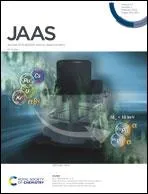
Journal of Analytical Atomic Spectrometry
基本信息
期刊简写:
J ANAL ATOM SPECTROM
影响因子:
3.1
ISSN:
0267-9477
研究领域:
CHEMICAL
h-index:
104
自引率:
25.8%
年发文量:
254
SCI收录来源:
Science Citation Index Expanded
期刊官网:
https://pubs.rsc.org/en/journals/journalissues/ja
期刊介绍:
The Journal of Analytical Atomic Spectrometry (JAAS) is the central journal for publishing innovative research on fundamentals, instrumentation, and methods in the determination, speciation and isotopic analysis of (trace) elements within all fields of application. This includes, but is not restricted to, the most recent progress, developments and achievements in all forms of atomic and elemental detection, isotope ratio determination, molecular analysis, plasma-based analysis and X-ray techniques. The journal welcomes full papers, communications, technical notes, critical and tutorial review articles, editorials, and comments, in addition to the Atomic Spectrometry Updates (ASU) literature reviews that are prepared by an expert panel. Submissions are welcome in the following areas, but note this list reflects the current scope and authors are strongly encouraged to contact the Editorial team if they believe that their work offers potentially new and emerging research relevant to the journal remit: Fundamental studies in the following. New and existing sources for atomic emission, absorption, fluorescence and mass spectrometry and those that provide both atomic and molecular information Sample introduction techniques for solids, liquids, gases Improvements in sensitivity, selectivity, precision, accuracy and/or robustness Isotope ratio measurements, including techniques for improving precision and mass bias correction Single channel and multichannel simultaneous detection systems Chemometrics, statistics, calibration techniques and internal standardisation Theoretical and numerical modelling of fundamental processes related to all of the above methodologies Novel or improved methodologies in areas of application including, but not limited to the following. Biosciences, including elemental, speciation and isotopic analysis in biological systems, immunoassays based on metal-labeled antibodies, bio-imaging, and nanoparticle toxicology Geochemistry Environmental science Materials science, including engineered nanoparticles and quantum dots Metrology, including reference materials Forensic analysis Food and agricultural sciences Energy Archaeometry Molecular analysis. Molecular sources for elemental and isotopic analysis Atomic sources for molecular analysis Atomic and molecular techniques simultaneously used for complementary chemical information All contributions are judged on originality and quality of scientific content, and appropriateness of length to content of new science.
CiteScore
CiteScore
6.2
SJR
0.722
SNIP
0.998
| 学科 | 排名 | 百分位 |
|---|---|---|
ChemistryAnalytical Chemistry |
44 / 156 | 72% |
期刊统计
Monthly
期/年
Time to first decision (peer reviewed only): 41 days
审稿周期
论文处理费
投稿信息
投稿网址:
http://mc.manuscriptcentral.com/ja收录体裁:
Communications
Full papers
Technical notes
Critical reviews
Tutorial reviews
Perspectives
Comments
Full papers
Technical notes
Critical reviews
Tutorial reviews
Perspectives
Comments
相关文献
A new technique for baseline calibration of soil X-ray fluorescence spectra based on enhanced generative adversarial networks combined with transfer learning
Xinghua He, Yanchun Zhao, Fusheng Li
2023-09-28
Paper
DOI: 10.1039/D3JA00235G
Determination of soil source using laser induced breakdown spectroscopy combined with feature selection
2023-10-03
Paper
DOI: 10.1039/D3JA00133D
Rapid classification of heavy metal soils from different mining areas by using a GSCV quadratic merit seeking network combined with MF-LIBS
2023-09-22
Paper
DOI: 10.1039/D3JA00254C
Atomic spectrometry update: review of advances in the analysis of metals, chemicals and materials
Robert Clough, Andy Fisher, Bridget Gibson, Ben Russell
2023-10-06
Atomic Spectrometry Update
DOI: 10.1039/D3JA90038J
Precise determination of lead isotope ratios by MC-ICP-MS without matrix separation exemplified by unique samples of diverse origin and history
Jakub Karasiński, Ewa Bulska, Andrii Tupys, Barbara Wagner
2023-10-04
Paper
DOI: 10.1039/D3JA00259D
Bayesian optimization of the conditions for highly sensitive detection of surface contamination by laser-induced breakdown spectroscopy
Tadatake Sato, Kenichi Tashiro, Yoshizo Kawaguchi, Hideki Ohmura, Haruhisa Akiyama
2023-09-21
Paper
DOI: 10.1039/D3JA00195D
Rapid screening of wood and leaf tissues: investigating silicon-based phytoliths in Populus trichocarpa for carbon storage applications using laser-induced breakdown spectroscopy and scanning electron microscopy–energy dispersive X-ray spectroscopy
Hunter B. Andrews, Ann M. Wymore, Elizabeth M. Herndon, Samir A. Martin, Natalie A. Griffiths, Xiaohan Yang, Wellington Muchero, David J. Weston, Madhavi Z. Martin
2023-10-04
Paper
DOI: 10.1039/D3JA00186E
Spatio-temporal dynamics of anisotropic emission from nano-second laser produced aluminium plasma
2023-09-26
Paper
DOI: 10.1039/D3JA00228D
您可能还喜欢
化合物问答
4-[4-三氟甲基苯基]恶唑(CAS号:1126636-40-5)通常如何合成?
4-[4-三氟甲基苯基]恶唑通常通过将4-三氟甲基苯酚与异硫氰酸苯酯在有机溶剂中进行酯化反应合成。该反应可在无水条件下,使用适当的催化剂,如四丁基氢氧化铵,以提...
1126636-40-54-(4-(Trifluoromethy...
59729-32-71-[3-(Dimethylamino)...
化合物问答
RockPhos Pd G3(CAS号:2009020-38-4)通常如何合成?
RockPhos Pd G3 通常通过钯催化偶联反应合成,使用配体 (2'-Amino-2-biphenylyl)(methanesulfonato-kappa...
2009020-38-4(2'-Amino-2-biphenyl...
化合物问答
1-哌啶甲酰胺(CAS号:2158-03-4)的市场或研究趋势如何?
1-哌啶甲酰胺作为有机合成中的重要中间体,其市场需求主要受医药、农药、染料等行业推动。近年来,随着新药开发和绿色化学的发展,该化合物的研究趋势集中在开发更高效、...
2158-03-41-Piperidinecarboxam...
化合物问答
2-(二苯基膦基)乙胺(CAS号:4848-43-5)适用哪些法规指南?
2-(二苯基膦基)乙胺适用于多种法规指南,包括但不限于《全球化学品统一分类和标签制度》(GHS),欧盟《化学品注册、评估、授权和限制》法规(REACH),以及美...
4848-43-52-(Diphenylphosphino...
化合物问答
如何储存间苯二甲酸二烯丙酯(CAS号:1087-21-4)?
间苯二甲酸二烯丙酯应储存在阴凉、干燥、通风良好的地方,远离火源和热源。储存容器应密封,避免光照和高温。储存温度应控制在25℃以下,相对湿度应低于80%。避免与其...
1087-21-4Diallyl isophthalate
化合物问答
什么是间甲苯异硫代异氰酸酯(CAS号:621-30-7)?
间甲苯异硫代异氰酸酯是一种有机化合物,分子式为C7H7NO2S,具有刺激性气味。它是一种重要的有机合成中间体,在合成其他化合物时广泛应用。
621-30-71-Isothiocyanato-3-m...
化合物问答
在合成中是否有N-Boc-D-苯丙氨醇(CAS号:106454-69-7)的替代品?
在合成中,可以考虑使用N-Cbz-D-苯丙氨醇或N-Fmoc-D-苯丙氨醇作为替代品。这些化合物同样具有保护氨基的功能,且在合成过程中表现出良好的反应性能。
106454-69-72-Methyl-2-propanyl ...
化合物问答
3-羟甲基-2-氧异丙基吡啶(CAS号:954240-50-7)的主要用途是什么?
3-羟甲基-2-氧异丙基吡啶主要用于有机合成领域,可以作为合成其他药物、农药或精细化学品的中间体。此外,它还可能在实验室研究中作为特定反应的前体或溶剂。
954240-50-7(2-Isopropoxy-3-pyri...
化合物问答
6-氨基-9-甲基嘌呤(CAS号:700-00-5)应用于哪些行业?
6-氨基-9-甲基嘌呤目前主要应用于医药行业,作为某些药物的中间体。此外,它还可能用于聚合物、传感器和半导体的某些领域,作为功能性单体或掺杂剂。
700-00-59-Methyl-9H-purin-6-...
推荐化合物
推荐供应商





免责声明
本页面提供的学术期刊信息仅供参考和研究使用。我们与任何期刊出版商均无关联,也不处理投稿事宜。如有投稿相关咨询,请直接联系相关期刊出版商。
如发现页面信息有误,请发送邮件至 support@chemtradehub.com 联系我们。我们将及时核实并处理您的问题。