


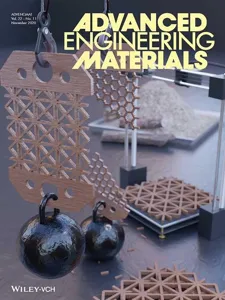
Journal of Elasticity
基本信息
期刊简写:
J ELASTICITY
影响因子:
1.8
ISSN:
0374-3535
研究领域:
ENGINEERING TECHNOLOGY
h-index:
51
自引率:
11.1%
年发文量:
66
SCI收录来源:
Science Citation Index Expanded
期刊官网:
https://www.springer.com/10659
期刊介绍:
The Journal of Elasticity was founded in 1971 by Marvin Stippes (1922-1979), with its main purpose being to report original and significant discoveries in elasticity. The Journal has broadened in scope over the years to include original contributions in the physical and mathematical science of solids. The areas of rational mechanics, mechanics of materials, including theories of soft materials, biomechanics, and engineering sciences that contribute to fundamental advancements in understanding and predicting the complex behavior of solids are particularly welcomed. The role of elasticity in all such behavior is well recognized and reporting significant discoveries in elasticity remains important to the Journal, as is its relation to thermal and mass transport, electromagnetism, and chemical reactions. Fundamental research that applies the concepts of physics and elements of applied mathematical science is of particular interest. Original research contributions will appear as either full research papers or research notes. Well-documented historical essays and reviews also are welcomed. Materials that will prove effective in teaching will appear as classroom notes. Computational and/or experimental investigations that emphasize relationships to the modeling of the novel physical behavior of solids at all scales are of interest. Guidance principles for content are to be found in the current interests of the Editorial Board.
CiteScore
CiteScore
3.7
SJR
0.563
SNIP
1.209
| 学科 | 排名 | 百分位 |
|---|---|---|
EngineeringMechanical Engineering |
268 / 672 | 60% |
期刊统计
Monthly
期/年
Submission to first decision (median): 6 days
审稿周期
£2390/$3690/€2790
论文处理费
投稿信息
投稿网址:
https://www.editorialmanager.com/elas相关文献
Pentaglyme–K salt binary mixtures: phase behavior, solvate structures, and physicochemical properties
Seiji Tsuzuki, Kazuhide Ueno, Masayoshi Watanabe
2014-12-05
Paper
DOI: 10.1039/C4CP05017G
Mechanical properties and stabilities of α-boron monolayers
Qing Peng, Liang Han, Sheng Liu, Zhongfang Chen, Jie Lian, Suvranu De
2014-11-25
Paper
DOI: 10.1039/C4CP04050C
Complex behaviour of vacancy point-defects in SrRuO3 thin films
Henning Schraknepper, Christoph Bäumer, Regina Dittmann, Roger A. De Souza
2014-11-12
Paper
DOI: 10.1039/C4CP03632H
Formation of 2- and 1-methyl-1,4-dihydronaphthalene isomers via the crossed beam reactions of phenyl radicals (C6H5) with isoprene (CH2C(CH3)CHCH2) and 1,3-pentadiene (CH2CHCHCHCH3)
Tao Yang, Lloyd Muzangwa, Dorian S. N. Parker, Ralf I. Kaiser, Alexander M. Mebel
2014-11-07
Paper
DOI: 10.1039/C4CP04612A
Modulating the phase transition between metallic and semiconducting single-layer MoS2 and WS2 through size effects
Ziyu Hu, Shengli Zhang, Da Wang, Haibo Zeng, Li-Min Liu
2014-11-04
Paper
DOI: 10.1039/C4CP04775C
Exploring the complexity of quantum control optimization trajectories
Arun Nanduri, Ofer M. Shir, Ashley Donovan, Tak-San Ho, Herschel Rabitz
2014-11-07
Paper
DOI: 10.1039/C4CP03853C
Origin of surface trap states in CdS quantum dots: relationship between size dependent photoluminescence and sulfur vacancy trap states
Aisea Veamatahau, Bo Jiang, Tom Seifert, Satoshi Makuta, Kay Latham, Masayuki Kanehara, Toshiharu Teranishi
2014-12-05
Paper
DOI: 10.1039/C4CP04761C
Exploring the phase space of time of flight mass selected PtxY nanoparticles
Federico Masini, Patricia Hernández-Fernández, Davide Deiana, Christian Ejersbo Strebel, David Norman McCarthy, Anders Bodin, Paolo Malacrida, Ifan Stephens, Ib Chorkendorff
2014-07-17
Paper
DOI: 10.1039/C4CP02144D
Optimal top electrodes for inverted polymer solar cells
Hye Rim Yeom, Jungwoo Heo, Gi-Hwan Kim, Seo-Jin Ko, Seyeong Song, Yimhyun Jo, Dong Suk Kim, Bright Walker, Jin Young Kim
2014-11-27
Paper
DOI: 10.1039/C4CP04788E
您可能还喜欢
化合物问答
4-[4-三氟甲基苯基]恶唑(CAS号:1126636-40-5)通常如何合成?
4-[4-三氟甲基苯基]恶唑通常通过将4-三氟甲基苯酚与异硫氰酸苯酯在有机溶剂中进行酯化反应合成。该反应可在无水条件下,使用适当的催化剂,如四丁基氢氧化铵,以提...
1126636-40-54-(4-(Trifluoromethy...
59729-32-71-[3-(Dimethylamino)...
化合物问答
RockPhos Pd G3(CAS号:2009020-38-4)通常如何合成?
RockPhos Pd G3 通常通过钯催化偶联反应合成,使用配体 (2'-Amino-2-biphenylyl)(methanesulfonato-kappa...
2009020-38-4(2'-Amino-2-biphenyl...
化合物问答
1-哌啶甲酰胺(CAS号:2158-03-4)的市场或研究趋势如何?
1-哌啶甲酰胺作为有机合成中的重要中间体,其市场需求主要受医药、农药、染料等行业推动。近年来,随着新药开发和绿色化学的发展,该化合物的研究趋势集中在开发更高效、...
2158-03-41-Piperidinecarboxam...
化合物问答
2-(二苯基膦基)乙胺(CAS号:4848-43-5)适用哪些法规指南?
2-(二苯基膦基)乙胺适用于多种法规指南,包括但不限于《全球化学品统一分类和标签制度》(GHS),欧盟《化学品注册、评估、授权和限制》法规(REACH),以及美...
4848-43-52-(Diphenylphosphino...
化合物问答
如何储存间苯二甲酸二烯丙酯(CAS号:1087-21-4)?
间苯二甲酸二烯丙酯应储存在阴凉、干燥、通风良好的地方,远离火源和热源。储存容器应密封,避免光照和高温。储存温度应控制在25℃以下,相对湿度应低于80%。避免与其...
1087-21-4Diallyl isophthalate
化合物问答
什么是间甲苯异硫代异氰酸酯(CAS号:621-30-7)?
间甲苯异硫代异氰酸酯是一种有机化合物,分子式为C7H7NO2S,具有刺激性气味。它是一种重要的有机合成中间体,在合成其他化合物时广泛应用。
621-30-71-Isothiocyanato-3-m...
化合物问答
在合成中是否有N-Boc-D-苯丙氨醇(CAS号:106454-69-7)的替代品?
在合成中,可以考虑使用N-Cbz-D-苯丙氨醇或N-Fmoc-D-苯丙氨醇作为替代品。这些化合物同样具有保护氨基的功能,且在合成过程中表现出良好的反应性能。
106454-69-72-Methyl-2-propanyl ...
化合物问答
3-羟甲基-2-氧异丙基吡啶(CAS号:954240-50-7)的主要用途是什么?
3-羟甲基-2-氧异丙基吡啶主要用于有机合成领域,可以作为合成其他药物、农药或精细化学品的中间体。此外,它还可能在实验室研究中作为特定反应的前体或溶剂。
954240-50-7(2-Isopropoxy-3-pyri...
化合物问答
6-氨基-9-甲基嘌呤(CAS号:700-00-5)应用于哪些行业?
6-氨基-9-甲基嘌呤目前主要应用于医药行业,作为某些药物的中间体。此外,它还可能用于聚合物、传感器和半导体的某些领域,作为功能性单体或掺杂剂。
700-00-59-Methyl-9H-purin-6-...
推荐化合物
![[2',6'-bis(propan-2-yloxy)-[1,1'-biphenyl]-3-yl]dicyclohexylphosphane structure](https://cnstatic.chemtradehub.com/structs/787/787618-22-8-dda2.webp "[2',6'-bis(propan-2-yloxy)-[1,1'-biphenyl]-3-yl]dicyclohexylphosphane structure")
[2',6'-bis(propan-2-yloxy)-[1,1'-biphenyl]-3-yl]dicyclohexylphosphane
CAS号:
787618-22-8
分子式:
C30H43O2P
![Bis[(1,2,3,4,5-eta)-1-(diphenylphosphino)cyclopentadienyl]iron structure](https://cnstatic.chemtradehub.com/structs/121/12150-46-8-ecd2.webp "Bis[(1,2,3,4,5-eta)-1-(diphenylphosphino)cyclopentadienyl]iron structure")
![2-Bromodibenzo[b,d]furan structure](https://cnstatic.chemtradehub.com/structs/86-/86-76-0-1814.webp "2-Bromodibenzo[b,d]furan structure")
![1-(Hexopyranosyloxy)-4a,5-dihydroxy-7-methyl-1,4a,5,6,7,7a-hexahydrocyclopenta[c]pyran-7-yl 3-phenylacrylate structure](https://cnstatic.chemtradehub.com/structs/192/19210-12-9-ecae.webp "1-(Hexopyranosyloxy)-4a,5-dihydroxy-7-methyl-1,4a,5,6,7,7a-hexahydrocyclopenta[c]pyran-7-yl 3-phenylacrylate structure")
推荐供应商







免责声明
本页面提供的学术期刊信息仅供参考和研究使用。我们与任何期刊出版商均无关联,也不处理投稿事宜。如有投稿相关咨询,请直接联系相关期刊出版商。
如发现页面信息有误,请发送邮件至 support@chemtradehub.com 联系我们。我们将及时核实并处理您的问题。