









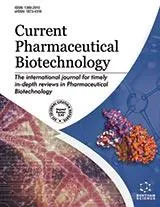
Current Pharmaceutical Biotechnology
基本信息
期刊简写:
CURR PHARM BIOTECHNO
影响因子:
2.2
ISSN:
1389-2010
研究领域:
MEDICAL
h-index:
73
自引率:
4.5%
年发文量:
139
SCI收录来源:
Science Citation Index Expanded
期刊官网:
https://benthamscience.com/journal/cpb
期刊介绍:
Current Pharmaceutical Biotechnology aims to cover all the latest and outstanding developments in Pharmaceutical Biotechnology. Each issue of the journal includes timely in-depth/mini reviews, original research articles and letters written by leaders in the field, covering a range of current topics in scientific areas of Pharmaceutical Biotechnology. Invited and unsolicited review articles are welcome. The journal encourages contributions describing research at the interface of drug discovery and pharmacological applications, involving in vitro investigations and pre-clinical or clinical studies. Scientific areas within the scope of the journal include pharmaceutical chemistry, biochemistry and genetics, molecular and cellular biology, and polymer and materials sciences as they relate to pharmaceutical science and biotechnology. In addition, the journal also considers comprehensive studies and research advances pertaining food chemistry with pharmaceutical implication. Areas of interest include: ● DNA/protein engineering and processing ● Synthetic biotechnology ● Omics (genomics, proteomics, metabolomics and systems biology) ● Therapeutic biotechnology (gene therapy, peptide inhibitors, enzymes) ● Drug delivery and targeting ● Nanobiotechnology ● Molecular pharmaceutics and molecular pharmacology ● Analytical biotechnology (biosensing, advanced technology for detection of bioanalytes) ● Pharmacokinetics and pharmacodynamics ● Applied Microbiology ● Bioinformatics (computational biopharmaceutics and modeling) ● Environmental biotechnology ● Regenerative medicine (stem cells, tissue engineering and biomaterials) ● Translational immunology (cell therapies, antibody engineering, xenotransplantation) ● Industrial bioprocesses for drug production and development ● Biosafety ● Biotech ethics Special Issues devoted to crucial topics, providing the latest comprehensive information on cutting-edge areas of research and technological advances, are welcome. Current Pharmaceutical Biotechnology is an essential journal for academic, clinical, government and pharmaceutical scientists who wish to be kept informed and up-to-date with the latest and most important developments.
CiteScore
CiteScore
5.6
SJR
0.492
SNIP
0.547
| 学科 | 排名 | 百分位 |
|---|---|---|
Pharmacology, Toxicology and PharmaceuticsPharmaceutical Science |
62 / 183 | 66% |
期刊统计
Bimonthly
期/年
审稿周期
论文处理费
投稿信息
投稿网址:
https://bentham.manuscriptpoint.com/journals/CPB相关文献
One single catalyst, Pd(OAc)2, for two sequential very different steps: allylic alcohol oxidation–Heck reaction. Access to functionalised α,β-unsaturated ketones
Frédéric Batt, Christel Gozzi, Fabienne Fache
2008-09-30
Communication
DOI: 10.1039/B810538C
Mixed antimonate-phosphonate ligands as polydentate bridging oxygen donors
Shoaib Ali, Viswanathan Baskar, Christopher A. Muryn, Richard E. P. Winpenny
2008-11-04
Communication
DOI: 10.1039/B815270E
Absolute helicity induction in three-dimensional homochiral frameworks
Jian Zhang, Xianhui Bu
2008-11-13
Communication
DOI: 10.1039/B816742G
Sensitive liposomes encoded with oligonucleotideamphiphiles: a biocompatible switch
Gregory Giannone
2008-09-23
Communication
DOI: 10.1039/B812398E
A modular and organocatalytic approach to γ-butyrolactone autoregulators from Streptomycetes
Petteri Elsner, Hao Jiang, Johanne B. Nielsen, Filippo Pasi, Karl Anker Jørgensen
2008-10-03
Communication
DOI: 10.1039/B812698D
The asymmetric total synthesis of (−)-securinine
Bhartesh Dhudshia, Benjamin F. T. Cooper, Charles L. B. Macdonald, Avinash N. Thadani
2008-12-09
Communication
DOI: 10.1039/B816576A
Trimacrocyclic arylamine and its polycationic states
Akihiro Ito, Yuko Yamagishi, Koji Fukui, Syuuzi Inoue, Yasukazu Hirao, Ko Furukawa, Tatsuhisa Kato
2008-11-12
Communication
DOI: 10.1039/B816311A
Silver-enhanced fluorescence emission of single quantum dot nanocomposites
Yi Fu, Jian Zhang, Joseph R. Lakowicz
2008-11-19
Communication
DOI: 10.1039/B816736B
Polyfunctional benzylic zinc chlorides by the direct insertion of magnesium into benzylic chlorides in the presence of LiCl and ZnCl2
Albrecht Metzger, Fabian M. Piller, Paul Knochel
2008-10-01
Communication
DOI: 10.1039/B812396A
Sn(iv) phosphonates as catalysts in solvent-free Baeyer–Villiger oxidations using H2O2
Sharath Kirumakki, Sandani Samarajeewa, Robert Harwell, Atashi Mukherjee, Rolfe H. Herber, Abraham Clearfield
2008-10-08
Communication
DOI: 10.1039/B807938B
您可能还喜欢
化合物问答
4-[4-三氟甲基苯基]恶唑(CAS号:1126636-40-5)通常如何合成?
4-[4-三氟甲基苯基]恶唑通常通过将4-三氟甲基苯酚与异硫氰酸苯酯在有机溶剂中进行酯化反应合成。该反应可在无水条件下,使用适当的催化剂,如四丁基氢氧化铵,以提...
1126636-40-54-(4-(Trifluoromethy...
59729-32-71-[3-(Dimethylamino)...
化合物问答
RockPhos Pd G3(CAS号:2009020-38-4)通常如何合成?
RockPhos Pd G3 通常通过钯催化偶联反应合成,使用配体 (2'-Amino-2-biphenylyl)(methanesulfonato-kappa...
2009020-38-4(2'-Amino-2-biphenyl...
化合物问答
1-哌啶甲酰胺(CAS号:2158-03-4)的市场或研究趋势如何?
1-哌啶甲酰胺作为有机合成中的重要中间体,其市场需求主要受医药、农药、染料等行业推动。近年来,随着新药开发和绿色化学的发展,该化合物的研究趋势集中在开发更高效、...
2158-03-41-Piperidinecarboxam...
化合物问答
2-(二苯基膦基)乙胺(CAS号:4848-43-5)适用哪些法规指南?
2-(二苯基膦基)乙胺适用于多种法规指南,包括但不限于《全球化学品统一分类和标签制度》(GHS),欧盟《化学品注册、评估、授权和限制》法规(REACH),以及美...
4848-43-52-(Diphenylphosphino...
化合物问答
如何储存间苯二甲酸二烯丙酯(CAS号:1087-21-4)?
间苯二甲酸二烯丙酯应储存在阴凉、干燥、通风良好的地方,远离火源和热源。储存容器应密封,避免光照和高温。储存温度应控制在25℃以下,相对湿度应低于80%。避免与其...
1087-21-4Diallyl isophthalate
化合物问答
什么是间甲苯异硫代异氰酸酯(CAS号:621-30-7)?
间甲苯异硫代异氰酸酯是一种有机化合物,分子式为C7H7NO2S,具有刺激性气味。它是一种重要的有机合成中间体,在合成其他化合物时广泛应用。
621-30-71-Isothiocyanato-3-m...
化合物问答
在合成中是否有N-Boc-D-苯丙氨醇(CAS号:106454-69-7)的替代品?
在合成中,可以考虑使用N-Cbz-D-苯丙氨醇或N-Fmoc-D-苯丙氨醇作为替代品。这些化合物同样具有保护氨基的功能,且在合成过程中表现出良好的反应性能。
106454-69-72-Methyl-2-propanyl ...
化合物问答
3-羟甲基-2-氧异丙基吡啶(CAS号:954240-50-7)的主要用途是什么?
3-羟甲基-2-氧异丙基吡啶主要用于有机合成领域,可以作为合成其他药物、农药或精细化学品的中间体。此外,它还可能在实验室研究中作为特定反应的前体或溶剂。
954240-50-7(2-Isopropoxy-3-pyri...
化合物问答
6-氨基-9-甲基嘌呤(CAS号:700-00-5)应用于哪些行业?
6-氨基-9-甲基嘌呤目前主要应用于医药行业,作为某些药物的中间体。此外,它还可能用于聚合物、传感器和半导体的某些领域,作为功能性单体或掺杂剂。
700-00-59-Methyl-9H-purin-6-...
推荐化合物
![1-(Hexopyranosyloxy)-4a,5-dihydroxy-7-methyl-1,4a,5,6,7,7a-hexahydrocyclopenta[c]pyran-7-yl 3-phenylacrylate structure](https://cnstatic.chemtradehub.com/structs/192/19210-12-9-ecae.webp "1-(Hexopyranosyloxy)-4a,5-dihydroxy-7-methyl-1,4a,5,6,7,7a-hexahydrocyclopenta[c]pyran-7-yl 3-phenylacrylate structure")

![2-{3-[4-(3-Chlorophenyl)-1-piperazinyl]propyl}[1,2,4]triazolo[4,3-a]pyridin-3(2H)-one hydrochloride (1:1) structure](https://cnstatic.chemtradehub.com/structs/253/25332-39-2-496e.webp "2-{3-[4-(3-Chlorophenyl)-1-piperazinyl]propyl}[1,2,4]triazolo[4,3-a]pyridin-3(2H)-one hydrochloride (1:1) structure")
推荐供应商





免责声明
本页面提供的学术期刊信息仅供参考和研究使用。我们与任何期刊出版商均无关联,也不处理投稿事宜。如有投稿相关咨询,请直接联系相关期刊出版商。
如发现页面信息有误,请发送邮件至 support@chemtradehub.com 联系我们。我们将及时核实并处理您的问题。