


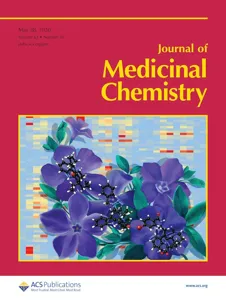
Journal of Medicinal Chemistry
基本信息
期刊简写:
J. Med. Chem.
影响因子:
6.8
ISSN:
0022-2623
研究领域:
MEDICAL
h-index:
240
自引率:
10.3%
年发文量:
922
SCI收录来源:
Science Citation Index Expanded
期刊官网:
https://pubs.acs.org/journal/jmcmar
期刊介绍:
Journal of Medicinal Chemistry publishes studies that contribute to an understanding of the relationship between molecular structure and biological activity or mode of action. Some specific areas that are appropriate include the following: Design, synthesis, and biological evaluation of novel biologically active compounds, diagnostic agents, or labeled ligands employed as pharmacological tools. Molecular modifications of reported series that lead to a significantly improved understanding of their structure-activity relationships (SAR). Routine extensions of existing series that do not utilize novel chemical or biological approaches or do not add significantly to a basic understanding of the SAR of the series will normally not be accepted for publication. Structural biological studies (X-ray, NMR, etc.) of relevant ligands and targets with the aim of investigating molecular recognition processes in the action of biologically active compounds. Molecular biological studies (e.g., site-directed mutagenesis) of macromolecular targets that lead to an improved understanding of molecular recognition. Computational studies that provide fresh insight into the SAR of compound series that are of current general interest or analysis of other available data that subsequently advance medicinal chemistry knowledge. Substantially novel computational chemistry methods with demonstrated value for the identification, optimization, or target interaction analysis of bioactive molecules. Effect of molecular structure on the distribution, pharmacokinetics, and metabolic transformation of biologically active compounds. This may include design, synthesis, and evaluation of novel types of prodrugs. Novel methodology with broad application to medicinal chemistry, but only if the methods have been tested on relevant molecules.
CiteScore
CiteScore
12.8
SJR
1.986
SNIP
1.594
| 学科 | 排名 | 百分位 |
|---|---|---|
Pharmacology, Toxicology and PharmaceuticsDrug Discovery |
5 / 146 | 96% |
期刊统计
Biweekly
期/年
Submission to First Editorial Decision (Median Days): 7
Submission to First Decision with Peer Review (Median Days): 28.1
Submission to Accept (Median Days): 86.1
Accept to ASAP Publication (Median Days): 14.3
审稿周期
论文处理费
投稿信息
投稿网址:
https://acs.manuscriptcentral.com/acs收录体裁:
Articles
Brief Articles
Perspectives
Drug Annotations
Viewpoint
Featured Articles
Brief Articles
Perspectives
Drug Annotations
Viewpoint
Featured Articles
期刊推荐

Biocatalysis and Biotransformation
Acta Metallurgica Sinica-English Letters
NDT & E International

Heteroatom Chemistry
Polycyclic Aromatic Compounds

Main Group Chemistry

Bioorganic & Medicinal Chemistry
Journal of the Indian Institute of Science

Journal of Chemical Sciences

Journal of Asian Natural Products Research
相关文献
A cavitand with a fluorous rim acts as an amine receptor
Richard J. Hooley, Per Restorp, Julius Rebek Jr
2008-11-06
Communication
DOI: 10.1039/B814069C
Thermoresponsive dendronized polymers with tunable lower critical solution temperatures
Wen Li, A. Dieter Schlüter
2008-09-23
Communication
DOI: 10.1039/B811464A
Titanocene-catalyzed alkylative dimerization of vinylGrignard reagent using alkyl halides
Yuuki Fujii, Jun Terao, Yuichiro Kato, Nobuaki Kambe
2008-10-06
Communication
DOI: 10.1039/B813596G
Rapid analysis of isotopically unmodified amino acids by high-resolution 14N-edited 1H–13C correlation NMR spectroscopy
Jean-Paul Amoureux, Bingwen Hu, Olivier Lafon, Julien Trébosc, Feng Deng
2008-11-07
Communication
DOI: 10.1039/B816362F
Relaxation rates for spirocyclohexyl nitroxyl radicals are suitable for interspin distance measurements at temperatures up to about 125 K
Velavan Kathirvelu, Christopher Smith, Christopher Parks, Md. Abdul Mannan, Yozo Miura, Keizo Takeshita, Sandra S. Eaton, Gareth R. Eaton
2008-11-25
Communication
DOI: 10.1039/B817758A
2-Phenylpyrimidine skeleton-based electron-transport materials for extremely efficient green organic light-emitting devices
Hisahiro Sasabe, Takayuki Chiba, Shi-Jian Su, Yong-Jin Pu, Ken-ichi Nakayama, Junji Kido
2008-10-03
Communication
DOI: 10.1039/B812270A
One-phase synthesis of small gold nanoparticles coated by a horizontal porphyrin monolayer
Junya Ohyama, Yasuhiro Higuchi, Masashi Shinagawa, Hidefumi Mukai, Masahito Kodera, Kentaro Teramura, Tetsuya Shishido, Tsunehiro Tanaka
2008-10-28
Communication
DOI: 10.1039/B815100H
Ordered mesoporous carbons as highly active catalysts for hydrogen production by CH4decomposition
Patricia Pizarro, Rut Guil-López, Gema Gómez
2008-11-12
Communication
DOI: 10.1039/B811800K
您可能还喜欢
化合物问答
4-[4-三氟甲基苯基]恶唑(CAS号:1126636-40-5)通常如何合成?
4-[4-三氟甲基苯基]恶唑通常通过将4-三氟甲基苯酚与异硫氰酸苯酯在有机溶剂中进行酯化反应合成。该反应可在无水条件下,使用适当的催化剂,如四丁基氢氧化铵,以提...
1126636-40-54-(4-(Trifluoromethy...
59729-32-71-[3-(Dimethylamino)...
化合物问答
RockPhos Pd G3(CAS号:2009020-38-4)通常如何合成?
RockPhos Pd G3 通常通过钯催化偶联反应合成,使用配体 (2'-Amino-2-biphenylyl)(methanesulfonato-kappa...
2009020-38-4(2'-Amino-2-biphenyl...
化合物问答
1-哌啶甲酰胺(CAS号:2158-03-4)的市场或研究趋势如何?
1-哌啶甲酰胺作为有机合成中的重要中间体,其市场需求主要受医药、农药、染料等行业推动。近年来,随着新药开发和绿色化学的发展,该化合物的研究趋势集中在开发更高效、...
2158-03-41-Piperidinecarboxam...
化合物问答
2-(二苯基膦基)乙胺(CAS号:4848-43-5)适用哪些法规指南?
2-(二苯基膦基)乙胺适用于多种法规指南,包括但不限于《全球化学品统一分类和标签制度》(GHS),欧盟《化学品注册、评估、授权和限制》法规(REACH),以及美...
4848-43-52-(Diphenylphosphino...
化合物问答
如何储存间苯二甲酸二烯丙酯(CAS号:1087-21-4)?
间苯二甲酸二烯丙酯应储存在阴凉、干燥、通风良好的地方,远离火源和热源。储存容器应密封,避免光照和高温。储存温度应控制在25℃以下,相对湿度应低于80%。避免与其...
1087-21-4Diallyl isophthalate
化合物问答
什么是间甲苯异硫代异氰酸酯(CAS号:621-30-7)?
间甲苯异硫代异氰酸酯是一种有机化合物,分子式为C7H7NO2S,具有刺激性气味。它是一种重要的有机合成中间体,在合成其他化合物时广泛应用。
621-30-71-Isothiocyanato-3-m...
化合物问答
在合成中是否有N-Boc-D-苯丙氨醇(CAS号:106454-69-7)的替代品?
在合成中,可以考虑使用N-Cbz-D-苯丙氨醇或N-Fmoc-D-苯丙氨醇作为替代品。这些化合物同样具有保护氨基的功能,且在合成过程中表现出良好的反应性能。
106454-69-72-Methyl-2-propanyl ...
化合物问答
3-羟甲基-2-氧异丙基吡啶(CAS号:954240-50-7)的主要用途是什么?
3-羟甲基-2-氧异丙基吡啶主要用于有机合成领域,可以作为合成其他药物、农药或精细化学品的中间体。此外,它还可能在实验室研究中作为特定反应的前体或溶剂。
954240-50-7(2-Isopropoxy-3-pyri...
化合物问答
6-氨基-9-甲基嘌呤(CAS号:700-00-5)应用于哪些行业?
6-氨基-9-甲基嘌呤目前主要应用于医药行业,作为某些药物的中间体。此外,它还可能用于聚合物、传感器和半导体的某些领域,作为功能性单体或掺杂剂。
700-00-59-Methyl-9H-purin-6-...
推荐化合物
![Bis[(1,2,3,4,5-eta)-1-(diphenylphosphino)cyclopentadienyl]iron structure](https://cnstatic.chemtradehub.com/structs/121/12150-46-8-ecd2.webp "Bis[(1,2,3,4,5-eta)-1-(diphenylphosphino)cyclopentadienyl]iron structure")
![[2',6'-bis(propan-2-yloxy)-[1,1'-biphenyl]-3-yl]dicyclohexylphosphane structure](https://cnstatic.chemtradehub.com/structs/787/787618-22-8-dda2.webp "[2',6'-bis(propan-2-yloxy)-[1,1'-biphenyl]-3-yl]dicyclohexylphosphane structure")
[2',6'-bis(propan-2-yloxy)-[1,1'-biphenyl]-3-yl]dicyclohexylphosphane
CAS号:
787618-22-8
分子式:
C30H43O2P
推荐供应商






免责声明
本页面提供的学术期刊信息仅供参考和研究使用。我们与任何期刊出版商均无关联,也不处理投稿事宜。如有投稿相关咨询,请直接联系相关期刊出版商。
如发现页面信息有误,请发送邮件至 support@chemtradehub.com 联系我们。我们将及时核实并处理您的问题。