


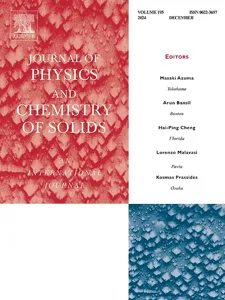
Journal of Physics and Chemistry of Solids
基本信息
期刊简写:
J PHYS CHEM SOLIDS
影响因子:
4.3
ISSN:
0022-3697
研究领域:
ENGINEERING TECHNOLOGY
h-index:
97
自引率:
4.7%
年发文量:
543
SCI收录来源:
Science Citation Index Expanded
期刊官网:
https://www.sciencedirect.com/journal/journal-of-physics-and-chemistry-of-solids
期刊介绍:
The Journal of Physics and Chemistry of Solids is a well-established international medium for publication of archival research in condensed matter and materials sciences. Areas of interest broadly include experimental and theoretical research on electronic, magnetic, spectroscopic and structural properties as well as the statistical mechanics and thermodynamics of materials. The focus is on gaining physical and chemical insight into the properties and potential applications of condensed matter systems. Within the broad scope of the journal, beyond regular contributions, the editors have identified submissions in the following areas of physics and chemistry of solids to be of special current interest to the journal: Low-dimensional systems Exotic states of quantum electron matter including topological phases Energy conversion and storage Interfaces, nanoparticles and catalysts From time-to-time, the journal publishes Special Issues containing collections of invited articles focused on topical or rapidly developing fields.
CiteScore
CiteScore
7.8
SJR
0.703
SNIP
0.878
| 学科 | 排名 | 百分位 |
|---|---|---|
Physics and AstronomyCondensed Matter Physics |
62 / 434 | 85% |
期刊统计
Monthly
期/年
Time to first decision: 11days
Review time: 67days
Submission to acceptance: 85days
Acceptance to publication: 6days
审稿周期
$2990
论文处理费
投稿信息
投稿网址:
https://www.editorialmanager.com/PCS收录体裁:
Original research papers, reviews, letters to the editor and commentaries
期刊推荐
Polycyclic Aromatic Compounds

NDT & E International
Biocatalysis and Biotransformation
Journal of the Indian Institute of Science

Journal of Asian Natural Products Research

Colloid Journal

Heteroatom Chemistry

Herald of the Russian Academy of Sciences
Critical Reviews in Solid State and Materials Sciences
Main Group Chemistry
相关文献
Efficient mono- and bis-functionalization of 3,6-dichloropyridazine using (tmp)2Zn·2MgCl2·2LiCl
Stefan Wunderlich, Paul Knochel
2008-11-04
Communication
DOI: 10.1039/B815903C
One single catalyst, Pd(OAc)2, for two sequential very different steps: allylic alcohol oxidation–Heck reaction. Access to functionalised α,β-unsaturated ketones
Frédéric Batt, Christel Gozzi, Fabienne Fache
2008-09-30
Communication
DOI: 10.1039/B810538C
“Everything is surface”: tunable polymer organic frameworks with ultrahigh dye sorption capacity
Pierre Kuhn, Kathleen Krüger, Arne Thomas, Markus Antonietti
2008-10-02
Communication
DOI: 10.1039/B814254H
Facile photoinduced charge separation through a cyanoacetylide bridge in a heterobimetallic Fe(ii)–Re(i) complex
Mark E. Smith, Emma L. Flynn, Mark A. Fox, Alexandre Trottier, Eckart Wrede, Dmitri S. Yufit, Judith A. K. Howard, Kate L. Ronayne, Michael Towrie, Anthony W. Parker, František Hartl, Paul J. Low
2008-10-07
Communication
DOI: 10.1039/B811357B
Multifunctional bipolar triphenylamine/oxadiazole derivatives: highly efficient blue fluorescence, red phosphorescence host and two-color based white OLEDs
Youtian Tao, Qiang Wang, Yuan Shang, Chuluo Yang, Liang Ao, Jingui Qin, Dongge Ma, Zhigang Shuai
2008-11-20
Communication
DOI: 10.1039/B816264F
The crystal structure of β-RDX—an elusive form of an explosive revealed
David I. A. Millar, Iain D. H. Oswald, Duncan J. Francis, William G. Marshall, Colin R. Pulham, Adam S. Cumming
2008-12-05
Communication
DOI: 10.1039/B817966B
Light-activation of gene function in mammalian cells viaribozymes
Douglas D. Young, R. Aaron Garner, Jeffrey A. Yoder, Alexander Deiters
2008-12-02
Communication
DOI: 10.1039/B819375D
Enzyme-mediated sol–gel processing of alkoxysilanes
Mark Frampton, Ateeya Vawda, Jackie Fletcher, Paul M. Zelisko
2008-09-23
Communication
DOI: 10.1039/B812389F
Modular synthesis of multivalent glycoarchitectures and their unique selectin binding behavior
Ilona Papp, Jens Dernedde, Sven Enders, Rainer Haag
2008-10-03
Communication
DOI: 10.1039/B813414F
您可能还喜欢
化合物问答
4-[4-三氟甲基苯基]恶唑(CAS号:1126636-40-5)通常如何合成?
4-[4-三氟甲基苯基]恶唑通常通过将4-三氟甲基苯酚与异硫氰酸苯酯在有机溶剂中进行酯化反应合成。该反应可在无水条件下,使用适当的催化剂,如四丁基氢氧化铵,以提...
1126636-40-54-(4-(Trifluoromethy...
59729-32-71-[3-(Dimethylamino)...
化合物问答
RockPhos Pd G3(CAS号:2009020-38-4)通常如何合成?
RockPhos Pd G3 通常通过钯催化偶联反应合成,使用配体 (2'-Amino-2-biphenylyl)(methanesulfonato-kappa...
2009020-38-4(2'-Amino-2-biphenyl...
化合物问答
1-哌啶甲酰胺(CAS号:2158-03-4)的市场或研究趋势如何?
1-哌啶甲酰胺作为有机合成中的重要中间体,其市场需求主要受医药、农药、染料等行业推动。近年来,随着新药开发和绿色化学的发展,该化合物的研究趋势集中在开发更高效、...
2158-03-41-Piperidinecarboxam...
化合物问答
2-(二苯基膦基)乙胺(CAS号:4848-43-5)适用哪些法规指南?
2-(二苯基膦基)乙胺适用于多种法规指南,包括但不限于《全球化学品统一分类和标签制度》(GHS),欧盟《化学品注册、评估、授权和限制》法规(REACH),以及美...
4848-43-52-(Diphenylphosphino...
化合物问答
如何储存间苯二甲酸二烯丙酯(CAS号:1087-21-4)?
间苯二甲酸二烯丙酯应储存在阴凉、干燥、通风良好的地方,远离火源和热源。储存容器应密封,避免光照和高温。储存温度应控制在25℃以下,相对湿度应低于80%。避免与其...
1087-21-4Diallyl isophthalate
化合物问答
什么是间甲苯异硫代异氰酸酯(CAS号:621-30-7)?
间甲苯异硫代异氰酸酯是一种有机化合物,分子式为C7H7NO2S,具有刺激性气味。它是一种重要的有机合成中间体,在合成其他化合物时广泛应用。
621-30-71-Isothiocyanato-3-m...
化合物问答
在合成中是否有N-Boc-D-苯丙氨醇(CAS号:106454-69-7)的替代品?
在合成中,可以考虑使用N-Cbz-D-苯丙氨醇或N-Fmoc-D-苯丙氨醇作为替代品。这些化合物同样具有保护氨基的功能,且在合成过程中表现出良好的反应性能。
106454-69-72-Methyl-2-propanyl ...
化合物问答
3-羟甲基-2-氧异丙基吡啶(CAS号:954240-50-7)的主要用途是什么?
3-羟甲基-2-氧异丙基吡啶主要用于有机合成领域,可以作为合成其他药物、农药或精细化学品的中间体。此外,它还可能在实验室研究中作为特定反应的前体或溶剂。
954240-50-7(2-Isopropoxy-3-pyri...
化合物问答
6-氨基-9-甲基嘌呤(CAS号:700-00-5)应用于哪些行业?
6-氨基-9-甲基嘌呤目前主要应用于医药行业,作为某些药物的中间体。此外,它还可能用于聚合物、传感器和半导体的某些领域,作为功能性单体或掺杂剂。
700-00-59-Methyl-9H-purin-6-...
推荐化合物
![1-(Hexopyranosyloxy)-4a,5-dihydroxy-7-methyl-1,4a,5,6,7,7a-hexahydrocyclopenta[c]pyran-7-yl 3-phenylacrylate structure](https://cnstatic.chemtradehub.com/structs/192/19210-12-9-ecae.webp "1-(Hexopyranosyloxy)-4a,5-dihydroxy-7-methyl-1,4a,5,6,7,7a-hexahydrocyclopenta[c]pyran-7-yl 3-phenylacrylate structure")
![2-{3-[4-(3-Chlorophenyl)-1-piperazinyl]propyl}[1,2,4]triazolo[4,3-a]pyridin-3(2H)-one hydrochloride (1:1) structure](https://cnstatic.chemtradehub.com/structs/253/25332-39-2-496e.webp "2-{3-[4-(3-Chlorophenyl)-1-piperazinyl]propyl}[1,2,4]triazolo[4,3-a]pyridin-3(2H)-one hydrochloride (1:1) structure")
推荐供应商




免责声明
本页面提供的学术期刊信息仅供参考和研究使用。我们与任何期刊出版商均无关联,也不处理投稿事宜。如有投稿相关咨询,请直接联系相关期刊出版商。
如发现页面信息有误,请发送邮件至 support@chemtradehub.com 联系我们。我们将及时核实并处理您的问题。