


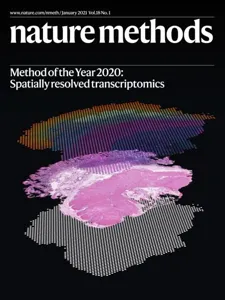
Nature Methods
基本信息
期刊简写:
NAT METHODS
影响因子:
36.1
ISSN:
1548-7091
研究领域:
BIOLOGICAL
h-index:
257
自引率:
2.8%
年发文量:
193
SCI收录来源:
Science Citation Index Expanded
期刊官网:
https://www.nature.com/nmeth
期刊介绍:
Nature Methods is a forum for the publication of novel methods and significant improvements to tried-and-tested basic research techniques in the life sciences. This monthly publication is aimed at a broad, interdisciplinary audience of academic and industry researchers actively involved in laboratory practice. It provides researchers with new tools to conduct their research and places a strong emphasis on immediate practical relevance and potential to advance new biological applications. The journal publishes method developments (Articles, Brief Communications), performance comparisons of related, established methods (Analyses), and collections of tools or datasets of broad interest (Resources) as primary research papers. The journal also publishes overviews of recent technical and methodological developments (Reviews, Perspectives) and opinion pieces (Comments). We are actively seeking papers of relevance to the broad life sciences basic research community, including methods grounded in chemistry, physics and computer science. To enhance the practical relevance of each paper, the description of the method must be accompanied by strong validation, an application to an important biological question and results illustrating its performance in comparison to available approaches. Papers are selected for publication based on broad interest, thorough assessments of methodological performance and comprehensive technical descriptions that facilitate immediate application. Specific areas of interest include, but are not limited to: Methods for genome sequencing and structure profiling Single cell analysis methods, including sequencing, 'omics and multi-omics approaches Methods for spatial 'omics Methods for metagenome analysis Methods for genome engineering Techniques for the analysis and manipulation of gene expression, including epigenetics, gene targeting, transduction Methods for proteomics, including mass spectrometry, analysis of binding interactions and analysis of post-translational modifications Methods for systems biology and interactome profiling Methods for glycobiology Methods for metabolomics Structural biology techniques, including cryo-electron microscopy, cryo-electron tomography, and crystallography Methods for protein engineering Chemical biology techniques, including chemical labeling, methods for expanding the genetic code and chemogenetic tools Biophysical methods, including single molecule and lab-on-a-chip technologies Optical and non-optical imaging technologies, including microscopy, spectroscopy and in vivo imaging Probe design, including genetically encoded and organic dye-based probes and sensors, as well as labeling strategies Methods for cell culture and manipulation, including microbiology approaches Methods to culture, manipulate and study stem cells, organoids and assembloids Immunological techniques, including antigen discovery methods, repertoire discovery methods and methods for studying immune cell interactions Methods for the study of physiology and disease processes including cancer, tumor microenvironment, and pathophysiology Neuroscience methods, such as approaches for studying the brain at different scales, including optical microscopy and MRI, and methods to study animal behavior Methods involving model organisms and their manipulation Computational, statistical and machine learning methods for analysis, modeling and visualization of biological data
CiteScore
CiteScore
58.7
SJR
14.796
SNIP
11.172
| 学科 | 排名 | 百分位 |
|---|---|---|
Biochemistry, Genetics and Molecular BiologyBiochemistry |
1 / 438 | 99% |
期刊统计
Monthly
期/年
Submission to first editorial decision (median days): 6
Submission to acceptance (median days): 231
审稿周期
€10290 EUR/$12290 USD/£8890 GBP
论文处理费
投稿信息
投稿网址:
https://author-welcome.nature.com/guided-oa/41592收录体裁:
Article, Brief Communication, Analysis, Resource, Correspondence, Matters Arising, News and Views, Review, Perspective, Commentary, Application Notes
相关文献
Single-wall carbon nanotubes and peapods investigated by EPR
B. Corzilius, K.-P. Dinse, K. Hata
2007-07-24
Perspective
DOI: 10.1039/B707936M
Oxygen-17 hyperfine structures in the pure rotational spectra of SrO, SnO, BaO, HfO and ThO
Christopher T. Dewberry, Kerry C. Etchison, Garry S. Grubbs II, Robert A. Powoski, Michal M. Serafin, Sean A. Peebles, Stephen A. Cooke
2007-10-09
Paper
DOI: 10.1039/B712798G
Selected ion flow tube cation–molecule reaction studies and threshold photoelectron photoion coincidence spectroscopy of cyclic-C5F8
Michael A. Parkes, Sahangir Ali, Richard P. Tuckett, Victor A. Mikhailov, Chris A. Mayhew
2007-08-02
Paper
DOI: 10.1039/B704862A
Acid/base equilibria in clusters and their role in proton exchange membranes: computational insight
Vassiliki-Alexandra Glezakou, Michel Dupuis, Christopher J. Mundy
2007-09-13
Paper
DOI: 10.1039/B709752B
Molecular dynamics study of dicarbollide anions in nitrobenzene solution and at its aqueous interface. Synergistic effect in the Eu(iii) assisted extraction
G. Chevrot, R. Schurhammer, G. Wipff
2007-09-28
Paper
DOI: 10.1039/B711284J
Structures and energetics of 98 atom Pd–Pt nanoalloys: potential stability of the Leary tetrahedron for bimetallic nanoparticles
Lauro Oliver Paz-Borbón, Thomas V. Mortimer-Jones, Roy L. Johnston, Alvaro Posada-Amarillas, Giovanni Barcaro, Alessandro Fortunelli
2007-07-17
Paper
DOI: 10.1039/B707136A
Fourth-order coherent Raman spectroscopy in a time domain: applications to buried interfaces
2007-07-05
Perspective
DOI: 10.1039/B704566M
您可能还喜欢
化合物问答
4-[4-三氟甲基苯基]恶唑(CAS号:1126636-40-5)通常如何合成?
4-[4-三氟甲基苯基]恶唑通常通过将4-三氟甲基苯酚与异硫氰酸苯酯在有机溶剂中进行酯化反应合成。该反应可在无水条件下,使用适当的催化剂,如四丁基氢氧化铵,以提...
1126636-40-54-(4-(Trifluoromethy...
59729-32-71-[3-(Dimethylamino)...
化合物问答
RockPhos Pd G3(CAS号:2009020-38-4)通常如何合成?
RockPhos Pd G3 通常通过钯催化偶联反应合成,使用配体 (2'-Amino-2-biphenylyl)(methanesulfonato-kappa...
2009020-38-4(2'-Amino-2-biphenyl...
化合物问答
1-哌啶甲酰胺(CAS号:2158-03-4)的市场或研究趋势如何?
1-哌啶甲酰胺作为有机合成中的重要中间体,其市场需求主要受医药、农药、染料等行业推动。近年来,随着新药开发和绿色化学的发展,该化合物的研究趋势集中在开发更高效、...
2158-03-41-Piperidinecarboxam...
化合物问答
2-(二苯基膦基)乙胺(CAS号:4848-43-5)适用哪些法规指南?
2-(二苯基膦基)乙胺适用于多种法规指南,包括但不限于《全球化学品统一分类和标签制度》(GHS),欧盟《化学品注册、评估、授权和限制》法规(REACH),以及美...
4848-43-52-(Diphenylphosphino...
化合物问答
如何储存间苯二甲酸二烯丙酯(CAS号:1087-21-4)?
间苯二甲酸二烯丙酯应储存在阴凉、干燥、通风良好的地方,远离火源和热源。储存容器应密封,避免光照和高温。储存温度应控制在25℃以下,相对湿度应低于80%。避免与其...
1087-21-4Diallyl isophthalate
化合物问答
什么是间甲苯异硫代异氰酸酯(CAS号:621-30-7)?
间甲苯异硫代异氰酸酯是一种有机化合物,分子式为C7H7NO2S,具有刺激性气味。它是一种重要的有机合成中间体,在合成其他化合物时广泛应用。
621-30-71-Isothiocyanato-3-m...
化合物问答
在合成中是否有N-Boc-D-苯丙氨醇(CAS号:106454-69-7)的替代品?
在合成中,可以考虑使用N-Cbz-D-苯丙氨醇或N-Fmoc-D-苯丙氨醇作为替代品。这些化合物同样具有保护氨基的功能,且在合成过程中表现出良好的反应性能。
106454-69-72-Methyl-2-propanyl ...
化合物问答
3-羟甲基-2-氧异丙基吡啶(CAS号:954240-50-7)的主要用途是什么?
3-羟甲基-2-氧异丙基吡啶主要用于有机合成领域,可以作为合成其他药物、农药或精细化学品的中间体。此外,它还可能在实验室研究中作为特定反应的前体或溶剂。
954240-50-7(2-Isopropoxy-3-pyri...
化合物问答
6-氨基-9-甲基嘌呤(CAS号:700-00-5)应用于哪些行业?
6-氨基-9-甲基嘌呤目前主要应用于医药行业,作为某些药物的中间体。此外,它还可能用于聚合物、传感器和半导体的某些领域,作为功能性单体或掺杂剂。
700-00-59-Methyl-9H-purin-6-...
推荐化合物
![[2',6'-bis(propan-2-yloxy)-[1,1'-biphenyl]-3-yl]dicyclohexylphosphane structure](https://cnstatic.chemtradehub.com/structs/787/787618-22-8-dda2.webp "[2',6'-bis(propan-2-yloxy)-[1,1'-biphenyl]-3-yl]dicyclohexylphosphane structure")
[2',6'-bis(propan-2-yloxy)-[1,1'-biphenyl]-3-yl]dicyclohexylphosphane
CAS号:
787618-22-8
分子式:
C30H43O2P


推荐供应商





免责声明
本页面提供的学术期刊信息仅供参考和研究使用。我们与任何期刊出版商均无关联,也不处理投稿事宜。如有投稿相关咨询,请直接联系相关期刊出版商。
如发现页面信息有误,请发送邮件至 support@chemtradehub.com 联系我们。我们将及时核实并处理您的问题。