


Determination of total sulfur in diesel fuel employing NIR spectroscopy and multivariate calibration
文献信息
发布日期
2003-07-18
DOI
10.1039/B305265F
影响因子
4.616
作者
Márcia C. Breitkreitz, Ivo M. Raimundo, Jr, Jarbas J. R. Rohwedder, Celio Pasquini, Heronides A. Dantas Filho, Gledson E. José, Mário C. U. Araújo
查看原文
摘要
A method for sulfur determination in diesel fuel employing near infrared spectroscopy, variable selection and multivariate calibration is described. The performances of principal component regression (PCR) and partial least square (PLS) chemometric methods were compared with those shown by multiple linear regression (MLR), performed after variable selection based on the genetic algorithm (GA) or the successive projection algorithm (SPA). Ninety seven diesel samples were divided into three sets (41 for calibration, 30 for internal validation and 26 for external validation), each of them covering the full range of sulfur concentrations (from 0.07 to 0.33% w/w). Transflectance measurements were performed from 850 to 1800 nm. Although principal component analysis identified the presence of three groups, PLS, PCR and MLR provided models whose predicting capabilities were independent of the diesel type. Calibration with PLS and PCR employing all the 454 wavelengths provided root mean square errors of prediction (RMSEP) of 0.036% and 0.043% for the validation set, respectively. The use of GA and SPA for variable selection provided calibration models based on 19 and 9 wavelengths, with a RMSEP of 0.031% (PLS-GA), 0.022% (MLR-SPA) and 0.034% (MLR-GA). As the ASTM 4294 method allows a reproducibility of 0.05%, it can be concluded that a method based on NIR spectroscopy and multivariate calibration can be employed for the determination of sulfur in diesel fuels. Furthermore, the selection of variables can provide more robust calibration models and SPA provided more parsimonious models than GA.
期刊推荐

Topics in Catalysis

Journal of Chemical Sciences
Bioorganic & Medicinal Chemistry

Journal of Asian Natural Products Research

Cellulose
Electroanalysis
Critical Reviews in Solid State and Materials Sciences

Bioorganic & Medicinal Chemistry Letters
Chinese Journal of Chemistry

Biocatalysis and Biotransformation
相关文献
Glycerol as a source of designer solvents: physicochemical properties of low melting mixtures containing glycerol ethers and ammonium salts
Pascual Pérez, José A. Mayoral, Elisabet Pires, José I. García
2017-09-27
Paper
DOI: 10.1039/C7CP04987K
The hydration structure of the heavy-alkalines Rb+ and Cs+ through molecular dynamics and X-ray absorption spectroscopy: surface clusters and eccentricity
Daniel Z. Caralampio, José M. Martínez, Rafael R. Pappalardo, Enrique Sánchez Marcos
2017-10-04
Paper
DOI: 10.1039/C7CP05346K
The promotion effects of thionation and isomerization on charge carrier mobility in naphthalene diimide crystals
2017-09-20
Paper
DOI: 10.1039/C7CP03787B
Polyaniline decorated Bi2MoO6 nanosheets with effective interfacial charge transfer as photocatalysts and optical limiters
Wei Zhao, Cheng Li, Aijian Wang, Cuncai Lv, Weihua Zhu, Shengping Dou, Qian Wang, Qin Zhong
2017-10-09
Paper
DOI: 10.1039/C7CP06320B
Revealing vilazodone's binding mechanism underlying its partial agonism to the 5-HT1A receptor in the treatment of major depressive disorder
Weiwei Xue, Yuzong Chen, Xiaojun Yao
2017-10-09
Paper
DOI: 10.1039/C7CP05688E
The influence of particle size of amino-functionalized MCM-41 silicas on CO2 adsorption
G. Gatti, C. Vittoni, D. Costenaro, G. Paul, E. Mangano, S. Brandani, L. Marchese
2017-10-18
Paper
DOI: 10.1039/C7CP05177H
Strain induced atomic structure at the Ir-doped LaAlO3/SrTiO3 interface
R. Arras, B. Warot-Fonrose, T. Hungria, M. Lippmaa, H. Daimon, M. J. Casanove
2017-10-02
Paper
DOI: 10.1039/C7CP05918C
Charge transport, interfacial interactions and synergistic mechanisms in BiNbO4/MWO4 (M = Zn and Cd) heterostructures for hydrogen production: insights from a DFT+U study
Francis Opoku, Krishna Kuben Govender, Cornelia Gertina Catharina Elizabeth van Sittert, Penny Poomani Govender
2017-10-02
Paper
DOI: 10.1039/C7CP04440B
The role of association of ions in ionic liquid/molecular solvent mixtures on metal extraction
J.-M. Andanson, P.-A. Cable, M. Traïkia, P. Husson
2017-10-09
Paper
DOI: 10.1039/C7CP05886A
您可能还喜欢
化合物问答
如何处理含有顺-二(2,2'-联吡啶)二氯化钌(II)二水合物(CAS号:67776-38-9)的废料?
处理含有该化合物的废料时,应先收集并分类,然后根据其危险特性选择合适的处理方法。推荐采用焚烧或由专业机构进行安全处理,以确保符合环保法规的要求。处理过程中应佩戴...
67776-38-93-{[(2R,3R,4S,5R,6R)...
化合物问答
4-amino-2-bromo-3-iodopyridine(CAS号:1300750-77-9)的市场或研究趋势如何?
4-氨基-2-溴-3-碘吡啶主要应用于药物合成和研究领域,尤其是在抗病毒和抗癌药物的研发中。随着新型药物的需求增加,该化合物的研究趋势较好。市场方面,由于其特殊...
1300750-77-92-bromo-3-iodopyridi...
化合物问答
4-乙酰基氨基-2-氨基-苯甲酸(CAS号:43134-76-5)的市场或研究趋势如何?
当前,4-乙酰基氨基-2-氨基-苯甲酸(CAS号:43134-76-5)在医药和化工领域有一定的应用。随着药物研发的进展,该化合物在新型药物设计中的应用可能增加...
43134-76-54-Acetamido-2-aminob...
化合物问答
庚a氟-1-(1-碘-1,2,2,2-四氟乙氧基)丙烷(CAS号:107432-46-2)的市场或研究趋势如何?
该化合物目前主要用于特定的工业应用,如氟聚合物的合成。市场趋势显示,由于其独特的结构和性能,未来可能在新型氟材料和特种化学品领域有更多的应用。研究趋势方面,主要...
107432-46-21,1,1,2,2,3,3-Heptaf...
化合物问答
在合成中是否有Propargyl-PEG13-bromide(CAS号:2055105-25-2)的替代品?
可以考虑使用1,3-丁二烯-1-炔-3-基-聚乙二醇-13-溴化物作为Propargyl-PEG13-bromide的替代品,因为两者在结构上相似,均可用于合成...
2055105-25-2Propargyl-peg13-brom...
化合物问答
2-氨基-6-甲氧基嘌呤(CAS号:20535-83-5)安全吗?
2-氨基-6-甲氧基嘌呤在正常使用条件下相对安全,但在操作时仍需注意防护措施,如佩戴手套和护目镜,避免吸入或接触皮肤和眼睛。
20535-83-56-Methoxy-7H-purin-2...
化合物问答
2-甲基-3-溴苯乙酸乙酯(CAS号:1261862-72-9)适用哪些法规指南?
该化合物根据其化学性质和潜在危害,可能适用于GHS(全球化学品统一分类和标签制度)的分类标准。具体分类需依据其毒性和燃烧危险性进行评估。此外,欧洲化学品管理局(...
1261862-72-9Ethyl (3-bromo-2-met...
化合物问答
4,4-二甲基吡咯烷-3-羧酸盐酸盐(CAS号:1351343-41-3)应用于哪些行业?
4,4-二甲基吡咯烷-3-羧酸盐酸盐在医药、聚合物和传感器领域有应用。在医药领域,它可以作为某些药物的中间体;在聚合物领域,它可用作某些聚合物的稳定剂;在传感器...
1351343-41-34,4-Dimethyl-3-pyrro...
化合物问答
处理5-Hydroxy-7-methoxy-2-(4-methoxyphenyl)-4-oxo-4H-chromen-6-yl 2-O-beta-D-xylopyranosyl-beta-D-glucopyranoside(CAS号:149998-39-0)时应注意哪些实验室安全事项?
处理该化合物时应注意使用个人防护装备(如手套、护目镜和实验服),在通风橱中操作。避免直接接触皮肤和吸入,泄漏时应立即清理并使用适当的吸收材料。参考安全数据表(S...
149998-39-05-Hydroxy-7-methoxy-...
化合物问答
7-甲基-1,2,3,4-四氢-吖啶-9-甲酸(CAS号:345621-27-4)的市场或研究趋势如何?
该化合物在医药研究中具有潜在应用价值,特别是在抗癌药物研发方面。随着研究的深入,对其合成方法的优化和生物活性的进一步探索将成为研究热点。
345621-27-47-Methyl-1,2,3,4-tet...
来源期刊
Analyst

CiteScore:
7.8
自引率:
5.6%
年发文量:
653
Analyst publishes analytical and bioanalytical research that reports premier fundamental discoveries and inventions, and the applications of those discoveries, unconfined by traditional discipline barriers.
推荐化合物
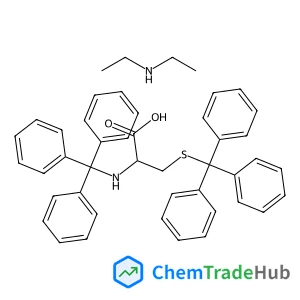
![4,4'-[2,5-Biphenyldiylbis(oxy)]dianiline structure](https://cnstatic.chemtradehub.com/structs/941/94148-67-1-24c6.webp "4,4'-[2,5-Biphenyldiylbis(oxy)]dianiline structure")
推荐供应商





免责声明
本页面提供的学术期刊信息仅供参考和研究使用。我们与任何期刊出版商均无关联,也不处理投稿事宜。如有投稿相关咨询,请直接联系相关期刊出版商。
如发现页面信息有误,请发送邮件至 support@chemtradehub.com 联系我们。我们将及时核实并处理您的问题。