





Parallel nucleic acid recognition by the LNA (locked nucleic acid) stereoisomers β-L-LNA and α-D-LNA; studies in the mirror image world
文献信息
发布日期
2003-12-19
DOI
10.1039/B312321A
影响因子
6.222
作者
Nanna K. Christensen, Torsten Bryld, Mads D. Sørensen, Khalil Arar, Jesper Wengel, Poul Nielsen
查看原文
摘要
Two LNA (locked nucleic acid) stereoisomers (β-L-LNA and α-D-LNA) are evaluated in the mirror-image world, that is by the study of two mixed sequences of LNA and α-L-LNA and their L-DNA and L-RNA complements. Both are found to display high-affinity RNA-recognition by the formation of duplexes with parallel strand orientation.
相关文献
In situ investigation of supercritical CO2 assisted impregnation of drugs into a polymer by high pressure FTIR micro-spectroscopy
J.-M. Thomassin, C. Jérôme, T. Tassaing
2014-11-20
Paper
DOI: 10.1039/C4AN01130A
Solid-state transformation of aqueous to organic electrolyte – Enhancing the operating voltage window of ‘in situ electrolyte’ supercapacitors
Desirée Leistenschneider, Lars Henning Heß, Andrea Balducci, Lars Borchardt
2020-02-26
Paper
DOI: 10.1039/D0SE00180E
Immobilized iridium complexes for hydrogen evolution from formic acid dehydrogenation
Yangbin Shen, Chuang Bai, Fandi Ning, Huihui Wang, Jun Wei, Guojun Lv, Xiaochun Zhou
2020-03-09
Paper
DOI: 10.1039/C9SE01247H
Chemically diverse polymer microarrays and high throughput surface characterisation: a method for discovery of materials for stem cell culture
A. D. Celiz, J. G. W. Smith, A. K. Patel, R. Langer, D. G. Anderson, D. A. Barrett, L. E. Young, M. C. Davies, C. Denning, M. R. Alexander
2014-05-12
Communication
DOI: 10.1039/C4BM00054D
Raman micro spectroscopy for in vitro drug screening: subcellular localisation and interactions of doxorubicin
Z. Farhane, F. Bonnier, A. Casey, H. J. Byrne
2015-03-31
Paper
DOI: 10.1039/C5AN00256G
Ammonia-etching-assisted nanotailoring of manganese silicate boosts faradaic capacity for high-performance hybrid supercapacitors
Xueying Dong, Yifu Zhang, Qiang Chen, Hanmei Jiang, Qiushi Wang, Changgong Meng, Zongkui Kou
2020-03-03
Paper
DOI: 10.1039/D0SE00042F
Survival, differentiation, and migration of high-purity mouse embryonic stem cell-derived progenitor motor neurons in fibrin scaffolds after sub-acute spinal cord injury
D. A. McCreedy, T. S. Wilems, H. Xu, J. C. Butts, C. R. Brown, A. W. Smith, S. E. Sakiyama-Elbert
2014-06-30
Paper
DOI: 10.1039/C4BM00106K
A safe Li–Se battery in an ionic liquid-based electrolyte operating at 25–70 °C by using a N,S,O tri-doped mesoporous carbon host material
Cuong Nguyen, Anders J. Barlow, Pavel V. Cherepanov, Maria Forsyth, Patrick C. Howlett, Douglas R. MacFarlane
2020-02-27
Paper
DOI: 10.1039/C9SE01074B
Cu2CoGeS4 nanocrystals for high performance aqueous polysulfide/iodide redox flow batteries: enhanced selectively towards the electrocatalytic conversion of polysulfides
Kai He, Tsegaye Tadesse Tsega, Nazakat Ali, Jiantao Zai, Shoushuang Huang, Xuefeng Qian, Zhiwen Chen
2020-03-18
Paper
DOI: 10.1039/C9SE01201J
您可能还喜欢
化合物问答
4-((4-甲基哌嗪-1-基)甲基)苯硼酸(CAS号:763120-62-3)的市场或研究趋势如何?
随着有机硼化学的发展,该化合物在催化、药物合成、材料科学等领域展现出潜在的应用价值。近年来,其在药物前体合成中的应用越来越受到关注。市场趋势显示,随着科研投入的...
763120-62-3{4-[(4-Methyl-1-pipe...
化合物问答
如何储存2,4,5-三甲基-1-硝基苯(CAS号:610-91-3)?
2,4,5-三甲基-1-硝基苯应储存在阴凉、干燥且通风良好的地方,避免阳光直射。储存在密封的金属容器中,远离火源和热源。储存温度应控制在25°C以下,湿度不宜过...
610-91-31,2,4-Trimethyl-5-ni...
化合物问答
处理2,5-二碘噻吩(CAS号:625-88-7)时应注意哪些实验室安全事项?
在处理2,5-二碘噻吩时,应穿戴适当的个人防护装备(PPE),包括实验室外套、手套和防护眼镜。在通风橱中进行操作以避免吸入蒸气。如果发生泄漏,应立即疏散人员并使...
625-88-72,5-Diiodothiophene
化合物问答
在合成中是否有6-bromo-3-chloro-1H-indole(CAS号:57916-08-2)的替代品?
在合成6-溴-3-氯-1H-吲哚(CAS号:57916-08-2)时,可以考虑使用一些类似的化合物作为替代品,如6-氯-3-氯-1H-吲哚或3-氯-1H-吲哚,...
57916-08-26-bromo-3-chloro-1H-...
化合物问答
在合成中是否有(R)-(-)-1-(1-萘基)乙基异氰酸酯(CAS号:42340-98-7)的替代品?
可以考虑使用类似结构的化合物,如1-[(1R)-1-(2-氨基乙基)萘-1-基]乙基异氰酸酯作为替代品。此外,还可以寻找其他类型的异氰酸酯衍生物,如苯基异氰酸酯...
42340-98-71-[(1R)-1-Isocyanato...
化合物问答
3-氨基苯甲酰苯胺(CAS号:14315-16-3)适用哪些法规指南?
3-氨基苯甲酰苯胺适用于多项法规指南,包括但不限于GHS(全球化学品统一分类和标签制度)分类为皮肤腐蚀/刺激类别2,以及潜在的皮肤过敏性类别1。在欧盟地区,它受...
14315-16-33-Amino-N-phenylbenz...
化合物问答
β-环柠檬醛-D5(CAS号:26309-95-5)通常如何合成?
β-环柠檬醛-D5可通过不对称合成方法获得。常见的合成路线包括以环己酮为原料,经过选择性氧化、还原、保护基引入等步骤,最终得到目标化合物。该合成过程中通常使用多...
26309-95-5[(2,2-Dimethylpropan...
34915-68-9Bunitrolol
化合物问答
如何处理含有BIO-1211(CAS号:187735-94-0)的废料?
对于含有BIO-1211(CAS号:187735-94-0)的废料,首先应进行分类收集,确保符合环保要求。然后,可以考虑通过焚烧或其他专业处理方法进行处置。在处...
187735-94-0BIO-1211
化合物问答
如何处理含有4-氯-2-氟-3-甲基苯酚(CAS号:1351668-24-0)的废料?
含有该化合物的废液应收集至专用容器中,避免与其他化学品混合。可采用焚烧或送交专业废弃物处理公司处理。处理过程中需遵守当地环保法规,确保不产生二次污染。处理前应进...
1351668-24-04-Chloro-2-fluoro-3-...
来源期刊
Chemical Communications
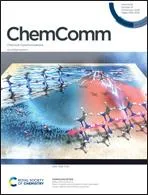
CiteScore:
8.6
自引率:
4.7%
年发文量:
2458
ChemComm publishes urgent research which is of outstanding significance and interest to experts in the field, while also appealing to the journal’s broad chemistry readership. Our communication format is ideally suited to short, urgent studies that are of such importance that they require accelerated publication. Our scope covers all topics in chemistry, and research at the interface of chemistry and other disciplines (such as materials science, nanoscience, physics, engineering and biology) where there is a significant novelty in the chemistry aspects. Major topic areas covered include: Analytical Chemistry Catalysis Chemical Biology and medicinal chemistry Computational Chemistry and Machine Learning Energy and sustainable chemistry Environmental Chemistry Green Chemistry Inorganic Chemistry Materials Chemistry Nanoscience Organic Chemistry Physical Chemistry Polymer Chemistry Supramolecular Chemistry
推荐化合物
推荐供应商






免责声明
本页面提供的学术期刊信息仅供参考和研究使用。我们与任何期刊出版商均无关联,也不处理投稿事宜。如有投稿相关咨询,请直接联系相关期刊出版商。
如发现页面信息有误,请发送邮件至 support@chemtradehub.com 联系我们。我们将及时核实并处理您的问题。