



Correlated ionic hopping processes in crystalline and glassy electrolytes resulting in MIGRATION-type and nearly-constant-loss-type conductivities
文献信息
发布日期
2004-11-30
DOI
10.1039/B414160C
影响因子
3.676
作者
K. Funke, R. D. Banhatti, C. Cramer
查看原文
摘要
Solid electrolytes with disordered structures may be crystalline or glassy. Their complex ionic conductivity displays a characteristic frequency dependence. Modelling the dynamics of the mobile ions, we have developed the MIGRATION concept, the acronym standing for MIsmatch Generated Relaxation for the Accommodation and Transport of IONs. With the help of the MIGRATION concept it is possible to reproduce frequency-dependent experimental conductivities and permittivities including their scaling behaviour. Scaling is a property typically observed in and below the radio frequency regime. At sufficiently high frequencies and low temperatures, however, conductivity spectra of crystals and glasses are often found to contain a second component which displays the so-called nearly-constant-loss (NCL) behaviour. Suitably modifying the MIGRATION concept, we are able to explain this feature and to show that it is caused by a displacive or hopping ionic motion that stays completely localised. Here, as in the unmodified MIGRATION concept, interactions between the ions play an essential role. Experimentally, interesting differences are detected between the NCL-type dynamics in a crystalline and in a glassy ion conductor. In crystalline γ-RbAg4I5 we find the same elementary rates for the MIGRATION-type and NCL-type hopping movements of the ions, suggesting identical barrier heights for the respective processes. On the other hand, the two rates are found to differ markedly from each other in glassy AgI-AgPO3, not only with regard to their absolute value but also in their temperature dependence. We suggest that the NCL effect in the glass results from dynamic localised displacements involving both the silver ions and negatively charged entities such as iodide ions and/or non-bridging oxygen ions.
期刊推荐

Herald of the Russian Academy of Sciences

Bioorganic & Medicinal Chemistry

Colloid Journal

Medicinal Chemistry Research
Critical Reviews in Solid State and Materials Sciences
Polycyclic Aromatic Compounds
Journal of Asian Natural Products Research

Biocatalysis and Biotransformation

Acta Metallurgica Sinica-English Letters
Journal of Chemical Sciences
相关文献
Macroscopic and local approaches of phase transition in sol–gel synthesized (Bi0.5Na0.5)TiO3–SrTiO3 thin films
Hyun-Young Lee, Jin Luo, Zhen Zhou, Wei Sun, Jing-Feng Li
2018-05-01
Paper
DOI: 10.1039/C8CP01830H
Hydrogen bond network structures of protonated short-chain alcohol clusters
Asuka Fujii, Natsuko Sugawara, Po-Jen Hsu, Takuto Shimamori, Ying-Cheng Li, Toru Hamashima, Jer-Lai Kuo
2018-03-05
Perspective
DOI: 10.1039/C7CP08072G
The effect of hydration on the electronic structure and stability of the superalkali cation Li3+
Jia-Huan Hou, Di Wu, Jia-Yuan Liu, Si-Yi Li, Dan Yu, Ying Li
2018-05-02
Paper
DOI: 10.1039/C8CP00862K
The evaporation kinetics of pure water droplets at varying drying rates and the use of evaporation rates to infer the gas phase relative humidity
Yong-yang Su, Rachael E. H. Miles, Zhi-ming Li, Jonathan P. Reid, Jiang Xu
2018-08-31
Paper
DOI: 10.1039/C8CP05250F
Li+-Induced fluorescent metallogel: a case of ESIPT-CHEF and ICT phenomenon
Manish Kumar Dixit, Mrigendra Dubey
2018-08-10
Paper
DOI: 10.1039/C8CP04579H
Anchoring of carboxyl-functionalized porphyrins on MgO, TiO2, and Co3O4 nanoparticles
Fabian Kollhoff, Johannes Schneider, Gao Li, Sami Barkaoui, Wenjie Shen, Thomas Berger, Oliver Diwald
2018-09-11
Paper
DOI: 10.1039/C8CP04873H
Thermodynamics and defect chemistry of substitutional and interstitial cation doping in layered α-V2O5
Kit McColl, Ian Johnson, Furio Corà
2018-05-11
Communication
DOI: 10.1039/C8CP02187B
Influence of Cu adatoms on the molecular assembly of 4,4′-bipyridine on Cu(111)
M.-A. Dubois, O. Guillermet, S. Gauthier, G. Zhan, Y. Makoudi, F. Palmino, X. Bouju, A. Rochefort
2018-05-07
Paper
DOI: 10.1039/C8CP01184B
Most favorable cumulenic structures in iron-capped linear carbon chains are short singlet odd-carbon dications: a theoretical view
Liang Pu, Zhong Zhang, R. Bruce King, Wesley D. Allen
2018-05-21
Paper
DOI: 10.1039/C7CP08673C
您可能还喜欢
化合物问答
6-氯-2H-1,4-苯并噁嗪-3(4H)-酮(CAS号:7652-29-1)应用于哪些行业?
6-氯-2H-1,4-苯并噁嗪-3(4H)-酮主要应用于医药、农药和聚合物等领域。在医药领域,该化合物可用于合成抗菌药物;在农药领域,可用作杀虫剂的中间体;在聚...
7652-29-16-Chloro-2H-1,4-benz...
化合物问答
活性氧化铝(CAS号:1302-74-5)应用于哪些行业?
活性氧化铝广泛应用于医药、聚合物、传感器、半导体和催化等领域。在医药行业,活性氧化铝用作吸附剂和干燥剂,有助于去除杂质和水分。在聚合物行业,它用作增白剂和抗结块...
1302-74-5aluminum;trihydrate
化合物问答
什么是硅胶(CAS号:112926-00-8)?
硅胶(Silica gel, pptd.,cryst.-free)是一种无定形、多孔的硅酸盐材料,主要成分为二氧化硅(SiO₂)。其结构由硅氧四面体构成,通过酸...
112926-00-8Silica gel, pptd.,cr...
化合物问答
二乙基甲基一氢硅烷(CAS号:760-32-7)的主要用途是什么?
二乙基甲基一氢硅烷主要用于有机合成、表面处理以及作为溶剂。它还被用作合成其他硅烷化合物的原料,以及在涂料、粘合剂和密封剂中的应用。
760-32-7Diethyl(methyl)silan...
化合物问答
在合成中是否有N-花生四烯酰基甘氨酸(CAS号:179113-91-8)的替代品?
在合成过程中,可以考虑使用类似结构的化合物作为替代品,例如N-亚油酰基甘氨酸或N-花生二烯酰基甘氨酸。这些替代品在结构上有类似的双键位置,但可能具有不同的物理化...
179113-91-8Glycine, N-[(5Z,8Z,1...
化合物问答
在合成中是否有1-(4-甲氧基苯基)丙烷-1,2-二酮(CAS号:10557-27-4)的替代品?
在合成过程中,可以考虑使用类似结构的化合物作为替代品,例如1-(3-甲氧基苯基)丙烷-1,2-二酮或1-(4-羟基苯基)丙烷-1,2-二酮。这些替代品具有相似的...
10557-27-41-(4-Methoxyphenyl)p...
化合物问答
N-(4-氨基-1-苄基-3-羟基-5-苯基戊基)-3-甲基-2-(2-氧代四氢嘧啶-1-基)-丁酰胺 5-氧代吡咯烷-2-甲酸(CAS号:192726-06-0)通常如何合成?
该化合物通常通过一系列复杂的有机合成步骤获得。首先,通过芳香族化合物的羟基化反应获得羟基化产物,然后通过酰化反应形成酰胺中间体,最后通过环化反应得到目标产物。常...
192726-06-05-Oxo-L-proline - (2...
化合物问答
(S)-2-氨基-3-喹啉-2-丙酸(CAS号:161513-46-8)的市场或研究趋势如何?
该化合物作为生物活性化合物,尤其是在药物化学领域表现出色。近年来,随着对新型抗炎、抗病毒和抗癌药物的研究增加,其市场和研究趋势持续增长。此外,其在神经科学领域的...
161513-46-8(S)-2-Amino-3-quinol...
化合物问答
核黄素磷酸钠(CAS号:130-40-5)安全吗?
核黄素磷酸钠在常规使用条件下安全,但高剂量可能引起刺激性反应。操作时需佩戴防护手套和护目镜,避免吸入粉尘。若接触皮肤或眼睛,应立即用大量清水冲洗。急救时需根据接...
130-40-5Sodium 1-deoxy-1-(7,...
化合物问答
盐酸丙胺卡因杂质A(EP) 标准品(CAS号:19281-31-3)通常如何合成?
盐酸丙胺卡因杂质A(EP) 标准品可通过重氮化反应和随后的酰胺化反应合成。首先,利用氯化反应将苯环上的氢原子转化为氯原子,然后通过芳香族重氮化反应引入氨基,最后...
19281-31-32-Chloro-N-(2-methyl...
来源期刊
Physical Chemistry Chemical Physics

CiteScore:
5.5
自引率:
10.3%
年发文量:
3036
Physical Chemistry Chemical Physics (PCCP) is an international journal co-owned by 19 physical chemistry and physics societies from around the world. This journal publishes original, cutting-edge research in physical chemistry, chemical physics and biophysical chemistry. To be suitable for publication in PCCP, articles must include significant innovation and/or insight into physical chemistry; this is the most important criterion that reviewers and Editors will judge against when evaluating submissions. The journal has a broad scope and welcomes contributions spanning experiment, theory, computation and data science. Topical coverage includes spectroscopy, dynamics, kinetics, statistical mechanics, thermodynamics, electrochemistry, catalysis, surface science, quantum mechanics, quantum computing and machine learning. Interdisciplinary research areas such as polymers and soft matter, materials, nanoscience, energy, surfaces/interfaces, and biophysical chemistry are welcomed if they demonstrate significant innovation and/or insight into physical chemistry. Joined experimental/theoretical studies are particularly appreciated when complementary and based on up-to-date approaches.
推荐化合物
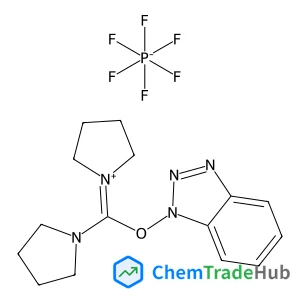
(1H-Benzotriazol-1-yloxy)(di-1-pyrrolidinyl)methylium hexafluorophosphate
CAS号:
105379-24-6
分子式:
C15H21F6N5OP
![1,2-Diphenyl-4-[2-(phenylsulfinyl)ethyl]-3,5-pyrazolidinedione structure](https://cnstatic.chemtradehub.com/structs/57-/57-96-5-efcc.webp "1,2-Diphenyl-4-[2-(phenylsulfinyl)ethyl]-3,5-pyrazolidinedione structure")
推荐供应商





免责声明
本页面提供的学术期刊信息仅供参考和研究使用。我们与任何期刊出版商均无关联,也不处理投稿事宜。如有投稿相关咨询,请直接联系相关期刊出版商。
如发现页面信息有误,请发送邮件至 support@chemtradehub.com 联系我们。我们将及时核实并处理您的问题。