





Organometallic based strategies for metal nanocrystal synthesis
文献信息
发布日期
2005-03-24
DOI
10.1039/B501835H
影响因子
6.222
作者
查看原文
摘要
Organometallic strategies normally employed for the production of semiconductor quantum dots have been successfully applied to the synthesis of metal nanoparticles. By controlling parameters such as capping agents, reaction temperature and precursor chemistry, precise nanostructures can be obtained that exhibit highly desirable magnetic, optical and catalytic properties.
相关文献
Effect of nano-pillared surfaces with an arrangement density gradient on droplet coalescence dynamics
Tao Li, MingYu Li, JunJun Wang, Jie Li, YunRui Duan, Hui Li
2018-09-04
Paper
DOI: 10.1039/C8CP05014G
Model – free approach to quadrupole spin relaxation in solid 209Bi-aryl compounds
Danuta Kruk, Christian Goesweiner, Elzbieta Masiewicz, Evrim Umut, Carina Sampl, Hermann Scharfetter
2018-09-04
Paper
DOI: 10.1039/C8CP03848A
Shape transition of water-in-CO2 reverse micelles controlled by the surfactant midpiece
Muhan Wang, Junfeng Wang, Timing Fang, Youguo Yan, Zhiyuan Wang, Jun Zhang
2018-05-19
Paper
DOI: 10.1039/C8CP01844H
Enhancement of field electron emission in topological insulator Bi2Se3 by Ni doping
Kushal Mazumder, Alfa Sharma, Yogendra Kumar, Mahendra A. More, Rupesh Devan
2018-06-08
Paper
DOI: 10.1039/C8CP01982G
Thermodynamics and defect chemistry of substitutional and interstitial cation doping in layered α-V2O5
Kit McColl, Ian Johnson, Furio Corà
2018-05-11
Communication
DOI: 10.1039/C8CP02187B
TEMPO-oxidised cellulose nanofibrils; probing the mechanisms of gelation via small angle X-ray scattering
Julien Schmitt, Vincenzo Calabrese, Marcelo A. da Silva, Saskia Lindhoud, Viveka Alfredsson, Karen J. Edler
2018-05-24
Paper
DOI: 10.1039/C8CP00355F
Different scenarios of dynamic coupling in glassy colloidal mixtures
Tatjana Sentjabrskaja, José Ruiz-Franco, Stefan U. Egelhaaf
2018-06-15
Paper
DOI: 10.1039/C8CP02559B
Constructing organic superacids from superhalogens is a rational route as verified by DFT calculations
Fu-Qiang Zhou, Ru-Fang Zhao, Jin-Feng Li, Wen-Hua Xu, Chao-Chao Li, Lan Luo, Jian-Li Li, Bing Yin
2019-01-04
Paper
DOI: 10.1039/C8CP07313A
Electrocatalytic studies on imidazolium based ionic liquids: defining experimental conditions
Miguel A. Montiel, José Solla-Gullón, Vicente Montiel, Carlos M. Sánchez-Sánchez
2018-06-22
Paper
DOI: 10.1039/C8CP02662A
Thermodiffusion of repulsive charged nanoparticles – the interplay between single-particle and thermoelectric contributions
M. Kouyaté, G. Demouchy, G. Mériguet, R. Aquino, E. Dubois, S. Nakamae, M. Roger, J. Depeyrot, R. Perzynski
2018-05-23
Paper
DOI: 10.1039/C8CP02558D
您可能还喜欢
化合物问答
N-2,2-丙烯基-2-丙烯酰胺(CAS号:2555-13-7)通常如何合成?
N-2,2-丙烯基-2-丙烯酰胺通常通过丙烯酰胺与丙烯基卤化物的缩合反应合成。该反应通常在温和的条件下进行,使用适量的碱如吡啶作为催化剂。反应的选择性良好,产率...
2555-13-7N-Allylacrylamide
化合物问答
什么是1,2-二碘四氟代乙烷(CAS号:354-65-4)?
1,2-二碘四氟代乙烷是一种有机化合物,化学式为C2F4I2,CAS号为354-65-4。它是一种无色透明液体,具有特殊的化学性质和物理性质,包括高沸点、低挥发...
354-65-41,1,2,2-Tetrafluoro-...
化合物问答
3-溴-1H-吡咯[3,2-c]吡啶-4-碳腈(CAS号:1000341-71-8)适用哪些法规指南?
根据GHS(全球化学品统一分类和标签制度),3-溴-1H-吡咯[3,2-c]吡啶-4-碳腈被归类为第2类易燃液体。在欧盟,该化合物需要符合REACH法规的要求,...
1000341-71-83-Bromo-1H-pyrrolo[3...
化合物问答
1-氯甲基萘磺酸(CAS号:87491-79-0)安全吗?
1-氯甲基萘磺酸在使用时需要谨慎,因为它具有一定的刺激性和腐蚀性。操作时应佩戴适当的防护装备,如防化服、手套、护目镜等,避免直接接触皮肤和吸入其蒸汽。
87491-79-01-((Chloromethyl)sul...
化合物问答
二氯(二环戊二烯)铂(CAS号:12083-92-0)的主要用途是什么?
该化合物主要用于催化剂领域,特别是在有机合成中的催化氧化反应以及作为某些药物合成的中间体。此外,它还被研究用于纳米材料的制备。
12083-92-0(1S,7R)-Tricyclo[5.2...
化合物问答
3-溴-7-氯噻吩并[3,2-b]吡啶-6-甲腈(CAS号:798574-82-0)安全吗?
3-溴-7-氯噻吩并[3,2-b]吡啶-6-甲腈在处理时需要谨慎,因其含有溴和氯等强卤素,可能具有一定的刺激性和腐蚀性。使用时应佩戴适当的个人防护装备,避免皮肤...
798574-82-03-Bromo-7-chlorothie...
化合物问答
(R)-1-((R)-2-(2’-二环己基膦苯基)三戊铁基]乙基(双-3,5-三氟甲基苯基)膦(CAS号:494227-32-6)的主要用途是什么?
该化合物主要用于有机合成领域,特别是作为催化剂或配体,在有机合成反应中发挥重要作用。此外,它还可能应用于催化加氢反应、偶联反应等。
494227-32-6Walphos SL-W008-1
化合物问答
3-[6-(Diphenylphosphoryl)-2-naphthyl]-1,10-phenanthroline(CAS号:1480371-38-7)安全吗?
3-[6-(Diphenylphosphoryl)-2-naphthyl]-1,10-phenanthroline在正常使用条件下相对安全,但在操作时应穿戴适当...
1480371-38-73-[6-(Diphenylphosph...
化合物问答
在合成中是否有ETHYL 2-(4-(4,4,5,5-TETRAMETHYL-1,3,2-DIOXABOROLAN-2-YL)CYCLOHEX-3-ENYL)ACETATE(CAS号:1166829-70-4)的替代品?
可以考虑使用类似结构的化合物作为替代品,如2-(4-环戊基环己烯基)乙酸酯,这种化合物在结构上相似,可能在某些合成路径中作为替代品。
1166829-70-4Ethyl [4-(4,4,5,5-te...
化合物问答
如何处理含有3-(3-氨基丙基)丙酮缩甘油(CAS号:131606-42-3)的废料?
处理含有3-(3-氨基丙基)丙酮缩甘油的废料时,首先应确保遵守当地的环保法规。对于危险废物,应进行分类收集,然后送至专业的废物处理设施进行焚烧或安全填埋。在处理...
131606-42-33-[(2,2-Dimethyl-1,3...
来源期刊
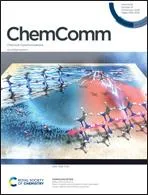
Chemical Communications
CiteScore:
8.6
自引率:
4.7%
年发文量:
2458
ChemComm publishes urgent research which is of outstanding significance and interest to experts in the field, while also appealing to the journal’s broad chemistry readership. Our communication format is ideally suited to short, urgent studies that are of such importance that they require accelerated publication. Our scope covers all topics in chemistry, and research at the interface of chemistry and other disciplines (such as materials science, nanoscience, physics, engineering and biology) where there is a significant novelty in the chemistry aspects. Major topic areas covered include: Analytical Chemistry Catalysis Chemical Biology and medicinal chemistry Computational Chemistry and Machine Learning Energy and sustainable chemistry Environmental Chemistry Green Chemistry Inorganic Chemistry Materials Chemistry Nanoscience Organic Chemistry Physical Chemistry Polymer Chemistry Supramolecular Chemistry
推荐化合物
![[1-(5-Methyl-2-pyridinyl)-1H-pyrazol-4-yl]methanol structure](https://cnstatic.chemtradehub.com/structs/143/1439822-99-7-6cc9.webp "[1-(5-Methyl-2-pyridinyl)-1H-pyrazol-4-yl]methanol structure")
推荐供应商



免责声明
本页面提供的学术期刊信息仅供参考和研究使用。我们与任何期刊出版商均无关联,也不处理投稿事宜。如有投稿相关咨询,请直接联系相关期刊出版商。
如发现页面信息有误,请发送邮件至 support@chemtradehub.com 联系我们。我们将及时核实并处理您的问题。