












An electrochemical immunosensor using p-aminophenol redox cycling by NADH on a self-assembled monolayer and ferrocene-modified Au electrodes
文献信息
发布日期
2008-08-11
DOI
10.1039/B806302H
影响因子
4.616
作者
Seong Jung Kwon, Haesik Yang, Kyungmin Jo, Juhyoun Kwak
查看原文
摘要
Redox cycling of enzymatically amplified electroactive species has been widely employed for high signal amplification in electrochemical biosensors. However, gold (Au) electrodes are not generally suitable for redox cycling using a reducing (or oxidizing) agent because of the high background current caused by the redox reaction of the agent at highly electrocatalytic Au electrodes. Here we report a new redox cycling scheme, using nicotinamide adenine dinucleotide (NADH), which can be applied to Au electrodes. Importantly, p-aminophenol (AP) redox cycling by NADH is achieved in the absence of diaphorase enzyme. The Au electrodes are modified with a mixed self-assembled monolayer of mercaptododecanoic acid and mercaptoundecanol, and a partially ferrocenyl-tethered dendrimer layer. The self-assembled monolayer of long thiol molecules significantly decreases the background current of the modified Au electrodes, and the ferrocene modification facilitates easy oxidation of AP. The low amount of ferrocene on the Au electrodes minimizes ferrocene-mediated oxidation of NADH. In sandwich-type electrochemical immunosensors for mouse immunoglobulin G (IgG), an alkaline phosphatase label converts p-aminophenylphosphate (APP) into electroactive AP. The amplified AP is oxidized to p-quinoneimine (QI) by electrochemically generated ferrocenium ion. NADH reduces QI back to AP, which can be re-oxidized. This redox cycling enables a low detection limit for mouse IgG (1 pg mL−1) to be obtained.
相关文献
The photoionisation of two phenylcarbenes and their diazirine precursors investigated using synchrotron radiation
Bastian Noller, Patrick Hemberger, Ingo Fischer, Christian Alcaraz, Gustavo A. Garcia, Héloïse Soldi-Lose
2009-04-22
Paper
DOI: 10.1039/B823269E
Initiated and oxidative chemical vapor deposition: a scalable method for conformal and functional polymer films on real substrates
Salmaan H. Baxamusa, Sung Gap Im, Karen K. Gleason
2009-03-26
Perspective
DOI: 10.1039/B900455F
DFT 2H quadrupolar coupling constants of ruthenium complexes: a good probe of the coordination of hydrides in conjuction with experiments
Iker del Rosal, Torsten Gutmann, Laurent Maron, Franck Jolibois, Bruno Chaudret, Bernadeta Walaszek, Hans-Heinrich Limbach, Romuald Poteau, Gerd Buntkowsky
2009-05-05
Paper
DOI: 10.1039/B822150B
Motion of single wandering diblock-macromolecules directed by a PTFE nano-fence: real time SFM observations
Marat O. Gallyamov, Shuhui Qin, Krzysztof Matyjaszewski, Martin Möller
2009-04-20
Paper
DOI: 10.1039/B819011A
Water adsorption on hydrophilic and hydrophobic self-assembled monolayers as proxies for atmospheric surfaces. A grand canonical Monte Carlo simulation study
Martina Roeselová
2010-03-16
Paper
DOI: 10.1039/B923382B
Quantum chemical study of benzimidazole derivatives to tune the second-order nonlinear optical molecular switching by proton abstraction
Shabbir Muhammad, Hongliang Xu, Muhammad Ramzan Saeed Ashraf Janjua, Zhongmin Su
2010-03-24
Paper
DOI: 10.1039/B924241D
Charge separation and photocurrent polarity-switching at CdS quantum dots assembly in polyelectrolyte interfaced with hole scavengers
Maysaa El Harakeh, Leen Alawieh, Samer Saouma, Lara I. Halaoui
2009-05-27
Paper
DOI: 10.1039/B820895F
Understanding microwave heating effects in single mode type cavities—theory and experiment
John Robinson, Sam Kingman, Derek Irvine, Peter Licence, Alastair Smith, Georgios Dimitrakis, David Obermayer, C. Oliver Kappe
2010-03-16
Paper
DOI: 10.1039/B922797K
Dissociative double photoionization of CO2 molecules in the 36–49 eV energy range: angular and energy distribution of ion products
P. Candori, S. Falcinelli, M. Lavollée, F. Pirani, R. Richter, F. Vecchiocattivi
2010-04-01
Paper
DOI: 10.1039/B926960F
您可能还喜欢
化合物问答
十二烷基磺酸钠(CAS号:2386-53-0)的主要用途是什么?
十二烷基磺酸钠主要用作表面活性剂,广泛应用于洗涤剂、肥皂、化妆品和工业清洁产品中。它能有效去除油脂和污垢,常用于制造洗发水、沐浴露、洗衣粉和金属清洗剂。此外,它...
2386-53-01-Dodecanesulfonic a...
化合物问答
5-羟基异喹啉(CAS号:2439-04-5)适用哪些法规指南?
5-羟基异喹啉作为化学品,主要适用的法规包括GHS全球化学品统一分类和标签制度,REACH法规等。GHS将5-羟基异喹啉分类为皮肤腐蚀/刺激类别2,严重眼损伤/...
2439-04-55-Isoquinolinol
化合物问答
在合成中是否有FIDAS-5 | Wnt(CAS号:1391934-98-7)的替代品?
合成中可以考虑使用类似结构的化合物,如4-[(E)-2-(2-氯-6-氟苯基)乙烯基]-N-甲基苯胺的类似物或衍生物作为替代品。这类化合物可能具有相似的生物活性...
1391934-98-74-[(E)-2-(2-Chloro-6...
化合物问答
(R)-tert-Butyl 2-(5-bromo-1H-imidazol-2-yl)pyrrolidine-1-carboxylate(CAS号:1370600-56-8)通常如何合成?
该化合物通常通过如下步骤合成:首先,将4-溴-1H-咪唑与对甲苯磺酸在乙酸乙酯中反应,得到中间体5-溴-1H-咪唑-2-甲酸乙酯。然后,该中间体与2-甲基-2-...
1370600-56-82-Methyl-2-propanyl ...
化合物问答
处理4-(吡咯烷-1-基)环己酮(CAS号:10421-18-8)时应注意哪些实验室安全事项?
处理4-(吡咯烷-1-基)环己酮时,应佩戴手套、护目镜和实验室外套,以防止直接接触或吸入。在通风橱中操作,确保良好的通风条件。一旦发生泄漏,应立即清理并使用适当...
10421-18-84-(Pyrrolidin-1-yl)c...
化合物问答
如何处理含有异麦芽糖醇(CAS号:534-73-6)的废料?
含有异麦芽糖醇的废液应首先进行分类收集,避免与其他化学品混合。对于小规模的废液,可以通过焚烧或加入特定的化学试剂进行无害化处理。对于大规模的废液,建议联系专业的...
534-73-66-O-alpha-D-Glucopyr...
化合物问答
7-甲基壬酸(CAS号:41653-89-8)的主要用途是什么?
7-甲基壬酸主要用于有机合成领域,作为合成其他化合物的原料。此外,它还可能作为一种中间体用于药品制造和香料合成,但具体用途需要根据其具体的化学结构和反应特性来确...
41653-89-87-Methylnonanoic aci...
化合物问答
N-甲氧基-N-甲基甲基吡啶羧酰胺(CAS号:148493-07-6)应用于哪些行业?
N-甲氧基-N-甲基甲基吡啶羧酰胺在医药领域有一定的应用,作为一种潜在的药物前体或中间体。此外,该化合物也可能应用于聚合物改性剂、传感器材料等。由于其独特的化学...
148493-07-6N-Methoxy-N-methylpi...
化合物问答
什么是惕各酸香叶酯(CAS号:7785-33-3)?
惕各酸香叶酯是一种化合物,化学名称为(2E)-3,7-二甲基-2,6-辛二烯-1-基(2E)-2-甲基-2-丁烯酸酯。它是一种具有香叶香气的化合物,分子式为C1...
7785-33-3(2E)-3,7-Dimethyl-2,...
化合物问答
1-环丁基哌嗪(CAS号:132800-13-6)安全吗?
1-环丁基哌嗪在适当的操作条件下是相对安全的,但如遇明火或高热会释放有毒气体。操作时应佩戴防护眼镜和手套,避免吸入或接触皮肤、眼睛。
132800-13-61-Cyclobutylpiperazi...
来源期刊
Analyst

CiteScore:
7.8
自引率:
5.6%
年发文量:
653
Analyst publishes analytical and bioanalytical research that reports premier fundamental discoveries and inventions, and the applications of those discoveries, unconfined by traditional discipline barriers.
推荐化合物

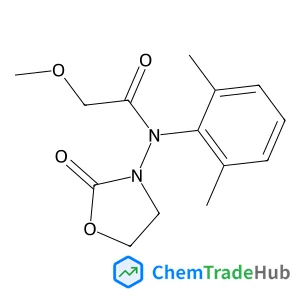
N-(2,6-Dimethylphenyl)-2-methoxy-N-(2-oxo-1,3-oxazolidin-3-yl)acetamide
CAS号:
77732-09-3
分子式:
C14H18N2O4

推荐供应商



免责声明
本页面提供的学术期刊信息仅供参考和研究使用。我们与任何期刊出版商均无关联,也不处理投稿事宜。如有投稿相关咨询,请直接联系相关期刊出版商。
如发现页面信息有误,请发送邮件至 support@chemtradehub.com 联系我们。我们将及时核实并处理您的问题。