


Rapid hydrolysis and electrochemical detection of trace carbofuran at a disposable heated screen-printed carbon electrode
文献信息
发布日期
2008-09-04
DOI
10.1039/B806750C
影响因子
4.616
作者
Hang Wei, Jian-Jun Sun, Yan-Min Wang, Xiao Li, Guo-Nan Chen
查看原文
摘要
A disposable heated screen-printed carbon electrode (HSPCE) is successfully fabricated. It demonstrates rapid responses to electrical heating and is easily elevated above the water boiling point by a high frequency alternating current. The temperature rise at the HSPCE was found to be strongly dependent on the square of the heating current and the electrode width. Carbofuran (CAF) could be rapidly hydrolyzed to carbofuran phenol at the HSPCE with raised temperature, and then determined at the same electrode at room temperature by differential potential voltammetry (DPV). The factors influencing the detection were examined, including pH, hydrolytic temperature and heating time. Under the optimum conditions, the detection linear range of CAF was from 4.0 × 10⁻⁷ to 4.0 × 10⁻⁴ mol L−1 and the detection limit was 5.0 × 10⁻⁸ mol L−1 (S/N = 3). This method was successfully applied to the analysis of CAF residues in real samples (spiked water, soil and vegetables), and satisfactory recoveries were obtained.
期刊推荐

Herald of the Russian Academy of Sciences

Acta Metallurgica Sinica-English Letters

Journal of Chemical Sciences

Topics in Catalysis

Journal of Asian Natural Products Research

Journal of the Indian Institute of Science

Biocatalysis and Biotransformation

Critical Reviews in Solid State and Materials Sciences

Colloid Journal

Bioorganic & Medicinal Chemistry
相关文献
Recent progress on the construction of axial chirality through transition-metal-catalyzed benzannulation
Qian Zhao, Yu-Ting Wang
2021-03-15
Review Article
DOI: 10.1039/D1QO00307K
Brønsted-base-catalyzed remote cascade reactivity of 2,4-dienones – asymmetric synthesis of tetrahydrothiophenes
Artur Przydacz, Rafał Kowalczyk, Łukasz Albrecht
2017-10-04
Communication
DOI: 10.1039/C7OB02397A
Highly regioselective gold-catalyzed formal hydration of propargylic gem-difluorides
Jean-Denys Hamel, Tatsuru Hayashi, Mélissa Cloutier, Paul R. Savoie, Olivier Thibeault, Meggan Beaudoin, Jean-François Paquin
2017-11-13
Paper
DOI: 10.1039/C7OB02406A
Metal-free oxidative para-acylation of unprotected anilines with N-heteroarylmethanes
Min Liu, Xue Chen, Tieqiao Chen, Qing Xu, Shuang-Feng Yin
2017-10-25
Paper
DOI: 10.1039/C7OB02490H
Fluorination and fluoroalkylation of alkenes/alkynes to construct fluoro-containing heterocycles
Xin Wang, Jia Lei, Yingjie Liu, Yong Ye, Jiazhu Li, Kai Sun
2021-02-23
Review Article
DOI: 10.1039/D0QO01629B
Pd-Catalyzed one-pot sequential cross-coupling reactions of tetrabromothiophene
Kapil Mohan Saini, Rakesh K. Saunthwal, Akhilesh K. Verma
2017-11-17
Paper
DOI: 10.1039/C7OB02601C
您可能还喜欢
化合物问答
十二烷基磺酸钠(CAS号:2386-53-0)的主要用途是什么?
十二烷基磺酸钠主要用作表面活性剂,广泛应用于洗涤剂、肥皂、化妆品和工业清洁产品中。它能有效去除油脂和污垢,常用于制造洗发水、沐浴露、洗衣粉和金属清洗剂。此外,它...
2386-53-01-Dodecanesulfonic a...
化合物问答
5-羟基异喹啉(CAS号:2439-04-5)适用哪些法规指南?
5-羟基异喹啉作为化学品,主要适用的法规包括GHS全球化学品统一分类和标签制度,REACH法规等。GHS将5-羟基异喹啉分类为皮肤腐蚀/刺激类别2,严重眼损伤/...
2439-04-55-Isoquinolinol
化合物问答
在合成中是否有FIDAS-5 | Wnt(CAS号:1391934-98-7)的替代品?
合成中可以考虑使用类似结构的化合物,如4-[(E)-2-(2-氯-6-氟苯基)乙烯基]-N-甲基苯胺的类似物或衍生物作为替代品。这类化合物可能具有相似的生物活性...
1391934-98-74-[(E)-2-(2-Chloro-6...
化合物问答
(R)-tert-Butyl 2-(5-bromo-1H-imidazol-2-yl)pyrrolidine-1-carboxylate(CAS号:1370600-56-8)通常如何合成?
该化合物通常通过如下步骤合成:首先,将4-溴-1H-咪唑与对甲苯磺酸在乙酸乙酯中反应,得到中间体5-溴-1H-咪唑-2-甲酸乙酯。然后,该中间体与2-甲基-2-...
1370600-56-82-Methyl-2-propanyl ...
化合物问答
处理4-(吡咯烷-1-基)环己酮(CAS号:10421-18-8)时应注意哪些实验室安全事项?
处理4-(吡咯烷-1-基)环己酮时,应佩戴手套、护目镜和实验室外套,以防止直接接触或吸入。在通风橱中操作,确保良好的通风条件。一旦发生泄漏,应立即清理并使用适当...
10421-18-84-(Pyrrolidin-1-yl)c...
化合物问答
如何处理含有异麦芽糖醇(CAS号:534-73-6)的废料?
含有异麦芽糖醇的废液应首先进行分类收集,避免与其他化学品混合。对于小规模的废液,可以通过焚烧或加入特定的化学试剂进行无害化处理。对于大规模的废液,建议联系专业的...
534-73-66-O-alpha-D-Glucopyr...
化合物问答
7-甲基壬酸(CAS号:41653-89-8)的主要用途是什么?
7-甲基壬酸主要用于有机合成领域,作为合成其他化合物的原料。此外,它还可能作为一种中间体用于药品制造和香料合成,但具体用途需要根据其具体的化学结构和反应特性来确...
41653-89-87-Methylnonanoic aci...
化合物问答
N-甲氧基-N-甲基甲基吡啶羧酰胺(CAS号:148493-07-6)应用于哪些行业?
N-甲氧基-N-甲基甲基吡啶羧酰胺在医药领域有一定的应用,作为一种潜在的药物前体或中间体。此外,该化合物也可能应用于聚合物改性剂、传感器材料等。由于其独特的化学...
148493-07-6N-Methoxy-N-methylpi...
化合物问答
什么是惕各酸香叶酯(CAS号:7785-33-3)?
惕各酸香叶酯是一种化合物,化学名称为(2E)-3,7-二甲基-2,6-辛二烯-1-基(2E)-2-甲基-2-丁烯酸酯。它是一种具有香叶香气的化合物,分子式为C1...
7785-33-3(2E)-3,7-Dimethyl-2,...
化合物问答
1-环丁基哌嗪(CAS号:132800-13-6)安全吗?
1-环丁基哌嗪在适当的操作条件下是相对安全的,但如遇明火或高热会释放有毒气体。操作时应佩戴防护眼镜和手套,避免吸入或接触皮肤、眼睛。
132800-13-61-Cyclobutylpiperazi...
来源期刊
Analyst

CiteScore:
7.8
自引率:
5.6%
年发文量:
653
Analyst publishes analytical and bioanalytical research that reports premier fundamental discoveries and inventions, and the applications of those discoveries, unconfined by traditional discipline barriers.
推荐化合物
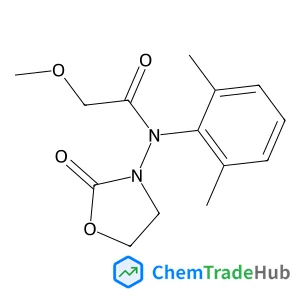
N-(2,6-Dimethylphenyl)-2-methoxy-N-(2-oxo-1,3-oxazolidin-3-yl)acetamide
CAS号:
77732-09-3
分子式:
C14H18N2O4
推荐供应商


免责声明
本页面提供的学术期刊信息仅供参考和研究使用。我们与任何期刊出版商均无关联,也不处理投稿事宜。如有投稿相关咨询,请直接联系相关期刊出版商。
如发现页面信息有误,请发送邮件至 support@chemtradehub.com 联系我们。我们将及时核实并处理您的问题。