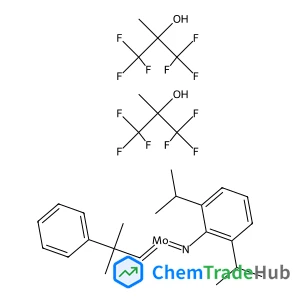
2,6-Diisopropylphenylimidoneophylidene molybdenum(VI) bis(hexafluoro-t-butoxide)
CAS号:
139220-25-0
分子式:
C30H37F12MoNO2
Bruno C. Batista, Elton Sitta, Markus Eiswirth, Hamilton Varela
We studied the open circuit interaction of methanol and ethanol with oxidized platinum electrodes using in situ infrared spectroscopy. For methanol, it was found that formic acid is the main species formed in the initial region of the transient and that the steep decrease of the open circuit potential coincides with an explosive increase in the CO2 production, which is followed by an increase in the coverage of adsorbed CO. For ethanol, acetaldehyde was the main product detected and only traces of dissolved CO2 and adsorbed CO were found after the steep potential decay. In both cases, the transients were interpreted in terms of (a) the emergence of sub-surface oxygen in the beginning of the transient, where the oxide content is high, and (b) the autocatalytic production of free platinum sites for lower oxide content during the steep decay of the open circuit potential.
Manuel Weh, Olga Anhalt
DOI: 10.1039/D3SC05341E
Yujin Li, Yu Mei, Roya Momen, Bai Song, Yujie Huang, Xue Zhong, Hanrui Ding, Wentao Deng, Guoqiang Zou, Hongshuai Hou, Xiaobo Ji
DOI: 10.1039/D3SC05593K
Toshiyuki Sugiyama, Francisco Medina, Wouter van Beek, Jun-ya Hasegawa
DOI: 10.1039/D3SC04466A
James D. Swarbrick, Alasdair I. McKay
DOI: 10.1039/D3SC01944F
Douglas Turnbull, Marc-André Légaré
DOI: 10.1039/D3SC05071H
DOI: 10.1039/D3SC04519F
Jonathan E. Tsang, David A. Nathanson
DOI: 10.1039/D3SC04424F
Liming Sun, Yaya Yuan, Xiaoxiao He, Wenwen Zhan, Dong Li, Yanli Zhao, Xiao-Jun Wang, Xiguang Han
DOI: 10.1039/D3SC04328B
Kalyan Jyoti Kalita, Saikat Mondal, C. Malla Reddy, Ratheesh K. Vijayaraghavan
DOI: 10.1039/D3SC03267A
Yun Zhu, Sangho D. Yun, Tianqi Zhang, Jing-Yuan Chang, Lauren Stover, Arthur Laganowsky
DOI: 10.1039/D3SC04938H
5-氯咪唑并[1,2-c]嘧啶需遵循多项法规指南,包括但不限于GHS(全球化学品统一分类和标签制度),用于危险品的分类和标签。此外,根据其用途,还需遵循REAC...
3-磺丙基十六烷基二甲基铵广泛应用于医药、聚合物、传感器和半导体等领域。在医药行业,它作为乳化剂和稳定剂用于制备药物制剂;在聚合物行业中,作为增塑剂和抗静电剂;...
(R)-1-苄氧羰基-2-苄基哌嗪盐酸主要应用于医药、有机合成等行业。它作为药物合成中的中间体,具有重要的应用价值。此外,该化合物还可用于聚合物合成、传感器制造...
Benzo[c][1,2,5]thiadiazole-5,6-二硫醇是一种含硫的有机化合物,具有独特的化学结构。该化合物的分子式为C8H5NOS4,分子量为22...
处理(5-氯-2-甲基吲哚-3)-乙酸时应佩戴防护眼镜和手套,保护皮肤和眼睛。通风橱应开启以确保良好的通风。如果不慎接触皮肤或眼睛,应立即用大量清水冲洗并寻求医...
在合成中,生物素亚砜的替代品包括生物素、生物素硫代半缩醛等。生物素硫代半缩醛作为生物素的衍生物,具有相似的化学性质,但在某些反应中可能表现出不同的行为。选择替代...
在合成过程中,可以考虑使用含有类似结构的化合物作为替代品,例如4-氟-2-羟基-1,3-二氧戊环或其他含有相应氟原子的四氢呋喃衍生物。这些化合物在化学性质上与目...
2,3-二氢吡咯并[1,2-C]嘧啶-1,4-二酮在处理时需要适当的安全措施。它属于一般化学品,虽然相对稳定,但在高温或强酸强碱条件下可能分解或发生化学反应。建...
反式-3-庚烯应储存在阴凉、通风良好的地方,避免阳光直射和高温。储存容器应密封,放置在温度不超过25℃的环境中,并远离火源和热源。建议使用耐腐蚀的容器,并确保良...
1-乙酰基-1H-吲哚-6-甲腈的毒性较低,但在操作时仍需谨慎。使用时应避免吸入其粉尘或烟雾,避免皮肤接触,佩戴防护眼镜和手套。

Physical Chemistry Chemical Physics (PCCP) is an international journal co-owned by 19 physical chemistry and physics societies from around the world. This journal publishes original, cutting-edge research in physical chemistry, chemical physics and biophysical chemistry. To be suitable for publication in PCCP, articles must include significant innovation and/or insight into physical chemistry; this is the most important criterion that reviewers and Editors will judge against when evaluating submissions. The journal has a broad scope and welcomes contributions spanning experiment, theory, computation and data science. Topical coverage includes spectroscopy, dynamics, kinetics, statistical mechanics, thermodynamics, electrochemistry, catalysis, surface science, quantum mechanics, quantum computing and machine learning. Interdisciplinary research areas such as polymers and soft matter, materials, nanoscience, energy, surfaces/interfaces, and biophysical chemistry are welcomed if they demonstrate significant innovation and/or insight into physical chemistry. Joined experimental/theoretical studies are particularly appreciated when complementary and based on up-to-date approaches.