


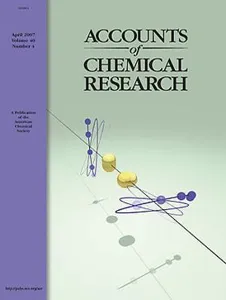
Transition metalborylene complexes: boron analogues of classical organometallic systems
文献信息
发布日期
2009-01-07
DOI
10.1039/B816042B
影响因子
6.222
作者
Dragoslav Vidovic, Glesni A. Pierce, Simon Aldridge
查看原文
摘要
In the ten years since the first examples of terminal borylene complexes were reported, rapid advances in the chemistry of this ligand class have been made, and parallels emerged with classical organometallic ligand systems (such as carbenes, vinylidenes and even CO) as well as with other subvalent main group ligand systems. This article reviews key developments in synthetic, structural and reaction chemistry, with particular attention focusing on recent discoveries in the field.
相关文献
Enhancing the perovskite solar cell performance by the interface modification of Zn–Sn–O compound heterostructures
Ramarajan Ramanathan, Chellakumar R., K. Ravichandran, Michel Zinigrad
2023-12-01
Paper
DOI: 10.1039/D3MA00674C
Synthesis of N-methylol polyamide 4: characterization, properties, and biodegradability
Norioki Kawasaki, Naoko Yamano, Atsuyoshi Nakayama
2023-12-05
Paper
DOI: 10.1039/D3MA00047H
Insight into the electron transfer and anti-thermal quenching of europium doped Li4SrCa(SiO4)2
Philippe F. Smet, Rik Van Deun, David Van der Heggen
2023-11-28
Paper
DOI: 10.1039/D3MA00772C
Electron/hole piezocatalysis in chemical reactions
Ghodsi Mohammadi Ziarani, Alireza Badiei, Siavash Iravani
2023-11-01
Review Article
DOI: 10.1039/D3MA00620D
A tailored polyoxometalate-derived RuW/g-C3N4-based electrocatalyst for enhanced hydrogen evolution reaction
Menon Ankitha, Ajith Arjun Mohan, Neermunda Shabana, Yongfeng Tong
2023-11-21
Paper
DOI: 10.1039/D3MA01010D
Versatile MXenes as electrochemical sensors for heavy metal ions and phenolic moiety-containing industrial chemicals: recent development and prospects
G. Manasa, Chandra Sekhar Rout
2023-11-24
Review Article
DOI: 10.1039/D3MA00362K
The state of understanding of the electrochemical behaviours of a valve-regulated lead–acid battery comprising manganese dioxide-impregnated gel polymer electrolyte
Bipin S. Chikkatti, Nagaraj R. Banapurmath
2023-10-16
Paper
DOI: 10.1039/D3MA00563A
Enhancing the conductivity of plasma polymer functionalized electrodes using gold nanoparticles
Alex Gheorghiu, Daisy Yang, Tiexin Li, Essam M. Dief, Nadim Darwish, Melanie MacGregor
2023-11-20
Paper
DOI: 10.1039/D3MA00641G
DPP-bridged narrow band gap oligomer-like donor materials: significant effect of molecular structure regulation on photovoltaic performance
Chang Liu, Lunxiang Yin, Yanli Guo, Bao Xie, Xu Wang, Yanqin Li
2023-12-06
Paper
DOI: 10.1039/D3MA00925D
您可能还喜欢
化合物问答
P11(CAS号:848644-86-0)安全吗?
P11作为一种化学化合物,需要谨慎处理。一般来说,该化合物无毒,但在操作过程中仍需遵循实验室安全规定,避免皮肤接触和吸入。建议在通风良好的环境中操作,并佩戴适当...
848644-86-0L-Histidyl-L-seryl-L...
化合物问答
氨甲环酸杂质C(CAS号:330838-52-3)通常如何合成?
氨甲环酸杂质C通常通过氨甲环酸的衍生物与环己烯进行缩合反应合成。常见的合成方法包括一步合成法和多步合成法,其中多步合成法可以提高产物的选择性和产率。反应通常在无...
330838-52-34-(Aminomethyl)-1-cy...
化合物问答
(±)-茉莉酸(CAS号:221682-41-3)通常如何合成?
(±)-茉莉酸的合成通常采用生物合成或者化学合成的方法。化学合成方法中,可以通过2-戊烯-1-醇与环戊酮的缩合反应,再经过氧化反应得到目标产物。该反应需要温和的...
221682-41-3{3-Oxo-2-[(2E)-2-pen...
化合物问答
(4S,4'S)-2,2'-(1,1-环己烷二基)双(4-异丙基-4,5-二氢-1,3-噁唑)(CAS号:1373357-00-6)安全吗?
(4S,4'S)-2,2'-(1,1-环己烷二基)双(4-异丙基-4,5-二氢-1,3-噁唑)属于有机化合物,应遵循实验室安全规范。在操作时应佩戴适当的个人防护...
1373357-00-6(4S,4'S)-2,2'-(1,1-C...
化合物问答
什么是6-苄氧基-5-甲氧基-2-羧基吲哚(CAS号:2495-92-3)?
6-苄氧基-5-甲氧基-2-羧基吲哚是一种有机化合物,分子式为C16H15NO3。它是一种含有苄氧基、甲氧基和羧基官能团的吲哚衍生物。
2495-92-36-(Benzyloxy)-5-meth...
化合物问答
丙二酸丁酯乙酯(CAS号:17373-84-1)安全吗?
丙二酸丁酯乙酯属于易燃物质,具有一定的毒性。在操作时应佩戴防护眼镜和手套,避免接触皮肤和眼睛。储存时应远离热源和火源,避免阳光直射,以减少火灾和爆炸的风险。
17373-84-1Butyl ethyl malonate
化合物问答
2-碘-3-甲基吡嗪(CAS号:58139-08-5)的市场或研究趋势如何?
2-碘-3-甲基吡嗪作为一种特殊结构的化合物,目前在工业和学术研究中的应用相对有限。然而,随着对特定化学结构及其潜在应用的深入研究,预计未来可能在农药、医药等领...
58139-08-52-Iodo-3-methylpyraz...
化合物问答
千层纸素A-7-0-β-D-葡萄糖醛酸苷甲酯(CAS号:82475-01-2)的物理化学性质是什么?
千层纸素A-7-0-β-D-葡萄糖醛酸苷甲酯是一种白色结晶固体,分子量为616.27 g/mol。该化合物在水中溶解度较低,在有机溶剂中溶解度较高。其反应活性主...
82475-01-25-Hydroxy-8-methoxy-...
化合物问答
什么是7-苄基-4,7-二氮杂螺[2.5]辛烷(CAS号:1222106-45-7)?
7-苄基-4,7-二氮杂螺[2.5]辛烷是一种有机化合物,其结构由一个环状的7-苄基-4,7-二氮杂螺环和一个苯基组成。该化合物的分子式为C14H16N2。它具...
1222106-45-77-Benzyl-4,7-diazasp...
化合物问答
在合成中是否有丁酰胺酸甲酯(CAS号:53171-39-4)的替代品?
丁酰胺酸甲酯的合成中可能的替代品包括其他氨基酸衍生物,如乙酰胺酸甲酯或丙酰胺酸甲酯。这些替代品在某些合成路线中可能更为便利或成本更低。
53171-39-4Methyl 4-amino-4-oxo...
来源期刊
Chemical Communications
CiteScore:
8.6
自引率:
4.7%
年发文量:
2458
ChemComm publishes urgent research which is of outstanding significance and interest to experts in the field, while also appealing to the journal’s broad chemistry readership. Our communication format is ideally suited to short, urgent studies that are of such importance that they require accelerated publication. Our scope covers all topics in chemistry, and research at the interface of chemistry and other disciplines (such as materials science, nanoscience, physics, engineering and biology) where there is a significant novelty in the chemistry aspects. Major topic areas covered include: Analytical Chemistry Catalysis Chemical Biology and medicinal chemistry Computational Chemistry and Machine Learning Energy and sustainable chemistry Environmental Chemistry Green Chemistry Inorganic Chemistry Materials Chemistry Nanoscience Organic Chemistry Physical Chemistry Polymer Chemistry Supramolecular Chemistry
推荐化合物
![N-[2,6-Di(9-anthryl)-4-oxido-8,9,10,11,12,13,14,15-octahydrodinaphtho[2,1-d:1',2'-f][1,3,2]dioxaphosphepin-4-yl]-1,1,1-trifluoromethanesulfonamide structure](https://cnstatic.chemtradehub.com/structs/122/1227374-64-2-cdb5.webp "N-[2,6-Di(9-anthryl)-4-oxido-8,9,10,11,12,13,14,15-octahydrodinaphtho[2,1-d:1',2'-f][1,3,2]dioxaphosphepin-4-yl]-1,1,1-trifluoromethanesulfonamide structure")
推荐供应商



免责声明
本页面提供的学术期刊信息仅供参考和研究使用。我们与任何期刊出版商均无关联,也不处理投稿事宜。如有投稿相关咨询,请直接联系相关期刊出版商。
如发现页面信息有误,请发送邮件至 support@chemtradehub.com 联系我们。我们将及时核实并处理您的问题。