


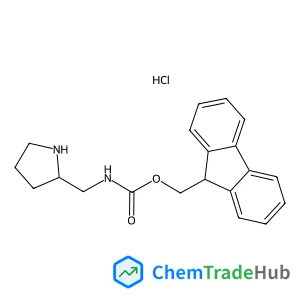
(S)-(9H-Fluoren-9-yl)methyl (pyrrolidin-2-ylmethyl)carbamate hydrochloride
CAS号:
1217813-15-4
分子式:
C20H23ClN2O2
Cosimo Bonetti, Maxime T. A. Alexandre, Ivo H. M. van Stokkum, Roger G. Hiller, Marie Louise Groot, Rienk van Grondelle, John T. M. Kennis
The peridinin chlorophyll-a protein (PCP) is a water–soluble, trimeric light harvesting complex found in marine dinoflagellates that binds peridinin and Chl-a in an unusual stoichiometric ratio of 4 : 1. In this paper, the pathways of excited-state energy transfer and relaxation in PCP were identified by means of femtosecond visible-pump, mid-infrared probe spectroscopy. In addition, excited-state relaxation of peridinin dissolved in organic solvent (CHCl3 and MeOH) was investigated. For peridinin in solution, the transient IR signatures of the low-lying S1 and intramolecular charge transfer (ICT) states were similar, in line with a previous ultrafast IR study. In PCP, excitation of the optically allowed S2 state of peridinin results in ultrafast energy transfer to Chl-a, in competition with internal conversion to low-lying optically forbidden states of peridinin. After vibrational relaxation of the peridinin hot S1 state in 150 fs, two separate low-lying peridinin singlet excited states are distinguished, assigned to an ICT state and to a slowly transferring, vibrationally relaxed S1 state. These states exhibit different lactone bleaches, indicating that the ICT and S1 states localize on distinct peridinins. Energy transfer from the peridinin ICT state to Chl-a constitutes the dominant energy transfer channel and occurs with a time constant of 2 ps. The peridinin S1 state mainly decays to the ground state through internal conversion, in competition with slow energy transfer to Chl-a. The singlet excited state of Chl-a undergoes intersystem crossing (ISC) to the triplet state on the nanosecond timescale, followed by rapid triplet excitation energy transfer (TEET) from Chl-a to peridinin, whereby no Chl-a triplet is observed but rather a direct rise of the peridinin triplet. The latter contains some Chl-a features due to excitonic coupling of the pigments. The peridinin triplet state shows a lactone bleach mode at 1748 cm−1, while that of the peridinin ICT state is located at 1745 cm−1, indicating that the main channels of singlet and triplet energy transfer in PCP proceed through distinct peridinins. Our results are consistent with an energy transfer scheme where the ICT state mainly localizes on Per621/611 and Per623/613, the S1 state on Per622/612 and the triplet state on Per624/614.
Jose J. Plata, Francisca Romero-Sarria, Javier Amaya Suárez, Antonio M. Márquez, Óscar H. Laguna, José A. Odriozola, Javier Fdez Sanz
DOI: 10.1039/C8CP03706J
T. I. Burganov, S. A. Katsyuba, S. M. Sharipova, A. A. Kalinin, A. Monari, X. Assfeld
DOI: 10.1039/C8CP03780A
Qian-Rui Huang, Ying-Cheng Li, Kun-Lin Ho, Jer-Lai Kuo
DOI: 10.1039/C8CP00533H
R. J. Shannon, J. C. Gómez Martín, R. L. Caravan, M. Agúndez, A. Canosa, G. El Dib, J. Cernicharo
DOI: 10.1039/C7CP04561A
Nicolai Ree, Cecilie Lindholm Andersen, Martin Drøhse Kilde, Ole Hammerich, Mogens Brøndsted Nielsen, Kurt V. Mikkelsen
DOI: 10.1039/C7CP08687C
Weifeng Jin, Xiaojing Mu, Kun Zhang, Zhengguo Shang
DOI: 10.1039/C8CP02859A
Woon Yong Sohn, Jeong Jin Kim, Myeongwon Jeon, Takuma Aoki, Shun-ichi Ishiuchi, Masaaki Fujii, Hyuk Kang
DOI: 10.1039/C8CP02106F
该化合物需遵循REACH法规以确保其安全使用和管理。同时,根据其潜在的生物降解性和毒性,也需要符合GHS分类中的相应要求。此外,若用于医药或食品相关领域,则还需...
反式-度骨化醇是一种脂溶性维生素D3的衍生物,呈无色或白色结晶性粉末,不溶于水,溶于乙醇、丙酮、氯仿等有机溶剂。其分子式为C28H44O,分子量为404.65。...
莲花掌苷作为一种天然产物,近年来在抗炎、抗癌等生物活性研究方面显示出一定的潜力,因此市场需求逐渐增长。市场动态方面,随着天然产物开发的深入,预计该化合物的研究会...
2-溴-6-(吡咯烷-1-基)吡啶-4-硼酸频那醇酯在医药领域有着广泛的应用,它可以用作药物合成中的中间体。此外,它还可以用于有机合成,特别是在构建复杂杂环化合...
methyl 2-(4-溴苯基)-3-甲基丁酸甲酯是一种化学物质,分子式为C12H13BrO2。它是一种有机化合物,具有一定的挥发性和易燃性。
CJC1-295是一种具有复杂肽链结构的化合物,其分子量约为1875 Da。该化合物在水中具有一定的溶解性,但在有机溶剂中的溶解性不佳。它是一种反应活性化合物,...
三正丁基锍碘作为一种重要的有机硫化合物,主要用于有机合成中作为亲电试剂。近年来,由于其在合成中的广泛应用,市场对其需求持续增长。此外,随着绿色化学的发展,对其替...
雌二醇-[13C3]同位素内标通常通过在雌二醇分子中引入[13C3]同位素来合成。常见的方法是通过化学标记反应,如与[13C3]标记的甲基溴化物进行亲核取代反应...
N1-(2-吡啶甲基)-N2-(2-甲基-1-萘基)草酰胺为固体化合物,具有良好的结晶形态,分子量为340.34 g/mol。该化合物在水中的溶解度较低,但在有...
含有十五碳烯酸甲酯(顺-10)(C15:1)标准品的废料应首先进行适当收集和储存,避免与其他化学品混合。然后,可采用焚烧或交由专业废物处理公司进行处理。处理过程...

Physical Chemistry Chemical Physics (PCCP) is an international journal co-owned by 19 physical chemistry and physics societies from around the world. This journal publishes original, cutting-edge research in physical chemistry, chemical physics and biophysical chemistry. To be suitable for publication in PCCP, articles must include significant innovation and/or insight into physical chemistry; this is the most important criterion that reviewers and Editors will judge against when evaluating submissions. The journal has a broad scope and welcomes contributions spanning experiment, theory, computation and data science. Topical coverage includes spectroscopy, dynamics, kinetics, statistical mechanics, thermodynamics, electrochemistry, catalysis, surface science, quantum mechanics, quantum computing and machine learning. Interdisciplinary research areas such as polymers and soft matter, materials, nanoscience, energy, surfaces/interfaces, and biophysical chemistry are welcomed if they demonstrate significant innovation and/or insight into physical chemistry. Joined experimental/theoretical studies are particularly appreciated when complementary and based on up-to-date approaches.
![[(5-Methyl-1,3,4-thiadiazol-2-yl)sulfanyl]acetic acid structure](https://cnstatic.chemtradehub.com/structs/509/50918-26-8-4ce8.webp "[(5-Methyl-1,3,4-thiadiazol-2-yl)sulfanyl]acetic acid structure")
![tert-Butyl 6-chloro-4-oxospiro[chroman-2,4'-piperidine]-1'-carboxylate structure](https://cnstatic.chemtradehub.com/structs/101/1011482-37-3-88a5.webp "tert-Butyl 6-chloro-4-oxospiro[chroman-2,4'-piperidine]-1'-carboxylate structure")
![4-Chloro-2-{[(2-chlorophenoxy)acetyl]amino}benzoic acid structure](https://cnstatic.chemtradehub.com/structs/351/351424-20-9-9467.webp "4-Chloro-2-{[(2-chlorophenoxy)acetyl]amino}benzoic acid structure")





